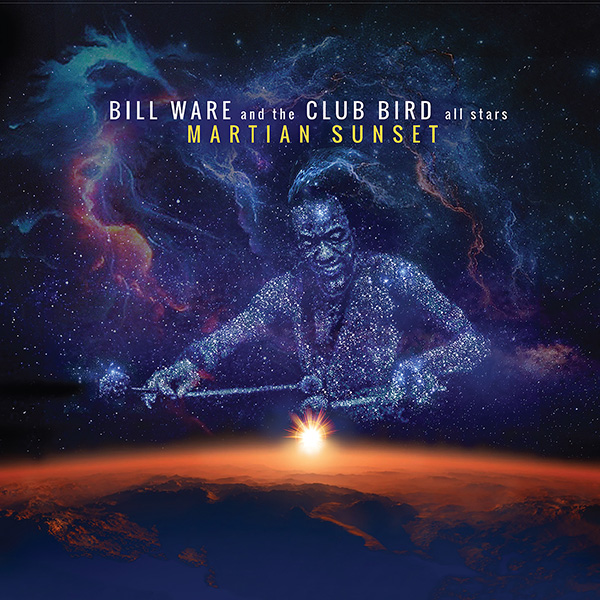
Bill Ware and The Club Bird All Stars: Martian Sunset
Ware, vibraphone; Rez Abbasi, guitar; Matt King, piano; Jay Anderson, bass; Taru Alexander, drums
Sunnyside (CD, Digital). 2025. Richard Levy, Dana Ware, prods.; Maureen Sickler, Ware, Katsuhiko Naito, engs.
Performance ***
Sonics **** Jazz and cooking have much in common. Both require fearlessness tempered by restraint, attentiveness married to flexibility. If one had to assign a culinary counterpart to the vibraphone, it would be paprika: versatile, emphasizing the subtlety of other flavors while bringing its own heat.
Vibraphonist Bill Ware functions as both the Hungarian (sweet) and Spanish (smoky) varieties on his latest album, Martian Sunset, a revisitation of his '90s vehicle The Club Bird All Stars (named for the Japanese club where they were in residence). Only pianist Matt King returns from the original incarnation alongside new members Rez Abbasi (guitar), Jay Anderson (bass), and Taru Alexander (drums). Ware wrote all 10 pieces, a teensy percentage of the 250 compositions he birthed between 2016 and 2020.
The combination of two electrically driven instruments that can change tone—Ware utilizes effects—juxtaposed against an acoustic rhythm section generates appealing textures, cosmic versus terrestrial. Ware's music is tethered to the latter, but his solos and especially Abbasi's point skyward, none more so than the guitar lead on the sixth track "In a Spiral." For those who don't know him, Abbasi embodies the umber and taste of the late Pat Martino.
Apart from some balladry, the set is upbeat in bluesy, bopping, or cerebral thrusts, only once ("Don't Take Me Wrong") approaching full fusion. Alexander is crucial in setting the various feels, and King is the fulcrum on which everything rests. The outlier is the ninth track, "Hangin' at the Rez," with the dedicatee on acoustic guitar and Ware adding melodica (which he also does earlier on "Happy Bird") for a slightly chicken-fried lope, almost begging to be a '70s TV theme.—Andrey Henkin
 JD Allen: Love Letters (The Ballad Sessions)
Allen, tenor saxophone; Brandon McCune, piano; Ian Kenselaar, bass; Nic Cacioppo, drums
Savant SCD 2226 (CD). 2025. Allen, prod.; David Stoller, eng.
Performance ****
Sonics **** Over the last 25 years, JD Allen compiled a respected discography, mostly on the Savant label, and became identified as a sax trio specialist. Most sax players, at some point, feel obligated to test themselves in this challenging chordless format (sax/bass/drums). But for Allen it has been a calling. Albums such as Victory! (2011) and Graffiti (2015) are definitive iterations of the sax-trio instrumentation. Love Letters is a surprise. It is a program of Songbook ballads performed by a quartet including a pianist. Who knew that Allen, a cutting-edge player/composer, was a closet romantic? When he interprets pieces like "You Are Too Beautiful" by Rodgers and Hart and "I Get Along Without You Very Well" by Hoagy Carmichael, his emotional exposure is unconditional. Yet there is enough of the street in his manner, and enough hard, clean edges in his melodic ornamentations, to protect him from sentimentality.
A decade or two ago, albums of standard ballads were common. But in today's jazz culture, with its fixation on original composition, Love Letters is an outlier. It is quietly thrilling to hear these songs again, especially when they are in the hands of a forward-looking, blues-oriented, hardcore improviser. Allen has long been known for his rich, huge tenor saxophone sound. Love Letters is the Allen album that his sound was meant for. When he applies his commanding voice to Cole Porter's "I Love You," no one within earshot could doubt that he speaks his heart's truth. That sound also creates intriguing effects on Hoagy Carmichael's single most immortal song. "Stardust" is famous for its unusual structure (A-B-A-C) and its convoluted melody, but mostly for its wistfulness and longing. Allen powers through "Stardust" in one of the least wistful versions on record.—Thomas Conrad
 Pat Bianchi: Confluence
Bianchi, organ; Troy Roberts, tenor saxophone; Colin Stranahan, drums
21H Records 21H005 (auditioned in WAV; available as CD). 2026. Bianchi, prod.; Chris Sulit, eng.
Performance ****
Sonics ****½ We are long past the day when some of the most popular small groups in jazz were organ trios. But organs are still with us. Jazz people can be roughly divided into two camps: those who love the Hammond B3 and B3-phobes. The former group gets off on the organ's greasy, down-and-dirty funk. The latter group thinks that B3s shriek too much and often sound nasty.
Your present correspondent has one foot in the latter camp, the other in the Pat Bianchi Fan Club. Bianchi is not your father's organist. He is not interested in standard-issue organ licks. He is much more musical and exploratory than most of his B3 peers. He gets a wider range of sonorities from the instrument. But don't get the idea that he is a wuss. On a piece like "It Was a Very Good Year" (a great song that few jazz musicians play), he uses the organ to do what it is famous for: kicking your ass.
Bianchi has chops of doom. He can speed by you in a blur while wailing. He uses atypical time signatures. He comes up with fresh concepts for arrangements. His improvisations take risks. Fats Waller's "Jitterbug Waltz" sounds new in 7/4. Coltrane's "Wise One," apparently an unplanned first take, proves that a B3 in the right hands can take on serious spiritual subjects.
Tenor saxophonist Troy Roberts is an asset. He is agile, fluent, and given to commanding clarion calls. The highlight of Confluence is "I Guess I'll Hang My Tears Up to Dry." Roberts and Bianchi channel their natural power into a slow, solemn, rapt ballad. Roberts phrases the song with patient fervor. Bianchi lays down a carpet of long sighs.
The brilliant sound of this album proves once again that Chris Sulit and Trading 8s Recording Studio are among the best engineers and sites for the recording of jazz.—Thomas Conrad
 Melissa Errico: I Can Dream, Can't I? (Illusions and Conversations from the Great American Songbook)
Self-released (CD). 2026. Phillip Hall, prod.; Oscar Zambrano, eng.
Performance *****
Sonics **** Unlike many Broadway stars' solo ventures, Melissa Errico's I Can Dream, Can't I? is worth celebrating. She exhibits subtle skills at musical storytelling in several genres and always sounds at ease.
Perhaps best known for her Sondheim (although there's nothing by him here), Errico is a legit jazz singer with a cabaret artist's sensibility. An important contributing factor to the record's tone and quality is pianist Tedd Firth. The voice-and-piano texture seems personal and conversational, avoiding the bombastic declamation that richer accompaniment can encourage. Firth's delicately sensuous style complements Errico's subtle expressiveness.
Errico has boldly expanded the Great American Songbook beyond the usual tropes, types, and sources, though love remains the constant topic. A case in point are two songs taken from Peggy Lee albums: "When in Rome (I Do as the Romans Do)" and "There'll Be Another Spring." Errico replaces Lee's brassy energy with her own contemplativeness, and it works.
"Like a Lover" comes from the 1967 Sergio Mendes album Look Around. There's an appealing frankness in Errico's take on this flowing tune and imaginative lyric. What a delight to hear her quietly aching meander through that Joni Mitchell masterpiece, "Both Sides Now."
Even on songs from musicals—the genre most associated with the Great American Songbook—Errico surprises us. Giving equal attention to stage shows and movies, she clearly dug into her trunk of sheet music up to her elbows. Jerome Kern's "All in Fun" transports listeners to a long-gone era of glamourous romance. Errico gives Kern's "Remind Me" a sardonic tinge.
These fine performances are well supported by Phillip Hall's intimate production.—Anne E. Johnson
 Joel Ross: Gospel Music
Ross, vibraphone, miscellaneous instruments; 12 others
Blue Note 00602488058308 (auditioned in WAV; available as CD, LP). 2026. Ross, prod.; Jason Rostkowski, eng.
Performance ***
Sonics *** There is a vibraphone resurgence happening in jazz, and Joel Ross is at the front of it. He is only 30 but already has five albums on Blue Note. Gospel Music is his most ambitious to date. Blue Note describes it as "a sonic interpretation of the biblical story and an exploration of [Ross's] faith that delivers a message of hope and love."
Unlike most of his vibraphonist contemporaries, Ross plays with two mallets, not four, which offers him more harmonic freedom. He uses that openness to strike discrete, vivid notes that he assembles into long lines of intricate, arcane, glistening lyricism. This album contains some of those beautiful lines, and the musicianship in his sextet (saxophonists Josh Johnson and María Grand; pianist Jeremy Corren; bassist Kanoa Mendenhall; drummer Jeremy Dutton) is solid. The purpose of this album is sincere and high-minded.
But as a record, Gospel Music is puzzling and often frustrating. Fifteen of the 17 tracks are Ross originals. Half are short, and all are based on simple little cyclical melodies. Ross's compositions are neither strong nor deep enough to render their large, sweeping subjects, such as sin and salvation. Perhaps Ross intended their repetitiveness to sound hymnlike and incantatory, but there is a fine line between incantation and monotony.
Solos, especially by anyone other than Ross, are infrequent and brief. Pieces like "Trinity" and "The Sacred Place" are welcome exceptions because, while their themes are still elemental vamps, they are taken through actual development. Ross offers solos on these songs that sound like joyful flowerings. Grand, Johnson, and Corren are allowed to step out and express themselves rather than filling defined roles in the ensemble. These tracks hint at what Gospel Music might have been.—Thomas Conrad
Ware, vibraphone; Rez Abbasi, guitar; Matt King, piano; Jay Anderson, bass; Taru Alexander, drums
Sunnyside (CD, Digital). 2025. Richard Levy, Dana Ware, prods.; Maureen Sickler, Ware, Katsuhiko Naito, engs.
Performance ***
Sonics **** Jazz and cooking have much in common. Both require fearlessness tempered by restraint, attentiveness married to flexibility. If one had to assign a culinary counterpart to the vibraphone, it would be paprika: versatile, emphasizing the subtlety of other flavors while bringing its own heat.
JD Allen: Love Letters (The Ballad Sessions)Allen, tenor saxophone; Brandon McCune, piano; Ian Kenselaar, bass; Nic Cacioppo, drums
Savant SCD 2226 (CD). 2025. Allen, prod.; David Stoller, eng.
Performance ****
Sonics **** Over the last 25 years, JD Allen compiled a respected discography, mostly on the Savant label, and became identified as a sax trio specialist. Most sax players, at some point, feel obligated to test themselves in this challenging chordless format (sax/bass/drums). But for Allen it has been a calling. Albums such as Victory! (2011) and Graffiti (2015) are definitive iterations of the sax-trio instrumentation. Love Letters is a surprise. It is a program of Songbook ballads performed by a quartet including a pianist. Who knew that Allen, a cutting-edge player/composer, was a closet romantic? When he interprets pieces like "You Are Too Beautiful" by Rodgers and Hart and "I Get Along Without You Very Well" by Hoagy Carmichael, his emotional exposure is unconditional. Yet there is enough of the street in his manner, and enough hard, clean edges in his melodic ornamentations, to protect him from sentimentality.
Pat Bianchi: ConfluenceBianchi, organ; Troy Roberts, tenor saxophone; Colin Stranahan, drums
21H Records 21H005 (auditioned in WAV; available as CD). 2026. Bianchi, prod.; Chris Sulit, eng.
Performance ****
Sonics ****½ We are long past the day when some of the most popular small groups in jazz were organ trios. But organs are still with us. Jazz people can be roughly divided into two camps: those who love the Hammond B3 and B3-phobes. The former group gets off on the organ's greasy, down-and-dirty funk. The latter group thinks that B3s shriek too much and often sound nasty.
Melissa Errico: I Can Dream, Can't I? (Illusions and Conversations from the Great American Songbook)Self-released (CD). 2026. Phillip Hall, prod.; Oscar Zambrano, eng.
Performance *****
Sonics **** Unlike many Broadway stars' solo ventures, Melissa Errico's I Can Dream, Can't I? is worth celebrating. She exhibits subtle skills at musical storytelling in several genres and always sounds at ease.
Joel Ross: Gospel MusicRoss, vibraphone, miscellaneous instruments; 12 others
Blue Note 00602488058308 (auditioned in WAV; available as CD, LP). 2026. Ross, prod.; Jason Rostkowski, eng.
Performance ***
Sonics *** There is a vibraphone resurgence happening in jazz, and Joel Ross is at the front of it. He is only 30 but already has five albums on Blue Note. Gospel Music is his most ambitious to date. Blue Note describes it as "a sonic interpretation of the biblical story and an exploration of [Ross's] faith that delivers a message of hope and love."