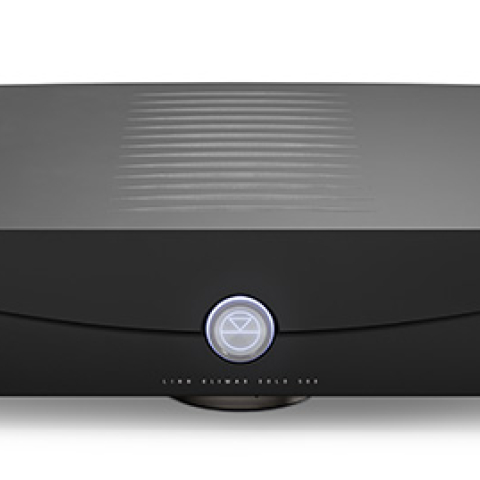
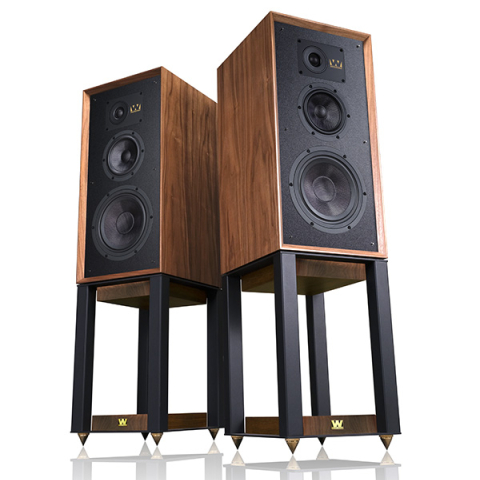
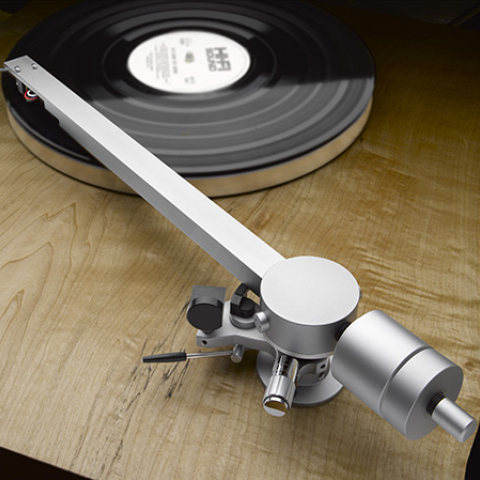
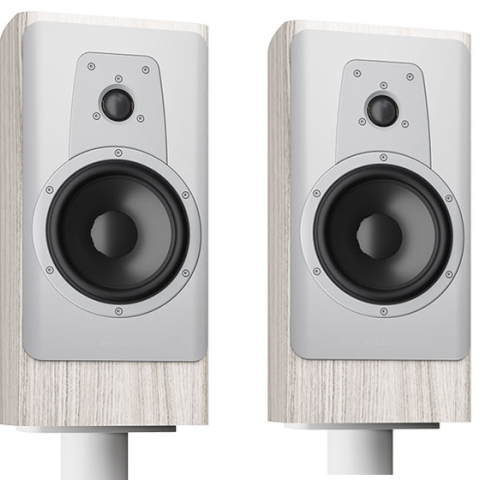
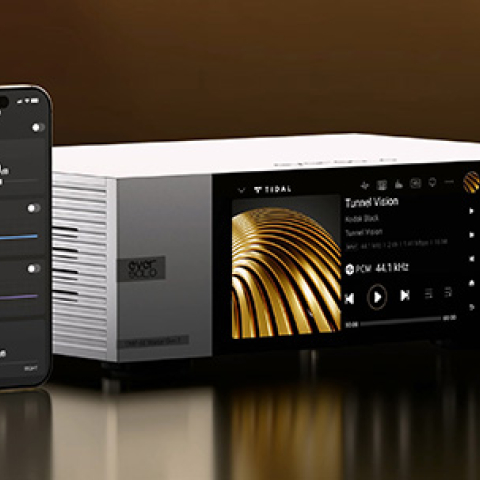
The Grimm LS1/SB1 system. Photo by Rogier van Bakel.
van Bakel: I listened to the LS1s with and without the SB1 subs. Even without them, my brain believed it was still hearing the entire bottom octave in bass-heavy music—even though according to the specs, the main speakers bottom out around 35Hz. What was happening?
Grimm: In two-way mode, we use DSP to correct for the absence of the subs, and we can get the LS1 to play as low as 20Hz all by itself. But that does greatly increase cone excursion, so distortion sets in. That distortion has a way of accentuating the very low frequencies even more, which can sound pleasing, but precision suffers both in the bass and in the midrange. With the SB1s in the system, all that changes. You still get 20Hz, but the woofers of the main speakers are no longer under stress, and the mids sound purer.
van Bakel: On your recommendation, I toed in the LS1s roughly 40°, much more than other speakers. I expected the soundstage to narrow, but the opposite happened. Can you explain why drastically toeing in these loudspeakers seems to embiggen the soundstage?
Grimm: This is going to necessitate a long answer. Every object is an obstacle to sound. Whether the sound is reflected by the object or bends around it is determined by its frequency. High frequencies are small, with short wavelengths. Low frequencies are the opposite. For example, 100Hz is roughly 10' long, 1000Hz is 1', and 10kHz is 0.1'. If an obstacle is larger than two-thirds of the wavelength of the sound, the sound is reflected. If it's smaller, the sound bends around it. So, for example, a 1000Hz tone will reflect against an obstacle that's larger than 8" wide.
The next thing to realize is that the first object that a sound encounters is the body of its own source. A human voice is acoustically modeled by the person's head. If a head is roughly 0.5' wide, it will reflect frequencies above 1300Hz. As a result, frequencies below 1300Hz bend around the head, but higher frequencies will become attenuated on the back and projected more to the front. This is a gradual effect; you will already hear the impact of the object at lower frequencies, let's say about an octave lower. So with the head, that means around 650Hz.
Now, this is true for a loudspeaker too. The generic narrow speaker that is so common these days has more or less the same width as the human head. So frequencies below about 650Hz will completely bend around it, and from 1300Hz and up they're more focused to the front.
When we designed the LS1, we asked ourselves what the best frequency would be for this baffle step effect, as it's called. We decided that 650Hz doesn't make much sense, because the mid frequencies would then be radiated into the room in a completely different way than the high frequencies. We aimed instead for 250Hz, because below that frequency all sorts of room effects, like room modes, become dominant. So this is kind of an "acoustic crossover frequency" in the room. If a loudspeaker enclosure needs to gradually become an obstacle from 250Hz upwards, it has to be 2' wide—like the LS1.
van Bakel: I'm beginning to see your point about toe-in. Drive it home for me.
Grimm: Sure. So if you toe in a standard narrow loudspeaker, the frequencies above 650Hz will be directed away from the nearby sidewall due to the effect described above. But all energy below 650Hz will still find its way to that wall. Because these mid frequencies have a strong impact on the stereo picture, you will get a blurrier image in the mid frequencies and a more focused image in the higher frequencies. The result is a lack of stereo definition. The highs become narrow, but they sound separated from the rest of the frequency band. To counteract this problem, many audiophiles place their narrow-baffle loudspeakers parallel with the walls. That way, the reflection receives about the same frequency balance as the direct sound. This is a good decision, though it comes at a price, because now the full frequency band suffers from a reflection that impacts the stereo image. But at least the sound is spectrally coherent.
It's different with the LS1 and similar wide-baffle speakers. Below 250Hz, there's much less stereo information. So by using a large toe-in, you attenuate the sidewall reflection for the full frequency range that defines the stereo image. It'll be very stable and precise.
van Bakel: Your life's work is all about pushing for perfection, and now I'm curious about whether you ever listen to imperfect recordings on an imperfect stereo and really enjoy them.
Grimm: Oh, hell yes! That happens often! I can become enchanted when I wake up with classical music playing on my mono FM clock radio. And before I installed an MU2 player in my girlfriend's house, I enjoyed listening to her 1950s Grundig 3068 Hi-Fi Zauberklang tube radio. A friend of mine restored it and it made me consider what 70 years of audio development have improved in the listening experience. Could we have stopped back then and remained happy forever? I have some 78rpm jazz records that belonged to my dad, and I ask myself the same question when I play them on my 1920s Columbia gramophone. There's something tangible in that type of reproduction. It's hard to achieve with modern technology.

Photo by Heleen Wiering
van Bakel: Speaking of which, the CD was introduced in 1982, so we've been at this for 43 years now. Are we getting to the finish line with digital? At what point will the tiniest of improvements cease to make an audible difference?
Grimm: I'm quite sure that will never happen. Behind every door we open, there appears to be a room full of improvements to explore. In a way, digital is just like analog: When you improve resolution, you hear more, so further improvements in resolution become audible. It seems infinite, and for me that's what keeps it interesting.
But in another way, digital is also very different from analog: It's easy and cheap to build very complex systems. Many designers embrace that nowadays. I see it happening in pro audio, where powerful computers make it possible to add dozens of effects to each recorded track while mixing, and in hi-fi, where DSP is used to generate artificial immersive sound. In my experience, all these treatments reduce resolution and lead us away from feeling connected to the original musicians. That's why it is so important to keep playing vintage vinyl on a minimalist, high-quality system. Listening to an old reference like that helps to check if we're not losing something along the way.
van Bakel: If a digital signal can be reclocked and reshaped to near-perfection, does the source matter anymore? Do transports or streamers really make an audible difference once the signal hits the system?
Grimm: Good question. The MU1 and MU2 feature the highest possible jitter suppression for external digital sources. Our FLL—Frequency-Locked Loop—uses a buffer memory to completely isolate the jitter of the source clock from the internal clock. The internal clock is then very slowly shifted to the source clock frequency to stay locked in the long term, but that's so slow that even extreme low frequency jitter is still attenuated. The advantage of the FLL concept is that the audio playback nevertheless starts instantaneously. Equally important is that the power supply regulator of our oscillator has extreme high isolation from all disturbances on the power rail over a very wide frequency range. However, all these measures increase the resolution of the system, and if you increase the resolution, even smaller anomalies become audible. So I don't dare say that there will be no audible difference between good and bad sources on an MU1 or MU2, but the differences will be exceedingly small.
van Bakel: Can you describe a concrete sonic effect—something audible, not just measurable—that you've heard vanish thanks to better clocking?
Grimm: The low end becomes more solid, the stereo image more tactile, and the high end less brittle. A large part of the so-called digital sound can be attributed to clock jitter.
van Bakel: Engineers thought they had jitter beat decades ago, but you're still managing to improve DACs by reducing timing errors. What degree of timing errors are we talking about? How low does jitter need to be before it ceases to be audible?
Grimm: One of the most overlooked aspects of jitter is that low-frequency modulations seem to be even more audible than high-frequency ones. Higher-frequency modulations manifest themselves as an increased noisefloor and perhaps some harshness in the sound or a certain coloration. Low-frequency modulations, on the other hand, don't matter spectrally so much but have an impact in the stereo image, in the coherence of the sound, and even in better musical timing—what people refer to as pace and rhythm. Those aspects have a lot to do with sound quality.
van Bakel: What factors most affect how good a DAC sounds?
Grimm: In audio, everything matters. If you reach for the top, you can't just do one element right and then use standard solutions for the rest of the design. So a good DAC has to have an extremely low jitter oscillator, a very high-quality power supply, great jitter suppression of the input circuitry, an extremely high precision upsampling filter, a smart and precise sigma-delta modulator, very high quality analog circuitry, a superb board layout, hand-picked components, highly stable control software, etc. When all factors are of equally high quality, the design starts to sing.
van Bakel: Other than Grimm's own products, what would you look for if you went shopping for an audio system today?
Grimm: Back when we founded the company, we had a love for high-efficiency loudspeakers and low-power tube amplifiers. Those can be highly addictive, with a great ability to draw you into the music. But they're not tonally neutral, which makes them of little use for professional mixing and mastering purposes. On the other hand, the average professional audio system won't move you emotionally. My dream with Grimm Audio was to develop equipment that would sound both neutral and emotionally involving. That's also the quality I'd be looking for if I bought a new hi-fi system. If I were listening purely for pleasure, I'd probably return to my first love, the tube setup. But I'm a musical omnivore, and with most genres, I would dearly miss the spectral neutrality and bass control of a more linear audio system.
van Bakel: In English, grim is kind of a negative word—dark in mood, dismal. Was it risky to give the company your name?
Grimm: Well, Grimm has a different meaning than grim, of course. People will perhaps be reminded of the brothers Grimm, who were well known for the fairy tales they collected in the early 19th century. Apart from it being my last name, the association with magical sound qualities appealed to us. And I do really like stories with a little edge!