Sidebar 3: Measurements
I used DRA Labs' MLSSA system and a calibrated DPA 4006 microphone to measure the GoldenEar Triton Five's frequency response in the farfield; and, for the nearfield responses, an Earthworks QTC-40, which has a ¼" capsule.
The Triton Five's voltage sensitivity is specified as 90dB/2.83V/m, which is high; my estimate was slightly higher, at 90.8dB(B)/2.83V/m. This is a speaker that will play loudly on just the few watts provided by the tube amplifiers Herb Reichert prefers. The GoldenEar's impedance is specified as being "compatible with 8 ohms." Fig.1 shows my measurement of the Triton Five's impedance magnitude (solid trace) and electrical phase angle (dotted). The magnitude remains at or below 6 ohms for much of the midrange and from the mid-treble upward, with minimum values of 3.86 ohms at 195Hz and 3.5 ohms at 3.9kHz. With the speaker's high sensitivity, the impedance should not be a problem for low-powered amplifiers. However, as there is a combination of 5 ohms and a –51° electrical phase angle at 3.15kHz, a frequency where music can have high energy, a tube amplifier will probably work best with the Triton Five when the speaker is driven from the amp's 4 ohm output-transformer tap.


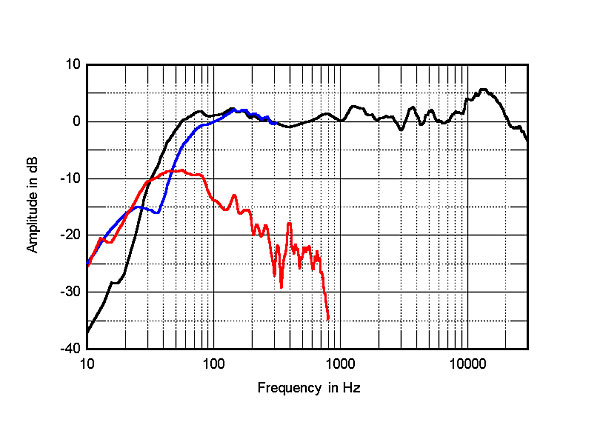 The black trace above 300Hz in fig.3 shows the Triton Five's farfield frequency response on the tweeter axis, averaged across a 30° horizontal window. Though some small peaks and dips can be seen, the response is impressively flat from the lower midrange through to the beginning of the top octave. The broad peak between 1 and 2kHz might make the speaker sound a touch forward, but I note that HR actually found the speaker's overall balance neutral. The excess of energy in the top octave actually compensates for the folded-ribbon tweeter's lack of output off axis in this region, as can be seen in fig.4. Other than a slight flare at the bottom of the tweeter's passband—the corresponding slight lack of energy at the top of the woofers' passband might correlate with HR commenting that some singers sounded "ghostly, and (strangely) more generalized" than the DeVore O/93—this graph reveals that, below the top octave, the Triton Five has wide, even dispersion.


Fig.1 GoldenEar Triton Five, electrical impedance (solid) and phase (dashed) (2 ohms/vertical div.).
As the Triton Five is covered with a black cloth "sock," which gives my accelerometer no firm surface to which to be attached, I rolled the sock down to examine how lively the enclosure was. There were a couple of high-Q resonances on the cabinet, these highest in level on the rear panel (fig.2). However, because these are high in frequency and will be damped by the sock, they shouldn't affect the GoldenEar's sound quality.
Fig.2 GoldenEar Triton Five, cumulative spectral-decay plot calculated from output of accelerometer fastened to center of rear panel behind tweeter (MLS driving voltage to speaker, 7.55V; measurement bandwidth, 2kHz).
The red trace in fig.3 is the summed output of the four passive radiators on the Triton Five's sides; the blue trace is that of the woofers; all six units were measured in the nearfield and their outputs were scaled in the ratio of the square roots of the total radiating areas. The slight notch at 35Hz in the woofers' response suggests that the passive radiators are tuned to that frequency, though their output actually covers a wider bandpass than the norm for a reflex design. The black trace below 300Hz is the complex sum of the outputs of the woofers and radiators; as expected, it is down by 6dB at the radiator tuning frequency.
Fig.3 GoldenEar Triton Five, anechoic response on tweeter axis at 50", averaged across 30° horizontal window and corrected for microphone response, with: nearfield responses of woofers (blue), passive radiators (red), and their complex sum (black), respectively plotted below 300Hz, 800Hz, and 300Hz.
Fig.4 GoldenEar Triton Five, lateral response family at 50", normalized to response on tweeter axis, from back to front: differences in response 90–5° off axis, reference response, differences in response 5–90° off axis.
In the vertical plane (fig.5), the GoldenEar's output suffers from a broad suckout in the crossover region more than 10° above the tweeter axis, which is 36" above the floor. (A survey performed in the 1990s by Stereophile contributor Thomas J. Norton found that 36" is the height of the ears of the average listener sitting in an average chair—not a so-called director's chair, whose seats tend to be significantly higher.)
Fig.5 GoldenEar Triton Five, vertical response family at 50", normalized to response on tweeter axis, from back to front: differences in response 15–5° above axis, reference response, differences in response 5–10° below axis.
Turning to the time domain, the Triton Five's step response on the tweeter axis (fig.6) suggests that the tweeter is connected in inverted polarity, the woofers in positive polarity. However, as the decay of the tweeter's step doesn't quite blend with the start of the woofers' step, this driver's acoustic center appears to be a little too forward compared with that of the woofers. Still, fig.3 indicates that the frequency response in the crossover region is well managed. Finally, although the GoldenEar's cumulative spectral-decay plot (fig.7) reveals the presence of some low-level delayed energy in the low and mid-treble, this graph demonstrates an impressively clean initial decay overall.
Fig.6 GoldenEar Triton Five, step response on tweeter axis at 50" (5ms time window, 30kHz bandwidth).
Fig.7 GoldenEar Triton Five, cumulative spectral-decay plot on tweeter axis at 50" (0.15ms risetime).
GoldenEar's Triton Five Tower appears to be another well-engineered loudspeaker from Messrs. Gross and Johnston, offering excellent measured performance at an affordable price.—John Atkinson