Sidebar 3: Measurements
I used DRA Labs' MLSSA system and a calibrated DPA 4006 microphone to measure the Dynaudio Excite X14's frequency response in the farfield, and an Earthworks QTC-40 with its ¼" capsule for the nearfield responses. Though the Excite X14 is supplied with a grille, and an optional foam plug for its port, I performed the measurements without either. Dynaudio specifies the X14 as having a voltage sensitivity of 85dB/2.83V/m; my estimate was 83dB(B)/2.83V/m, which is both lower than the specified figure and 1dB lower than my estimate of the earlier Excite X12's sensitivity. Despite this low sensitivity, the X14 is very easy to drive, its impedance remaining above 8 ohms at almost all frequencies (fig.1, solid trace), and about 2 ohms higher than the X12's impedance. The minimum magnitude is a mild 6.4 ohms at 210Hz, and the small electrical phase angle (dashed trace) is relatively benign.
The traces in fig.1 are free from the small wrinkles in the midrange that would suggest the presence of panel resonances, and indeed, cumulative spectral-decay plots calculated from the output of a simple accelerometer attached to the cabinet walls confirmed this absence. Fig.2 was taken with the accelerometer attached to the center of one of the sidewalls; the only modes present are both high in frequency and low in level. (Ignore the broad hump in the bass in this graph, which I suspect is due to the speaker's port-tuning resonance exciting the wooden floor of the room in which I performed this measurement.) The X14 is much better than the X12 in this respect, and I suspect that this is why Bob Reina found the X12's midbass to sound "a bit sluggish and warm by comparison."

 The notch centered on 55Hz in the blue trace in fig.3, which is the woofer's response measured in the nearfield, suggests that this is the tuning frequency of the large, flared port on the cabinet's rear. The port's output (red trace) is identical with that of the X12, peaking between 30 and 100Hz, and with a strong resonant mode apparent between 700 and 900Hz. As the port fires to the speaker's rear, it's possible that this mode will not affect the X14's sound quality. The complex sum of the woofer and port responses, taking into account both acoustic phase and the different distance of each source from a nominal farfield microphone position, is shown in fig.3 as the black trace below 300Hz. The broad hump in the upper bass is primarily an artifact of the nearfield measurement technique; the speaker's bass will be down by 6dB at the port tuning frequency, which is actually okay low-frequency extension for so small a speaker.
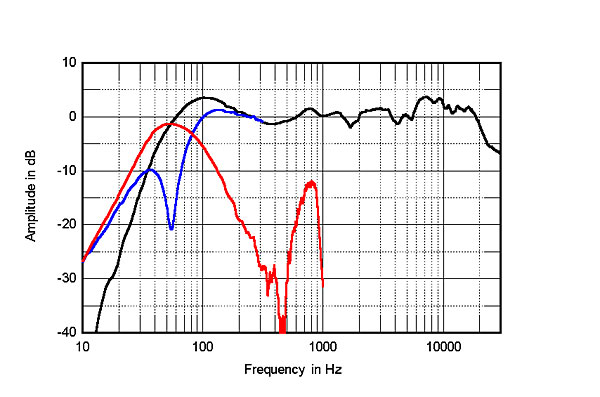


Fig.1 Dynaudio Excite X14, electrical impedance (solid) and phase (dashed) (2 ohms/vertical div.).
Fig.2 Dynaudio Excite X14, cumulative spectral-decay plot calculated from output of accelerometer fastened to center of side panel (MLS driving voltage to speaker, 7.55V; measurement bandwidth, 2kHz).
Fig.3 Dynaudio Excite X14, anechoic response on tweeter axis at 50", averaged across 30° horizontal window and corrected for microphone response, with nearfield responses of woofer (blue), port (red), and their complex sum, respectively plotted below 300Hz, 1kHz, and 300Hz.
Higher in frequency in fig.3, the X14's response, averaged across a 30° horizontal window centered on the tweeter axis, is quite similar to the X12's, but with more energy apparent in the presence region (2–5kHz). As I would expect, BJR described the X12's high frequencies as being "less detailed" than the X14's, which were "cleaner and more articulate in high-level passages." In fig.3 the top two octaves are seen to be a little exaggerated, which, in a room of small to medium size, will compensate for the narrowed horizontal radiation pattern in this region (fig.4). The slight off-axis flare between 3 and 5kHz in this graph will add to the impression of treble detail, but it might also make the X14 a bit fussy about system matching in rooms that are not acoustically well damped. In the vertical plane, the X14's dispersion (fig.5) suggests that low stands will work better than high ones, a suckout at the crossover frequency developing more than 10° below the tweeter axis.
Fig.4 Dynaudio Excite X14, lateral-response family at 50", normalized to response on tweeter axis, from back to front: differences in response 90–5° off axis, reference response, differences in response 5–90° off axis.
Fig.5 Dynaudio Excite X14, vertical-response family at 50", normalized to response on tweeter axis, from back to front: differences in response 45–5° above axis, reference response, differences in response 5–45° below axis.
The Excite X14's step response on its tweeter axis (fig.6) reveals that its two drive-units are connected in positive acoustic polarity. The decay of the tweeter's step smoothly blends into the woofer's step, correlating with the good frequency-domain integration of their outputs. Other than some low-level hash in the crossover region, the X14's cumulative spectral-decay plot on the tweeter axis (fig.7) features a very clean initial decay and, overall, a cleaner decay than the X12.
Fig.6 Dynaudio Excite X14, step response on tweeter axis at 50" (5ms time window, 30kHz bandwidth).
Fig.7 Dynaudio Excite X14, cumulative spectral-decay plot on tweeter axis at 50" (0.15ms risetime).
Like its predecessor, Dynaudio's Excite X14 is a well-engineered design.—John Atkinson