Sidebar 2: Measurements
I examined the performance of one of the DefTech speakers with DRA Labs' MLSSA system. I used a calibrated DPA 4006 microphone to measure the speaker's frequency response in the farfield, and an Earthworks QTC-40 mike for the nearfield responses. I estimated the SM 45's voltage sensitivity at 86dB(B)/2.83V/m, which is typical for a small speaker like this but well below the specified 90dB. The nominal impedance is specified at 8 ohms; while the plot of impedance magnitude against frequency (fig.1, solid trace) remains above 8 ohms in the upper midrange and treble, it drops below 6 ohms between 120 and 500Hz. The minimum impedance is 3.6 ohms at 190Hz, but the electrical phase angle (dotted trace) is generally benign. A good amplifier rated at 8 ohms should have no problem driving this speaker.

 The saddle centered on 45Hz in the impedance-magnitude trace suggests that this is the tuning frequency of the flared port on the cabinet's rear. The corresponding minimum-motion notch in the woofer's nearfield output (fig.3, blue trace) actually occurs at 48Hz, with the port's nearfield output (red trace) peaking very slightly lower in frequency. The port rolls off in textbook manner above its tuning frequency, but then there are two very strong resonances, at 700 and 910Hz, that rise almost to full level. Fortunately, the fact that the port faces away from the listener will reduce the audibility of these resonances, but they do affect the woofer's output—and lead, I suspect, to the small rise in the same region in the farfield response (black trace).
The slight rise in the SM 45's low-frequency response in fig.3 will be entirely due to the nearfield measurement technique. The DefTech is actually flat down to 70Hz or so, then –6dB at the port tuning frequency. Higher in frequency in fig.3, the SM 45 is balanced impressively flat through the lower midrange to the mid-treble. The response rises in the top octave, but as is often the case, this will be offset by the speaker's limited dispersion in the same region (fig.4). This graph also reveals that the suckout at 14kHz in the on-axis output fills in to the speaker's sides. Vertically (fig.5), a suckout develops in the SM 45's crossover region more than 5° above the tweeter axis, which suggests that tall stands will work better than short ones.
The saddle centered on 45Hz in the impedance-magnitude trace suggests that this is the tuning frequency of the flared port on the cabinet's rear. The corresponding minimum-motion notch in the woofer's nearfield output (fig.3, blue trace) actually occurs at 48Hz, with the port's nearfield output (red trace) peaking very slightly lower in frequency. The port rolls off in textbook manner above its tuning frequency, but then there are two very strong resonances, at 700 and 910Hz, that rise almost to full level. Fortunately, the fact that the port faces away from the listener will reduce the audibility of these resonances, but they do affect the woofer's output—and lead, I suspect, to the small rise in the same region in the farfield response (black trace).
The slight rise in the SM 45's low-frequency response in fig.3 will be entirely due to the nearfield measurement technique. The DefTech is actually flat down to 70Hz or so, then –6dB at the port tuning frequency. Higher in frequency in fig.3, the SM 45 is balanced impressively flat through the lower midrange to the mid-treble. The response rises in the top octave, but as is often the case, this will be offset by the speaker's limited dispersion in the same region (fig.4). This graph also reveals that the suckout at 14kHz in the on-axis output fills in to the speaker's sides. Vertically (fig.5), a suckout develops in the SM 45's crossover region more than 5° above the tweeter axis, which suggests that tall stands will work better than short ones.
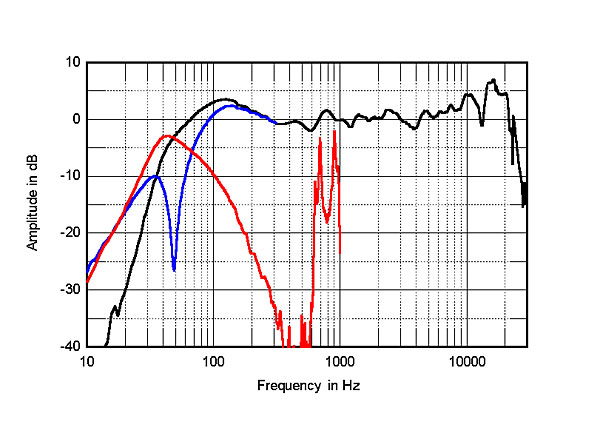
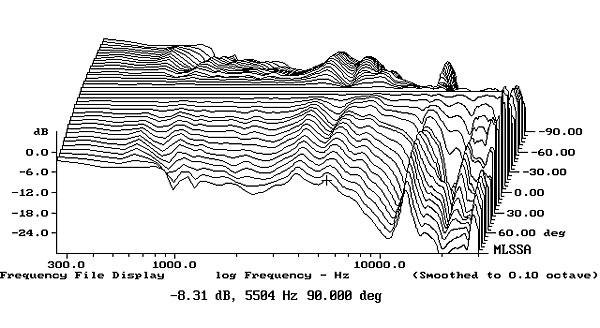
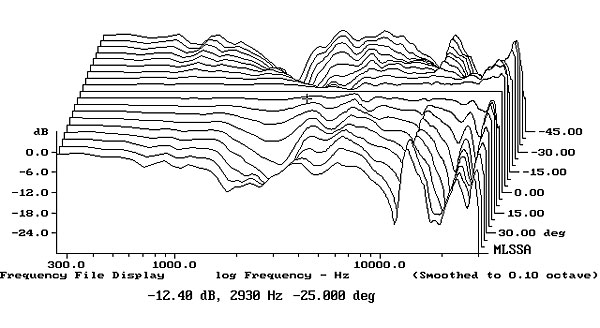
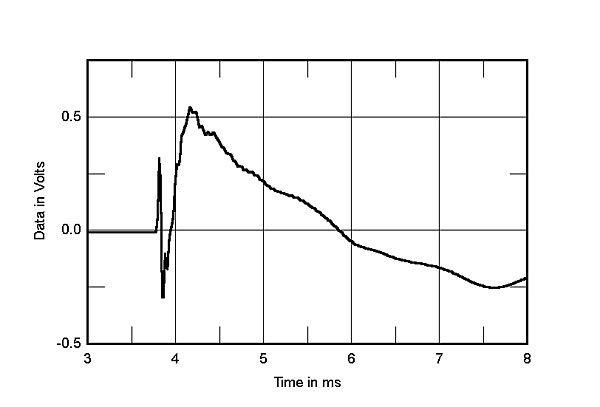
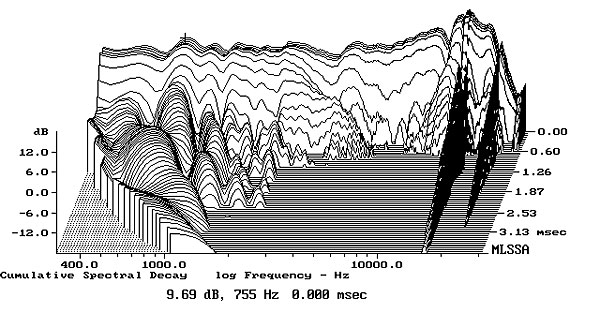
Fig.1 Definitive Technology SM 45, electrical impedance (solid) and phase (dashed) (2 ohms/vertical div.).
There is a significant glitch just under 700Hz in the impedance traces, with a less severe discontinuity at 320Hz. A cumulative spectral-decay plot calculated from the output of an accelerometer fastened to the center of the top panel (fig.2) indicates a strong ridge of delayed energy at 320Hz, a less intense one at 700Hz, and two strong, high-Q modes between 1 and 2kHz. The 700Hz mode was stronger on the side panels (not shown). SM wrote that "knocking on a side panel resulted in a hollow tone that was slight and well controlled-not quite the dull thud you expect from more expensive speakers, but satisfying nonetheless." The higher-frequency resonances will be less worrying, but that 320Hz mode concerns me—not only because it's high in level, but because the lower midrange is most sensitive to cabinet misbehavior.
Fig.2 Definitive Technology SM 45, cumulative spectral-decay plot calculated from output of accelerometer fastened to center of top panel (MLS driving voltage to speaker, 7.55V; measurement bandwidth, 2kHz).
Fig.3 Definitive Technology SM 45, anechoic response on HF axis at 50", averaged across 30° horizontal window and corrected for microphone response, with nearfield responses of woofer (blue trace), port (red), and their complex sum (black), respectively plotted below 300Hz, 1kHz, 300Hz.
Fig.4 Definitive Technology SM 45, lateral response family at 50", normalized to response on HF axis, from back to front: differences in response 90–5°off axis, reference response, differences in response 5–90¯ off axis.
Fig.5 Definitive Technology SM 45, vertical response family at 50", normalized to response on HF axis, from back to front: differences in response 45–5° above axis, reference response, differences in response 5–45° below axis.
Turning to the time domain, the step response on the DefTech's tweeter axis (fig.6) reveals that both drive-units are connected in the same, positive acoustic polarity, but also indicates that the optimal axis is actually just below the tweeter. (The small discontinuity where the decay of the tweeter's step should blend smoothly into the rise of the woofer's step will disappear if the microphone is placed slightly lower.) Other than some ridges of delayed energy at the frequencies of the port resonances, the cumulative spectral-decay or waterfall plot on the tweeter axis is impressively clean (fig.7). (Ignore the black ridge of delayed energy just below 16kHz, which is due to leakage from the computer's video circuitry.)
Fig.6 Definitive Technology SM 45, step response on HF axis at 50" (5ms time window, 30kHz bandwidth).
Fig.7 Definitive Technology SM 45, cumulative spectral-decay plot on HF axis at 50" (0.15ms risetime).
Other than that lively enclosure and the port resonances, the Definitive Technology SM 45 measures very well for an inexpensive loudspeaker. It should sound neutral and clean.—John Atkinson