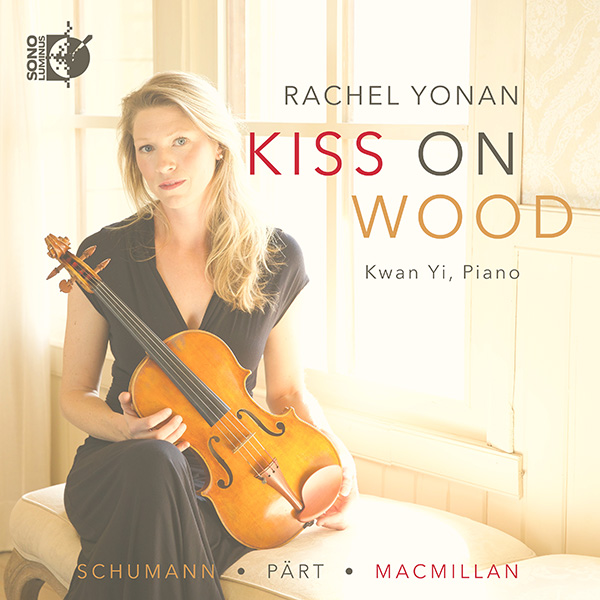
Rachel Yonan: Kiss on Wood
Rachel Yonan, viola; Kwan Yi, piano. Sono Luminus DSL-92283. CD (reviewed in 24/352.8). 2025. Ulrike Schwartz, prod.; Daniel Shores, eng.
Performance ****
Sonics ***** In an intriguing, surprisingly short program, violist Rachel Yonan and pianist Kwan Yi mix three intentionally sparse "modern" pieces by Arvo Pärt and Sir James MacMillan with Robert Schumann's four far more effusive Märchenbilder (fairy tales). The contrasts are many, and the rewards are considerable. Those rewards are enhanced by Daniel Shores's commitment to recording in DXD. Images are realistically large, the sound full, detailed, and free of digital edge. Shores's kinship with the DXD team of engineer Jim Anderson and producer Ulrike Schwartz is reflected in Schwartz's involvement as producer and Anderson's hand in supplying booklet photographs.
The major draw is the first recording of MacMillan's seven-minute Kiss on Wood, arranged for viola and piano by Yonan. Described by MacMillan as "a short, static and serene meditation," its inspiration lies in a Latin phrase that on Good Friday invites church attendees to come forward and kiss the wood on Christ's cross in adoration. The slow, still beauty of the piece is marked by sighing, groaning, and some of the same stillness that makes Pärt's Fratres and Spielel im Spiegel so magical and riveting. I sat transfixed by the increasingly soft piano chords at the end, whose subtle transformations are captured to perfection by DXD.
Occasionally, Yonan's flow is interrupted by slight unsteadiness. In Spiegel im Spiegel, her decision to alternate between straight tone and moderate vibrato seems capricious. Most striking, her time travel (with Kwan) to Schumann's era does not find them plumbing the romantic depths. In works as short as the Märchenbilder, changes in tempo and dynamics are essential. To compare this duo's final melancholic movement with those from other artists is to discover what more could have been said.—Jason Victor Serinus
 Shostakovich: Piano Concerti 1–2; Piano Works
Yuja Wang, piano; Boston Symphony/Andris Nelsons
Deutsche Grammophon 486 6956 (CD). 2025. Shawn Murphy, prod.; Shawn Murphy and Nick Squire, engs.
Performance ***
Sonics ****
Yuja Wang and company shine in a convincing account of the Second Concerto. After a light-textured orchestral march, the soloist takes off at a gallop with clean runs; a sudden hush heralds the mysterious second group. In the Andante, the strings' searching, contained chorale turns introspective, while Wang's delicate phrasing almost evokes a Chopin nocturne. The finale, launched attacca, grows unbuttoned but never quite rambunctious. Wang's runs sparkle, though her topmost chords lack depth. Woodwinds sound pushed in the first movement's quirky, Festive Overture–like passage; otherwise, the orchestra supports her marvelously.
In the First Concerto, conversely, almost everyone involved seems slightly miscast. The Boston strings are haunting in warm, translucent sectional lines, but soft-edged attacks dilute the score's spiky propulsion into an anodyne flow, particularly in the scurrying finale. Tonal definition suffers in the tempo transitions. And, while Wang again offers lapidary articulation in running figures, her insufficiently supported tone in the central movements leaves her no room for coloring the harmonic shifts. Only Thomas Rolfs's crisp, cheeky trumpet obbligatos capture an appropriate carnival atmosphere.
As a follow-up, we get an odd cross-section of the 24 Preludes and Fugues. Two preludes stand alone, shorn of their accompanying fugues, and vanish before they leave a mark. Their brevity makes them feel like sketches—interesting but too slight to register with emotional weight. Best are the A minor Prelude and Fugue: the Prelude's rippling, fluid textures, which again don't quite shimmer, take on a foreboding tone as they descend, and Wang projects the Fugue with crisp energy. The D-flat Major pairing offers heartiness, agogic rhetoric, and restraint as needed.—Stephen Francis Vasta
 Begin The Song! A Purcell Academy
Paul-Antoine Bénos-Djian, countertenor; Le Consort
Harmonia Mundi HMM 902741 (CD, reviewed as 24/96). 2025. Alban Moraud, Alexandra Evrard, prods.; Moraud and Evrard, eng.
Performance *****
Sonics ****½ In his first recorded recital, distinctively voiced Paul-Antoine Bénos-Djian exhibits a true alto with far more body, weight, and emotional import than most countertenor voices. A 2017 HSBC Révélation award winner at the Festival d'Aix-en-Provence, Bénos-Djian has already sung with many of the world's leading period music conductors and ensembles. His arrestingly beautiful instrument seems fully engaged and at ease transitioning from rapid runs to plangent lyricism. The subject of this month's Recording of the Month, Salzburg-born Heinrich Ignaz Franz von Biber, composed instrumental music that was both serious and lighthearted. Apparently many of his English counterparts composed vocal music grounded in sadness—that, at least, is what's on this recital. Bénos-Djian and the superb four-person early music ensemble Le Consort (augmented by musicians who play flute, recorder, oboe, theorbo, and baroque guitar) intersperse 14 pieces by Purcell with others by Barrett, Croft, Eccles, Blow, Jeremiah Clarke, and anon. Even "O Ravishing Delight," by Eccles, seems to equate joy with suffering. You may feel the need to come up for air midway through.
For those who seek cheer, there are two saving graces: Bénos-Djian's consistently mellifluous, graceful singing and the glories of Le Consort's six colorful, often upbeat instrumentals. Their imaginative instrumental blend inspires a mixture of respect and gratitude.
Don't miss Purcell's well-known "Sound the Trumpet." Compare what Bénos-Djian and Paul Figuier do to the classic recording by countertenors Paul and Alfred Deller—two completely different sound worlds and different sensibilities.
In every respect, this wonderful new recording takes the palm.—Jason Victor Serinus
 Chopin: 24 Préludes; Sonata 2
Emil Gryesten, piano
Con Fuoco 5707785014844 (24/96 download). 2025. Federico Mattioli, prod. and eng.
Performance ***½
Sonics ****
In a Romantic extension of the "historical performance" movement, Emil Gryesten plays his program on an Érard grand piano built in 1837, the same year Chopin composed the Préludes. In common with many older instruments, it's smaller scaled than the modern concert grand, with a quicker action and a lighter sound.
In some Préludes, the immediate attack and rebalanced voicings are an advantage. The rapid writing in the brief D major coalesces in soft-edged, fluid harmonies. The C-sharp minor's high trills shimmer. Light, uncluttered textures benefit the turbulent F-sharp minor and transform the E-flat major into a buoyant cloud of tone.
Interpretively, Gryesten scores in the gentle rubato of the waltzish A major—not too sentimental—and in the C minor's ambivalence. On the other hand, some of his rubatos are strained, and the rippling G major's themes ought to stand in sharper relief.
Other pieces sound limited. The proclamatory opening chords of the B-flat minor lack depth, although the ensuing passagework is dazzling. The hard-edged tone in the F minor clearly comes from the piano, not the engineers. In lyrical episodes, especially in the A minor and E minor, Gryesten, perhaps to compensate for the Érard's more restricted sustaining power, accents every note of the broad melodies, which don't bind and sing.
Oddly, the difficulties mostly disappear in the B minor Sonata. The opening bass attack is firm and balanced. I'd still have liked fuller high chords in the second subject. The turbulent Scherzo scales down delicately with a graceful, rocking Trio; the famous Funeral March, steady and grim, gradually turns tender. The busy finale feels too short.
I never noticed the sonics—high praise, indeed.—Stephen Francis Vasta
Rachel Yonan, viola; Kwan Yi, piano. Sono Luminus DSL-92283. CD (reviewed in 24/352.8). 2025. Ulrike Schwartz, prod.; Daniel Shores, eng.
Performance ****
Sonics ***** In an intriguing, surprisingly short program, violist Rachel Yonan and pianist Kwan Yi mix three intentionally sparse "modern" pieces by Arvo Pärt and Sir James MacMillan with Robert Schumann's four far more effusive Märchenbilder (fairy tales). The contrasts are many, and the rewards are considerable. Those rewards are enhanced by Daniel Shores's commitment to recording in DXD. Images are realistically large, the sound full, detailed, and free of digital edge. Shores's kinship with the DXD team of engineer Jim Anderson and producer Ulrike Schwartz is reflected in Schwartz's involvement as producer and Anderson's hand in supplying booklet photographs.
Shostakovich: Piano Concerti 1–2; Piano WorksYuja Wang, piano; Boston Symphony/Andris Nelsons
Deutsche Grammophon 486 6956 (CD). 2025. Shawn Murphy, prod.; Shawn Murphy and Nick Squire, engs.
Performance ***
Sonics ****
Begin The Song! A Purcell AcademyPaul-Antoine Bénos-Djian, countertenor; Le Consort
Harmonia Mundi HMM 902741 (CD, reviewed as 24/96). 2025. Alban Moraud, Alexandra Evrard, prods.; Moraud and Evrard, eng.
Performance *****
Sonics ****½ In his first recorded recital, distinctively voiced Paul-Antoine Bénos-Djian exhibits a true alto with far more body, weight, and emotional import than most countertenor voices. A 2017 HSBC Révélation award winner at the Festival d'Aix-en-Provence, Bénos-Djian has already sung with many of the world's leading period music conductors and ensembles. His arrestingly beautiful instrument seems fully engaged and at ease transitioning from rapid runs to plangent lyricism. The subject of this month's Recording of the Month, Salzburg-born Heinrich Ignaz Franz von Biber, composed instrumental music that was both serious and lighthearted. Apparently many of his English counterparts composed vocal music grounded in sadness—that, at least, is what's on this recital. Bénos-Djian and the superb four-person early music ensemble Le Consort (augmented by musicians who play flute, recorder, oboe, theorbo, and baroque guitar) intersperse 14 pieces by Purcell with others by Barrett, Croft, Eccles, Blow, Jeremiah Clarke, and anon. Even "O Ravishing Delight," by Eccles, seems to equate joy with suffering. You may feel the need to come up for air midway through.
Chopin: 24 Préludes; Sonata 2Emil Gryesten, piano
Con Fuoco 5707785014844 (24/96 download). 2025. Federico Mattioli, prod. and eng.
Performance ***½
Sonics ****