". . . seizing and incorporating . . . There is nothing about us which is more strongly primitive."—Elias Canetti, Crowds and Power
I am a collector. Books, records, art, music, knickknacks, old blurry anonymous photos, and more—hanging, sitting, standing, and shelved, they surround me where I sit and follow me around our home. In collecting, less is certainly not more, and I believe that part of its appeal is that our collections help define not only who we are but who we'd like to become—or, perhaps, how things are and how we'd like them to be.
I love my collection of LPs. I enjoy getting new records and old new records from real record stores and bringing them to their new home. That first listen is full of an excitement that never grows old. I even get a strange sense of amusement when I place records and books on the shelf and discover whom their new neighbors will be. From the nicely congruous Nadler, Newsome, and Nico, to the other shelf and the perfectly mixed match of Rimbaud, Sacher-Masoch, de Sade, and Salinger.
So it was with some reluctance, years ago, that I first approached file-based playback. While digital downloads include cover art, they rarely include the full original liner notes. This absence of information removes an aspect of the original context that can go a long way in establishing meaning. Of course, all is not lost—we can roll our own, and there's an Internet's worth of information out there at our fingertips. I also know plenty of people who take great pains in editing their metadata, which I imagine is a process that helps to make their virtual collections feel more real.
 The largest issue with file-based music collections is of whether or not we have the same ownership rights to files that we do with physical media. The easiest example of our precarious hold on the virtual is the fact that we cannot resell downloads. The pending ReDigi case may shed more light on this. ReDigi.com, which styles itself the "World's First Pre-Owned Digital Marketplace," is being sued by EMI for copyright infringement. ReDigi allows its members to resell downloads, and claims that its software ensures that the original copy is deleted from the seller's computer. The obvious possibility of a copy remaining on a seller's external hard drive aside, the main takeaway is that the record labels don't believe that we actually own downloads. It's more like a lease with the option to delete.
All of which begs the question: Why are we being asked to pay ownership rates for downloads we do not have ownership rights to? I'll leave the sticky issue of being asked to pay higher prices for higher resolutions for another day; in this month's column, I talk about the future of music distribution.
Step Into the Same Stream Twice
The largest issue with file-based music collections is of whether or not we have the same ownership rights to files that we do with physical media. The easiest example of our precarious hold on the virtual is the fact that we cannot resell downloads. The pending ReDigi case may shed more light on this. ReDigi.com, which styles itself the "World's First Pre-Owned Digital Marketplace," is being sued by EMI for copyright infringement. ReDigi allows its members to resell downloads, and claims that its software ensures that the original copy is deleted from the seller's computer. The obvious possibility of a copy remaining on a seller's external hard drive aside, the main takeaway is that the record labels don't believe that we actually own downloads. It's more like a lease with the option to delete.
All of which begs the question: Why are we being asked to pay ownership rates for downloads we do not have ownership rights to? I'll leave the sticky issue of being asked to pay higher prices for higher resolutions for another day; in this month's column, I talk about the future of music distribution.
Step Into the Same Stream Twice
For a few bucks a month—or for free, if you don't mind the occasional ad and the lower bit rates—you have access to millions of albums. Today's most popular streaming services include Pandora, Rhapsody, and such higher-quality services as Spotify and, until recently, MOG, which was gobbled up first by Beats Electronics, then Apple. The important distinction between Spotify and MOG and the rest are those two companies' streaming bit rate of 320kpbs. Rhapsody and Pandora max out at 192kbps for their home audio service. If you don't believe that there's an audible difference between these rates, you and I will have to agree to strenuously disagree. But even at Spotify's higher bit rate, I find I grow tired of listening to lossy streaming services after about an album's worth of music. Not only is something missing; there's also something present—a dullness and a hollowness that wear on me. My tolerance level of an album's worth of listening at low bit rates is perfect for discovering new music on the Web from such free streaming services as Pitchfork Advance, Bandcamp, SoundCloud, and NPR's First Listen, to name a few; but for extended listening I've found lossy streaming to be sonically off-putting. As in, turn it off and put something else on, please. The solution, for those of us unwilling to pay for something of poor sound quality that we then still do not own, is CD- or higher-quality streaming. If only there were a service out there that offered lossless streaming, we'd be in file-based-music–lovin' heaven.
Qobuz Hi-Fi: CD-Quality Lossless Streaming
To suggest that lossless streaming is the future of music distribution is, to my mind, a gross understatement. That's not to toll the death knell of physical media, LPs or CDs; rather, I see lossless streaming as the perfect marriage of convenience and sound quality that file-based playback has promised all along.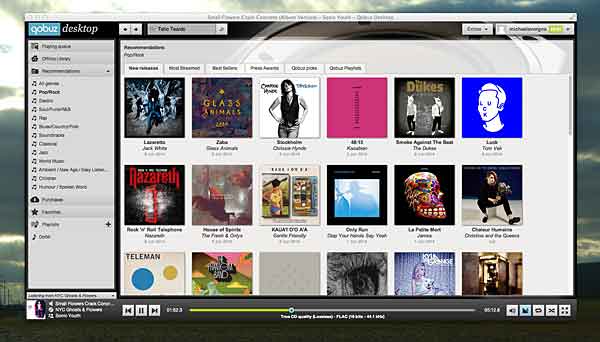 With streaming, we no longer have to worry about file formats, storage, or backups. No network-attached storage (NAS) device is necessary, we don't need to deal with third-party music-playback software (although we may want to), there are no metadata issues, no worrying over directory structure, compatibility, etc. All you have to do is hit Play.
The CD-quality (16-bit/44.1kHz or 1411kbps) Hi-Fi service from Qobuz.com is currently available in Qobuz's native France, Belgium, Luxembourg, the Netherlands, the UK, Ireland, Germany, Austria, and Switzerland for a monthly fee of 19.99 or $27. (You can also stream at 320kbps; this lower-quality service, Qobuz Premium, is available for 9.99/month; Qobuz Hi-Fi Classic, a classical-music–only lossless-streaming service, costs 14.99/month.) According to a Qobuz press release from February 2014, "Qobuz is currently preparing its launch in America, which will take place at the end of 2014." Here I talk about my experiences with a fully working trial version of this service (footnote 1).
Setting up the Qobuz Hi-Fi desktop app requires that you do only a few things. Once you've downloaded and launched the Qobuz desktop app (for Mac or PC) and sign in to your account, you need to go to "Settings" and select the box labeled "True CD Quality (Lossless) FLAC." Next, select your "Audio Output Device" from the dropdown menu. If you have an external DAC, and you really should, it will show up; you just have to select it.
With streaming, we no longer have to worry about file formats, storage, or backups. No network-attached storage (NAS) device is necessary, we don't need to deal with third-party music-playback software (although we may want to), there are no metadata issues, no worrying over directory structure, compatibility, etc. All you have to do is hit Play.
The CD-quality (16-bit/44.1kHz or 1411kbps) Hi-Fi service from Qobuz.com is currently available in Qobuz's native France, Belgium, Luxembourg, the Netherlands, the UK, Ireland, Germany, Austria, and Switzerland for a monthly fee of 19.99 or $27. (You can also stream at 320kbps; this lower-quality service, Qobuz Premium, is available for 9.99/month; Qobuz Hi-Fi Classic, a classical-music–only lossless-streaming service, costs 14.99/month.) According to a Qobuz press release from February 2014, "Qobuz is currently preparing its launch in America, which will take place at the end of 2014." Here I talk about my experiences with a fully working trial version of this service (footnote 1).
Setting up the Qobuz Hi-Fi desktop app requires that you do only a few things. Once you've downloaded and launched the Qobuz desktop app (for Mac or PC) and sign in to your account, you need to go to "Settings" and select the box labeled "True CD Quality (Lossless) FLAC." Next, select your "Audio Output Device" from the dropdown menu. If you have an external DAC, and you really should, it will show up; you just have to select it.
Footnote 1: On August 28, Qobuz filed for what appears to be the French equivalent of Chapter 11.—Ed.
The largest issue with file-based music collections is of whether or not we have the same ownership rights to files that we do with physical media. The easiest example of our precarious hold on the virtual is the fact that we cannot resell downloads. The pending ReDigi case may shed more light on this. ReDigi.com, which styles itself the "World's First Pre-Owned Digital Marketplace," is being sued by EMI for copyright infringement. ReDigi allows its members to resell downloads, and claims that its software ensures that the original copy is deleted from the seller's computer. The obvious possibility of a copy remaining on a seller's external hard drive aside, the main takeaway is that the record labels don't believe that we actually own downloads. It's more like a lease with the option to delete.
All of which begs the question: Why are we being asked to pay ownership rates for downloads we do not have ownership rights to? I'll leave the sticky issue of being asked to pay higher prices for higher resolutions for another day; in this month's column, I talk about the future of music distribution.
For a few bucks a month—or for free, if you don't mind the occasional ad and the lower bit rates—you have access to millions of albums. Today's most popular streaming services include Pandora, Rhapsody, and such higher-quality services as Spotify and, until recently, MOG, which was gobbled up first by Beats Electronics, then Apple. The important distinction between Spotify and MOG and the rest are those two companies' streaming bit rate of 320kpbs. Rhapsody and Pandora max out at 192kbps for their home audio service. If you don't believe that there's an audible difference between these rates, you and I will have to agree to strenuously disagree. But even at Spotify's higher bit rate, I find I grow tired of listening to lossy streaming services after about an album's worth of music. Not only is something missing; there's also something present—a dullness and a hollowness that wear on me. My tolerance level of an album's worth of listening at low bit rates is perfect for discovering new music on the Web from such free streaming services as Pitchfork Advance, Bandcamp, SoundCloud, and NPR's First Listen, to name a few; but for extended listening I've found lossy streaming to be sonically off-putting. As in, turn it off and put something else on, please. The solution, for those of us unwilling to pay for something of poor sound quality that we then still do not own, is CD- or higher-quality streaming. If only there were a service out there that offered lossless streaming, we'd be in file-based-music–lovin' heaven.
To suggest that lossless streaming is the future of music distribution is, to my mind, a gross understatement. That's not to toll the death knell of physical media, LPs or CDs; rather, I see lossless streaming as the perfect marriage of convenience and sound quality that file-based playback has promised all along.
With streaming, we no longer have to worry about file formats, storage, or backups. No network-attached storage (NAS) device is necessary, we don't need to deal with third-party music-playback software (although we may want to), there are no metadata issues, no worrying over directory structure, compatibility, etc. All you have to do is hit Play.
The CD-quality (16-bit/44.1kHz or 1411kbps) Hi-Fi service from Qobuz.com is currently available in Qobuz's native France, Belgium, Luxembourg, the Netherlands, the UK, Ireland, Germany, Austria, and Switzerland for a monthly fee of 19.99 or $27. (You can also stream at 320kbps; this lower-quality service, Qobuz Premium, is available for 9.99/month; Qobuz Hi-Fi Classic, a classical-music–only lossless-streaming service, costs 14.99/month.) According to a Qobuz press release from February 2014, "Qobuz is currently preparing its launch in America, which will take place at the end of 2014." Here I talk about my experiences with a fully working trial version of this service (footnote 1).
Footnote 1: On August 28, Qobuz filed for what appears to be the French equivalent of Chapter 11.—Ed.