My home, which overlooks a dairy farm, is easy to see from a mile away, invisible from the end of its own driveway. Elevation: 1345'. Population: 3.
 My computer speaks to the world through a 56kbps modem and a telephone line. It takes about five minutes to load the local forecast on Weather.com, and YouTube is something I can enjoy only when I visit other people's homes. (I signed up for a satellite Internet service called Wild Blue, but was astounded to discover that what they peddle as e-mail is in fact g-mail—and so buggy that it doesn't work through the user's own e-mail software. Run, don't walk, away from Wild Blue.) As recently as two years ago, Cherry Valley had no cell-phone service. I've never seen a Blackberry. I don't really know what Blue Tooth is. The only computer game I've played in the past 15 years is solitaire. The last one before that was Pac-Man. Tom Tomorrow I am not.
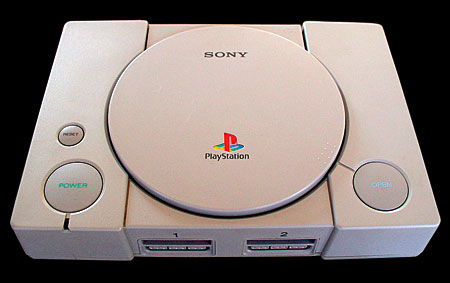
A year ago, when I heard that some audiophiles were using Sony's original PlayStation 1 as a CD player—my friend Michael Lavorgna, who writes for 6moons.com, was the first to cross my attention—I was more than a little confused. Sure, I'd heard of the Sony PlayStation, just as I've heard of the Game Boy and Nintendo (and Starbucks, and American Idol, and Anderson Cooper). But which is which? What do they look like? How do they work? I don't know, I don't know, I don't know.
So I asked someone who's younger and a bit more with it than I am to sit down at my very modern computer and type a few words about the PlayStation. Here's what my 10-year-old daughter, Julia, had to say, word for word:
You can play multiple games on it, like Mario, Zelda, and many more. You control the characters with a special remote control that you hook up to the PlayStation. There are multiple other PlayStations by Sony as well. There are even games for girls on it. This is how you play the game of your choice: First, you insert the game CD-R and hook up the memory chip to your PlayStation, then hopefully the CD will not be defective, and you press Menu, and press what you played last (if you saved your last game). Lastly, voilà, you can play your game leisurely until your mom calls you off to dinner (hopefully not spinach).
Thanks, sweetie. And remember: A dime a word is the most that anyone makes in this business. Honest.
Description
My computer speaks to the world through a 56kbps modem and a telephone line. It takes about five minutes to load the local forecast on Weather.com, and YouTube is something I can enjoy only when I visit other people's homes. (I signed up for a satellite Internet service called Wild Blue, but was astounded to discover that what they peddle as e-mail is in fact g-mail—and so buggy that it doesn't work through the user's own e-mail software. Run, don't walk, away from Wild Blue.) As recently as two years ago, Cherry Valley had no cell-phone service. I've never seen a Blackberry. I don't really know what Blue Tooth is. The only computer game I've played in the past 15 years is solitaire. The last one before that was Pac-Man. Tom Tomorrow I am not.
A year ago, when I heard that some audiophiles were using Sony's original PlayStation 1 as a CD player—my friend Michael Lavorgna, who writes for 6moons.com, was the first to cross my attention—I was more than a little confused. Sure, I'd heard of the Sony PlayStation, just as I've heard of the Game Boy and Nintendo (and Starbucks, and American Idol, and Anderson Cooper). But which is which? What do they look like? How do they work? I don't know, I don't know, I don't know.
So I asked someone who's younger and a bit more with it than I am to sit down at my very modern computer and type a few words about the PlayStation. Here's what my 10-year-old daughter, Julia, had to say, word for word:
You can play multiple games on it, like Mario, Zelda, and many more. You control the characters with a special remote control that you hook up to the PlayStation. There are multiple other PlayStations by Sony as well. There are even games for girls on it. This is how you play the game of your choice: First, you insert the game CD-R and hook up the memory chip to your PlayStation, then hopefully the CD will not be defective, and you press Menu, and press what you played last (if you saved your last game). Lastly, voilà, you can play your game leisurely until your mom calls you off to dinner (hopefully not spinach).
Thanks, sweetie. And remember: A dime a word is the most that anyone makes in this business. Honest.
Description
Last week, John Atkinson and Stephen Mejias sent me a Sony PlayStation 1 that John Marks had bought for himself second-hand, auditioned, then forwarded to Stereophile's editorial office in New York City. But by the time the PS1 arrived here in Cherry Valley, the mechanical noise that JM had noted in his April 2008 column had flowered into full mechanical failure—aggravated, no doubt, by rough handling in transit. Since JM had paid only $25 for it at a Salvation Army thrift store (footnote 1), no one was devastated when the poor thing had to be thrown away (the player, not JM). Stephen Mejias beat the bushes to find me another sample, and it didn't take long: John DeVore, of DeVore Fidelity, offered one of his own PlayStations, and sent it the very next day, using the other major shipping company: the good one. DeVore told me he'd paid $15 on eBay for this PS1. There are more Johns in this story than in the Governor's mansion. JDV's PS1 arrived in its original packing, with the original accessories and manual. If one's definition of a good manual is something that provides the owner with more information than he or she needs to know, the PlayStation's 20-page booklet is superb. Instructions for using the product specifically as a CD player are offered on p.12. I didn't really understand what was being discussed on the other 19 pages, but I was glad to have them, just in case.
 The PS1 is made of gray plastic—or, at least, all of the surfaces are that eyes can see or fingers can touch. That was no surprise, and no disappointment: The preponderance of audio products housed in thick, machined alloy enclosures that are heavier, fancier, more metallic, and, worst of all, much more expensive than they need to be—more expensive, often, than the parts they enclose—is one of the most depressing things about this hobby. Plastic is fine with me.
Inside the PS1, a KSM-440 transport—widely available as a replacement part for under $20—is isolated from a lightweight sheet-metal frame by three compliant rubber grommets. The edges of that frame provide some measure of shielding between a rudimentary switch-mode power supply (built with some very old-style parts, leading me to assume that it was bought-in from a different manufacturer) and the remainder of the circuitry, the latter heavily dependent on surface-mount technology.
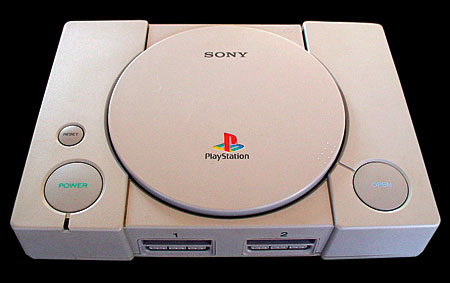
The PS1 has a detachable AC cord for household current, and connects to a line-level stereo input in one of two ways: RCA output jacks of the usual sort, or a 12-conductor audio-video socket, only five conductors of which are used. The latter is for use with a supplied cable, with molded RCA plugs at the other end. The only controls on the unit itself are two buttons labeled Reset and Power, and a third for opening the transport cover, which is purely mechanical. All other controls exist only on the remote handset, which is hardwired to the main unit, à la Mattel's Robot Commando toy of the mid-1960s.
The PS1 is made of gray plastic—or, at least, all of the surfaces are that eyes can see or fingers can touch. That was no surprise, and no disappointment: The preponderance of audio products housed in thick, machined alloy enclosures that are heavier, fancier, more metallic, and, worst of all, much more expensive than they need to be—more expensive, often, than the parts they enclose—is one of the most depressing things about this hobby. Plastic is fine with me.
Inside the PS1, a KSM-440 transport—widely available as a replacement part for under $20—is isolated from a lightweight sheet-metal frame by three compliant rubber grommets. The edges of that frame provide some measure of shielding between a rudimentary switch-mode power supply (built with some very old-style parts, leading me to assume that it was bought-in from a different manufacturer) and the remainder of the circuitry, the latter heavily dependent on surface-mount technology.
The PS1 has a detachable AC cord for household current, and connects to a line-level stereo input in one of two ways: RCA output jacks of the usual sort, or a 12-conductor audio-video socket, only five conductors of which are used. The latter is for use with a supplied cable, with molded RCA plugs at the other end. The only controls on the unit itself are two buttons labeled Reset and Power, and a third for opening the transport cover, which is purely mechanical. All other controls exist only on the remote handset, which is hardwired to the main unit, à la Mattel's Robot Commando toy of the mid-1960s.
Footnote 1: According to the statistics on the Salvation Army's website, the number of dealers listed in the specifications sidebar is the number of thrift shops they operate worldwide (US-only statistics not immediately available). Of course, the total number of places where one might find a PlayStation 1 for sale, not excluding lawn and garage sales, pawn shops, and eBay, is significantly greater.
My computer speaks to the world through a 56kbps modem and a telephone line. It takes about five minutes to load the local forecast on Weather.com, and YouTube is something I can enjoy only when I visit other people's homes. (I signed up for a satellite Internet service called Wild Blue, but was astounded to discover that what they peddle as e-mail is in fact g-mail—and so buggy that it doesn't work through the user's own e-mail software. Run, don't walk, away from Wild Blue.) As recently as two years ago, Cherry Valley had no cell-phone service. I've never seen a Blackberry. I don't really know what Blue Tooth is. The only computer game I've played in the past 15 years is solitaire. The last one before that was Pac-Man. Tom Tomorrow I am not.
A year ago, when I heard that some audiophiles were using Sony's original PlayStation 1 as a CD player—my friend Michael Lavorgna, who writes for 6moons.com, was the first to cross my attention—I was more than a little confused. Sure, I'd heard of the Sony PlayStation, just as I've heard of the Game Boy and Nintendo (and Starbucks, and American Idol, and Anderson Cooper). But which is which? What do they look like? How do they work? I don't know, I don't know, I don't know.
Last week, John Atkinson and Stephen Mejias sent me a Sony PlayStation 1 that John Marks had bought for himself second-hand, auditioned, then forwarded to Stereophile's editorial office in New York City. But by the time the PS1 arrived here in Cherry Valley, the mechanical noise that JM had noted in his April 2008 column had flowered into full mechanical failure—aggravated, no doubt, by rough handling in transit. Since JM had paid only $25 for it at a Salvation Army thrift store (footnote 1), no one was devastated when the poor thing had to be thrown away (the player, not JM). Stephen Mejias beat the bushes to find me another sample, and it didn't take long: John DeVore, of DeVore Fidelity, offered one of his own PlayStations, and sent it the very next day, using the other major shipping company: the good one. DeVore told me he'd paid $15 on eBay for this PS1. There are more Johns in this story than in the Governor's mansion. JDV's PS1 arrived in its original packing, with the original accessories and manual. If one's definition of a good manual is something that provides the owner with more information than he or she needs to know, the PlayStation's 20-page booklet is superb. Instructions for using the product specifically as a CD player are offered on p.12. I didn't really understand what was being discussed on the other 19 pages, but I was glad to have them, just in case.
The PS1 is made of gray plastic—or, at least, all of the surfaces are that eyes can see or fingers can touch. That was no surprise, and no disappointment: The preponderance of audio products housed in thick, machined alloy enclosures that are heavier, fancier, more metallic, and, worst of all, much more expensive than they need to be—more expensive, often, than the parts they enclose—is one of the most depressing things about this hobby. Plastic is fine with me.
Inside the PS1, a KSM-440 transport—widely available as a replacement part for under $20—is isolated from a lightweight sheet-metal frame by three compliant rubber grommets. The edges of that frame provide some measure of shielding between a rudimentary switch-mode power supply (built with some very old-style parts, leading me to assume that it was bought-in from a different manufacturer) and the remainder of the circuitry, the latter heavily dependent on surface-mount technology.
The PS1 has a detachable AC cord for household current, and connects to a line-level stereo input in one of two ways: RCA output jacks of the usual sort, or a 12-conductor audio-video socket, only five conductors of which are used. The latter is for use with a supplied cable, with molded RCA plugs at the other end. The only controls on the unit itself are two buttons labeled Reset and Power, and a third for opening the transport cover, which is purely mechanical. All other controls exist only on the remote handset, which is hardwired to the main unit, à la Mattel's Robot Commando toy of the mid-1960s.
Footnote 1: According to the statistics on the Salvation Army's website, the number of dealers listed in the specifications sidebar is the number of thrift shops they operate worldwide (US-only statistics not immediately available). Of course, the total number of places where one might find a PlayStation 1 for sale, not excluding lawn and garage sales, pawn shops, and eBay, is significantly greater.