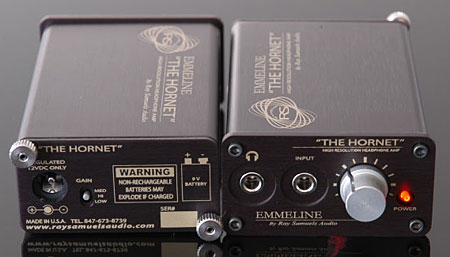
I've been a little remiss in writing about one of the best tools for travel I've experienced recently: Ray Samuels Audio's Emmeline The Hornet ($350), a tiny (3" L by 2" W by 1" H) rechargeable portable headphone amplifier. I tend to travel with my iPod packed with hi-rez music files and a pair of low-impedance headphones. That's not a marriage made in heaven, so I also need a headphone amplifier. Over the years, portable headphone amps have gotten better and better while getting smaller and smaller. The Hornet is the smallest I've discovered so far and is my current favorite.
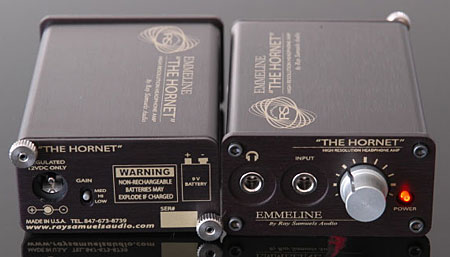 It's got audio cred, having been constructed with tantalum and film capacitors, 0.1% Vishay resistors, and a milspec OFC printed-circuit board (the PCB is smaller than 1" by 2" and boasts 4 oz copper traces!). The Hornet has a 15,000µF filter capacitor, and it buffers the output of its op-amp chip with a buffer about which Samuels won't really speak—except to say that it's many times more powerful than anything else available. The volume control is a custom-made Alps model that Samuels designed to ramp less linearly than conventional models—meaning that you have more control over the first 50% of its range. Combine that pot with the Hornet's rear-mounted, three-position gain switch and you have an extraordinary amount of control over level. The icing on the cake are a rechargeable 9V battery and a universal recharger/power supply—no more disposable batteries!
Did I mention that RSA offers its extruded aluminum case in six tasty shades of anodization? Yup: black, silver, red, gold, blue, and green. (Omigod, I so want a green Hornet!) The Hornet looks so great that every time I pull it out on an airplane and plug into it, someone stops at my seat and asks about it—in fact, on my flight to CES 2006, on an airplane full of people in the electronics biz, I actually drew a crowd large enough to have the flight attendants looking nervous.
Not only is the Hornet built like a brick house, it is mighty, mighty in action. I traveled with the Hornet and pairs of Etymotic ER-4P and Ultimate Ears UE-10 Pro headphones, and I stayed at home with the Hornet and Sennheiser HD650 and AKG 701 phones, and I'm here to tell you that the Hornet will not be the weak link in most systems. When it comes to high-end performance, it seems you can take it with you.
With the Ultimate Ears UE-10 Pros ($950), the Hornet produced synth bass tones from Massive Attack's Mezzanine (CD, Virgin 456032, uncompressed AIFF iTunes file) that had the physical presence of a kick to the head. That doesn't sound pleasant, but the tones were so deep in my body and so seemingly massive that I kept prying the UE-10s' custom molded earpiece out of my ear and glancing around guiltily to see if I was the only person hearing that stuff. Seemed so.
As satisfying as that type of trickery is, the hardest job a component has is making music sound, well, like music, not special effects. Voices sounded great through the Hornet, as was made readily apparent by Cantus' Comfort and Joy: Volume II (CD, Cantus CTS-1205, uncompressed AIFF iTunes file). Not only did the voices sound like voices, but they sounded like the voices I know. That wasn't just a bass, that was my buddy Tim Takach! That wa'n't no garden-variety tenor, that was Brian Arreola! And that wasn't just any room, it was Sauder Hall, the gloriously live auditorium at Indiana's Goshen College.
Or take the Los Angeles Guitar Quartet's Spin (CD, Telarc CD-80647, uncompressed AIFF iTunes file): The intricate interplay of the four guitars was easy to follow as four distinct voices and lines, not one very large four-necked instrument. When I took the Hornet out of the circuit the sound collapsed, losing that definition and separation—it could be one big mushy instrument. That tenor on the Cantus cut might be Brian—in fact, it almost certainly is—but it might just sound mostly like him.
Obviously, the Hornet can't make an iPod (or any other source) sound better than it is, but it certainly let me hear so much more of what it does sound like. I won't travel without mine now.
If you hear it, you'll want one, too.—Wes Phillips
It's got audio cred, having been constructed with tantalum and film capacitors, 0.1% Vishay resistors, and a milspec OFC printed-circuit board (the PCB is smaller than 1" by 2" and boasts 4 oz copper traces!). The Hornet has a 15,000µF filter capacitor, and it buffers the output of its op-amp chip with a buffer about which Samuels won't really speak—except to say that it's many times more powerful than anything else available. The volume control is a custom-made Alps model that Samuels designed to ramp less linearly than conventional models—meaning that you have more control over the first 50% of its range. Combine that pot with the Hornet's rear-mounted, three-position gain switch and you have an extraordinary amount of control over level. The icing on the cake are a rechargeable 9V battery and a universal recharger/power supply—no more disposable batteries!
Did I mention that RSA offers its extruded aluminum case in six tasty shades of anodization? Yup: black, silver, red, gold, blue, and green. (Omigod, I so want a green Hornet!) The Hornet looks so great that every time I pull it out on an airplane and plug into it, someone stops at my seat and asks about it—in fact, on my flight to CES 2006, on an airplane full of people in the electronics biz, I actually drew a crowd large enough to have the flight attendants looking nervous.
Not only is the Hornet built like a brick house, it is mighty, mighty in action. I traveled with the Hornet and pairs of Etymotic ER-4P and Ultimate Ears UE-10 Pro headphones, and I stayed at home with the Hornet and Sennheiser HD650 and AKG 701 phones, and I'm here to tell you that the Hornet will not be the weak link in most systems. When it comes to high-end performance, it seems you can take it with you.
With the Ultimate Ears UE-10 Pros ($950), the Hornet produced synth bass tones from Massive Attack's Mezzanine (CD, Virgin 456032, uncompressed AIFF iTunes file) that had the physical presence of a kick to the head. That doesn't sound pleasant, but the tones were so deep in my body and so seemingly massive that I kept prying the UE-10s' custom molded earpiece out of my ear and glancing around guiltily to see if I was the only person hearing that stuff. Seemed so.
As satisfying as that type of trickery is, the hardest job a component has is making music sound, well, like music, not special effects. Voices sounded great through the Hornet, as was made readily apparent by Cantus' Comfort and Joy: Volume II (CD, Cantus CTS-1205, uncompressed AIFF iTunes file). Not only did the voices sound like voices, but they sounded like the voices I know. That wasn't just a bass, that was my buddy Tim Takach! That wa'n't no garden-variety tenor, that was Brian Arreola! And that wasn't just any room, it was Sauder Hall, the gloriously live auditorium at Indiana's Goshen College.
Or take the Los Angeles Guitar Quartet's Spin (CD, Telarc CD-80647, uncompressed AIFF iTunes file): The intricate interplay of the four guitars was easy to follow as four distinct voices and lines, not one very large four-necked instrument. When I took the Hornet out of the circuit the sound collapsed, losing that definition and separation—it could be one big mushy instrument. That tenor on the Cantus cut might be Brian—in fact, it almost certainly is—but it might just sound mostly like him.
Obviously, the Hornet can't make an iPod (or any other source) sound better than it is, but it certainly let me hear so much more of what it does sound like. I won't travel without mine now.
If you hear it, you'll want one, too.—Wes Phillips
It's got audio cred, having been constructed with tantalum and film capacitors, 0.1% Vishay resistors, and a milspec OFC printed-circuit board (the PCB is smaller than 1" by 2" and boasts 4 oz copper traces!). The Hornet has a 15,000µF filter capacitor, and it buffers the output of its op-amp chip with a buffer about which Samuels won't really speak—except to say that it's many times more powerful than anything else available. The volume control is a custom-made Alps model that Samuels designed to ramp less linearly than conventional models—meaning that you have more control over the first 50% of its range. Combine that pot with the Hornet's rear-mounted, three-position gain switch and you have an extraordinary amount of control over level. The icing on the cake are a rechargeable 9V battery and a universal recharger/power supply—no more disposable batteries!
Did I mention that RSA offers its extruded aluminum case in six tasty shades of anodization? Yup: black, silver, red, gold, blue, and green. (Omigod, I so want a green Hornet!) The Hornet looks so great that every time I pull it out on an airplane and plug into it, someone stops at my seat and asks about it—in fact, on my flight to CES 2006, on an airplane full of people in the electronics biz, I actually drew a crowd large enough to have the flight attendants looking nervous.