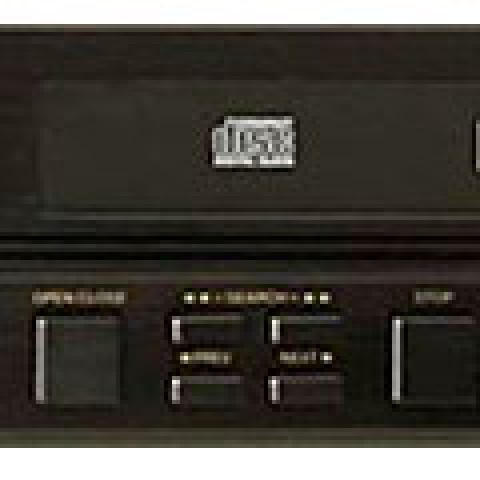
I first heard a CD player in my own system in 1984 or 1985, several years before I began writing for Stereophile. I was curious about the Compact Disc medium—I'd read about it, had listened to CDs in stores, and was eager to hear what they sounded like in my own system. I'd even bought a CD: the original-cast recording of 42nd Street, which I already had on LP. One evening, a friend who worked for Sony and knew that I was an audiophile brought over his latest acquisition: a CDP-501ES, the second from the top of Sony's line of CD players. He also brought along a bunch of CDs, including some solo-piano discs, and Erich Kunzel and the Cincinnati Symphony's then-famous recording of Tchaikovsky's 1812 Overture (Telarc CD-80041).
 We connected the Sony player to my system. My friend was most enthusiastic: "Listen to how quiet the background is! No ticks and pops like you get on records!" We listened to one of the solo-piano CDs. The sound was sharper, crisper than I'd been used to hearing from my Lps (footnote 1). And, yes, the background was very quiet—no ticks or pops. Promising. Then I put on the 1812 Overture. The background was still quiet, but—oh dear, when the massed strings came in, everything fell apart: a jumble of sound and lost definition, as if the entire string section had been replaced by a synthesizer. The brass at first seemed to fare better, but then I noticed an edge, a harshness that was distinctly less plausibly realistic than recordings of brass on LPs. The bass was good, tighter and more extended than on LP. And 42nd Street? The solo voices were well focused, but sounded somehow less natural, more artificial, and the soundstage depth that was present on the LP had been curtailed. Was this what they called "perfect sound forever"?
Trying not to put a damper on my friend's enthusiasm, I made vaguely positive comments about the clarity and the lack of noise, but I wasn't even slightly tempted to ask him if he could get me one of these players at the employee's-discount price. It was at least another year before I found a CD player (the Philips-based Mission DAD7000) I liked enough to buy. By then, it was becoming obvious that CD was the format of the future, and that resistance was futile.
I have a feeling that if the first CD player I heard in my system had been an Onkyo DX-7555, my impression of the format would have been much more positive.
Description and Design
We connected the Sony player to my system. My friend was most enthusiastic: "Listen to how quiet the background is! No ticks and pops like you get on records!" We listened to one of the solo-piano CDs. The sound was sharper, crisper than I'd been used to hearing from my Lps (footnote 1). And, yes, the background was very quiet—no ticks or pops. Promising. Then I put on the 1812 Overture. The background was still quiet, but—oh dear, when the massed strings came in, everything fell apart: a jumble of sound and lost definition, as if the entire string section had been replaced by a synthesizer. The brass at first seemed to fare better, but then I noticed an edge, a harshness that was distinctly less plausibly realistic than recordings of brass on LPs. The bass was good, tighter and more extended than on LP. And 42nd Street? The solo voices were well focused, but sounded somehow less natural, more artificial, and the soundstage depth that was present on the LP had been curtailed. Was this what they called "perfect sound forever"?
Trying not to put a damper on my friend's enthusiasm, I made vaguely positive comments about the clarity and the lack of noise, but I wasn't even slightly tempted to ask him if he could get me one of these players at the employee's-discount price. It was at least another year before I found a CD player (the Philips-based Mission DAD7000) I liked enough to buy. By then, it was becoming obvious that CD was the format of the future, and that resistance was futile.
I have a feeling that if the first CD player I heard in my system had been an Onkyo DX-7555, my impression of the format would have been much more positive.
Description and Design
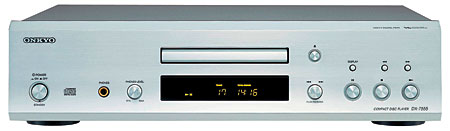
The DX-7555 matches the size and styling of Onkyo's A-9555 integrated amplifier, which I reviewed in the September 2007 Stereophile, and shares with it several design features. Like the A-9555, the DX-7555's front panel is brushed aluminum; it has a fairly heavy, antiresonant chassis, a power transformer of substantial size and weight, and features Onkyo's proprietary Vector Linear Shaping Circuitry (VLSC), which is claimed to remove digital noise from the analog signal by using a comparator/feedback method. The digital-to-analog conversion is handled by a Wolfson Microelectronics WMA8740 24-bit/192kHz DAC. The digital clock is said to be highly precise (±1.5ppm) and to produce very low jitter. The DX-7555's Setup mode permits selection of analog output polarity and digital filter slope: Sharp (flat to 20kHz, with a steep cutoff after that) or Slow (gradual high-frequency rolloff, to better maintain audio-band phase accuracy). An unusual feature of the player is that the frequency of its digital clock can be adjusted by the user to match specific CDs. I assume that this feature is included for the type of audiophile who feels compelled to adjust the cartridge VTA for every LP and writes down the optimal setting on the record jacket. After a bit of fiddling, with inconclusive results, I left the clock frequency alone. The DX-7555 has optical and coaxial digital outputs, the digital signal having a "direct" path to the output through shielded cables, to protect the signal from noise and interference.
The DX-7555 has a full set of convenience features: headphone output with volume control, 25-step memory playback, four repeat modes, four-mode display dimmer, and Remote Interactive (RI) input/output jacks for integration with other Onkyo RI-enabled devices. The remote control has the same sort of logical layout that I praised in the A-9555's remote, with a large, distinctively shaped Play button, but doesn't include controls for polarity and filter slope, which would have made these features more convenient to use.
 Oh, and it looks really nice, with fit and finish that suggest a product from a high-end specialist manufacturer rather than a medium-priced mass-market offering.
Sound
Oh, and it looks really nice, with fit and finish that suggest a product from a high-end specialist manufacturer rather than a medium-priced mass-market offering.
Sound
I've always thought that the principle of "first do no harm" should be applied to designers of audio products as well as to physicians, and the folks at Onkyo seem to have followed this principle in designing the DX-7555. Listened to on its own, without explicit comparison to any other digital source, the DX-7555 impressed me as sounding smooth, and lacking the annoying harshness that I remember from that first-generation Sony player of more than two decades ago. It had an easy-on-the-ears quality that allowed me to listen for long periods with no symptoms of the dreaded "listening fatigue."
We connected the Sony player to my system. My friend was most enthusiastic: "Listen to how quiet the background is! No ticks and pops like you get on records!" We listened to one of the solo-piano CDs. The sound was sharper, crisper than I'd been used to hearing from my Lps (footnote 1). And, yes, the background was very quiet—no ticks or pops. Promising. Then I put on the 1812 Overture. The background was still quiet, but—oh dear, when the massed strings came in, everything fell apart: a jumble of sound and lost definition, as if the entire string section had been replaced by a synthesizer. The brass at first seemed to fare better, but then I noticed an edge, a harshness that was distinctly less plausibly realistic than recordings of brass on LPs. The bass was good, tighter and more extended than on LP. And 42nd Street? The solo voices were well focused, but sounded somehow less natural, more artificial, and the soundstage depth that was present on the LP had been curtailed. Was this what they called "perfect sound forever"?
Trying not to put a damper on my friend's enthusiasm, I made vaguely positive comments about the clarity and the lack of noise, but I wasn't even slightly tempted to ask him if he could get me one of these players at the employee's-discount price. It was at least another year before I found a CD player (the Philips-based Mission DAD7000) I liked enough to buy. By then, it was becoming obvious that CD was the format of the future, and that resistance was futile.
The DX-7555 matches the size and styling of Onkyo's A-9555 integrated amplifier, which I reviewed in the September 2007 Stereophile, and shares with it several design features. Like the A-9555, the DX-7555's front panel is brushed aluminum; it has a fairly heavy, antiresonant chassis, a power transformer of substantial size and weight, and features Onkyo's proprietary Vector Linear Shaping Circuitry (VLSC), which is claimed to remove digital noise from the analog signal by using a comparator/feedback method. The digital-to-analog conversion is handled by a Wolfson Microelectronics WMA8740 24-bit/192kHz DAC. The digital clock is said to be highly precise (±1.5ppm) and to produce very low jitter. The DX-7555's Setup mode permits selection of analog output polarity and digital filter slope: Sharp (flat to 20kHz, with a steep cutoff after that) or Slow (gradual high-frequency rolloff, to better maintain audio-band phase accuracy). An unusual feature of the player is that the frequency of its digital clock can be adjusted by the user to match specific CDs. I assume that this feature is included for the type of audiophile who feels compelled to adjust the cartridge VTA for every LP and writes down the optimal setting on the record jacket. After a bit of fiddling, with inconclusive results, I left the clock frequency alone. The DX-7555 has optical and coaxial digital outputs, the digital signal having a "direct" path to the output through shielded cables, to protect the signal from noise and interference.
Oh, and it looks really nice, with fit and finish that suggest a product from a high-end specialist manufacturer rather than a medium-priced mass-market offering.
Sound
I've always thought that the principle of "first do no harm" should be applied to designers of audio products as well as to physicians, and the folks at Onkyo seem to have followed this principle in designing the DX-7555. Listened to on its own, without explicit comparison to any other digital source, the DX-7555 impressed me as sounding smooth, and lacking the annoying harshness that I remember from that first-generation Sony player of more than two decades ago. It had an easy-on-the-ears quality that allowed me to listen for long periods with no symptoms of the dreaded "listening fatigue."