Last December, when Wadia Digital announced that it was releasing an iPod docking cradle that could access the digital signal before it had passed through the player's own D/A converter, many audiopundits were surprised. I was disbelieving, and nearly told Wadia's John Schaffer that he was shining me on. After all, Apple has tiptoed around the whole issue of consumers being able to digitally copy their iTunes files, going so far as to wrap its iTunes Music Store files in digital rights management (DRM) code.
 Times had changed, Schaffer told me. Apple had initiated a program, Made For iPod (MFI), that would allow third-party vendors to make specialized products for Apple hardware—including porting out digital signals, which Schaffer discovered by a fortuitous circumstance. As a result of that epiphany, Wadia's 170iTransport ($379) would be the first MFI digital breakout box for the iPod (footnote 1).
I asked Schaffer to identify exactly who he expected would buy the 170iTransport. I wanted one, but audiolust is my profession—would a mainstream consumer believe he or she needed a $400 iPod dock?
"Because the iPod is so ubiquitous, we see there being more than one primary customer," Schaffer said. "Before now, diehard audiophiles wouldn't have dreamed of integrating an iPod into their systems—that inexpensive DAC would be a weak link in the chain. But with large-capacity iPods eliminating the need for lossy compression, people can carry music around with them and then access it in bit-perfect playback.
"As for mainstream consumers, it has become obvious that a high number of them, if not the vast majority, use the iPod as their primary source of music—and they will opt for a higher level of performance, as long as they aren't asked to give up any of the convenience they have become accustomed to."
What hours of transport we shall spend
Times had changed, Schaffer told me. Apple had initiated a program, Made For iPod (MFI), that would allow third-party vendors to make specialized products for Apple hardware—including porting out digital signals, which Schaffer discovered by a fortuitous circumstance. As a result of that epiphany, Wadia's 170iTransport ($379) would be the first MFI digital breakout box for the iPod (footnote 1).
I asked Schaffer to identify exactly who he expected would buy the 170iTransport. I wanted one, but audiolust is my profession—would a mainstream consumer believe he or she needed a $400 iPod dock?
"Because the iPod is so ubiquitous, we see there being more than one primary customer," Schaffer said. "Before now, diehard audiophiles wouldn't have dreamed of integrating an iPod into their systems—that inexpensive DAC would be a weak link in the chain. But with large-capacity iPods eliminating the need for lossy compression, people can carry music around with them and then access it in bit-perfect playback.
"As for mainstream consumers, it has become obvious that a high number of them, if not the vast majority, use the iPod as their primary source of music—and they will opt for a higher level of performance, as long as they aren't asked to give up any of the convenience they have become accustomed to."
What hours of transport we shall spend
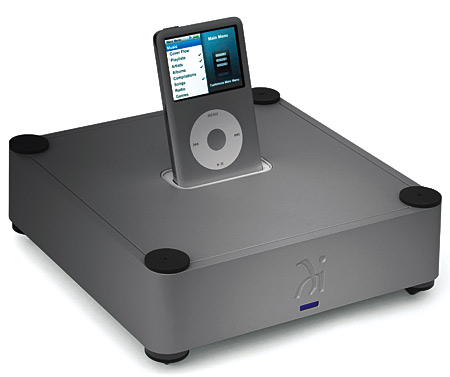
The 170iTransport is made in China. Its cast-aluminum body measures 8" W by 2.7" H by 8" D and sports a slot on top in which you dock an iPod. (The slot can be fitted with the ubiquitous Apple clamshell adaptors for all compatible iPod products.) The rear panel has a connector for the 170's external DC power supply, and outputs for S/PDIF coaxial digital, analog, S-video, and component video. A simple remote is included, as is a digital cable.
Not all iPods include the MFI authentication chip; only the following models will output a digital signal to the 170iTransport: iPod touch, iPod classic, iPod with video, and all three generations of the iPod nano. For this review, I used a Wadia-supplied nano 3G and an iPod Classic 80GB. I listened to Apple Lossless Codec (ALC) files, which I ripped myself from my CDs, and I connected the iTransport to the digital input of a Simaudio Moon Evolution SuperNova CD player, so I could easily compare the ALC files with the original CD through the same DAC.
Music is a means of rapid transportation
Stereophile has never been a fan of MP3, even at high bit rates—we disapprove of throwing away data. So we never reviewed an iPod until: 1) They had adequate capacity for high-resolution copies, and 2) Apple had developed ALC. (WAV, AIF, and FLAC are also good). So when Stereophile writes about iPods and suchlike, we aren't championing lossy MP3s, but what we deem are incredibly convenient transportation devices for storing audio files of "Red Book" quality. But even granting that an ALC file is a bit-perfect copy of the original recording, having to listen to it through an iPod's 37-cent DAC chip did represent a parameter that was out of our control: the file's perfect, the hi-fi is perfect, but that DAC...not so much. And that, my friends, is why John Atkinson, Jon Iverson, and I were agog at the 170iTransport's launch, last January, at the 2008 Consumer Electronics Show: We wanted it to work as advertised, because we wanted what Wadia said it could do.
At first, however, I wasn't sure the 170iTransport worked at all. I hooked it up to my system, connected the power cable, and waited for the small blue window under the front-panel Wadia logo to glow. (It's the IR window for the remote.) Nothing. I examined the 170 for a power switch. Nothing. I looked at the remote for an On button. Nothing. I parked the iPod Nano in the 170iTransport's dock. The Nano's screen lit up, announcing the song title and that it was in Pause mode. Success!
Of a sort. What I wasn't getting was a digital signal. I opened the user manual and discovered the following reference to "extended interface" mode: "Depressing the remote mode button will take the iPod out of 'extended interface' mode, enabling the analog audio outputs of the 170iTransport."
Oh. I had somehow turned off the digital output function—however would I restore it?
"To enter digital audio mode again, the iPod must be removed from the iTransport dock and then reinserted." Ah, a classic reboot.
And problem solved.
Dreams transport us
I concentrated on listening through the 170iTransport's digital output, because that's what makes it unique. I'm sure that Wadia's construction quality might make a difference, but really: If you're going to listen solely through its analog outputs, you could buy an iPod Classic and dinner for two with the $330 you save by buying a bog-standard iPod docking cradle. That digital output is the real deal. Feeding the Wadia's output to my Simaudio Moon Evolution SuperNova CD player's digital input and listening through a Cayin HA-1A headphone amplifier driving AKG K701 headphones with Cardas Fat Pipe cable, I was startled by the deep bass and detail in the Andante of Valentin Silvestrov's Symphony 5, as performed by Andrzej Borejko and the Ural State Philharmonic Orchestra (CD, Megadisc Classics MDC 7836). The cellos had me swooning with their lush tonal color, against which splashed descending harp arpeggios and discordant tone clusters. At the end of the movement, I frantically checked my iPod for the rest of the symphony. It wasn't there—quick, where's my CD? Surprisingly, I was able to find it, and seconds later I was listening to the disc on the SuperNova. Ahhhhhh... Wait a minute—this sounds the same as it did before. But that was from an iPod. This is a CD—they're s'posed to be better.
Yes, yes—as I said earlier, that is the whole point of the 170iTransport. But knowing it intellectually and actually experiencing it were two different things. I began playing tracks on Shuffle until I found one I thought sounded special, then compared that with the same track played from the original CD. Because the assortment on my iPod is already cherry-picked for tracks I really like, this happened all too frequently.
NRBQ's "Just Creep," from Music's Been Good to You (CD, Edisun CD-15), had me in the Shaboo Inn back in the day. This bouncy live recording sounds amazingly alive. The shimmer of Tom Ardolino's cymbals has all that Zildjian zing, and the band sounds awfully chipper to be singing such a dark little ditty. A loose piano solo by Terry Adams is a treat—and the Whole Wheat Horns' Keith Spring takes a tenor sax solo that he now refers to as "enigmatic." I'm sure it seemed like a good idea at the time—but half the fun of the 'Q was that nothing was forbidden.
Oh, there I go again, talking about that music stuff. The Wadia made me do it—between iPod and CD, no differences to report here.
Rob Wasserman's version of "(I Can't Get No) Satisfaction," from his Trios (CD, GRP/Mobile Fidelity Sound Lab UDCD752). Check. Sharp transient attacks, lots of body in the bass, wonderful "jump" factor. Both versions.
I've been trading mix discs with longtime reader Keith Spring (he of the enigmatic solo) for about a year, and he's introduced me to some fabulous music (and cost me a pretty penny in the process, but thanks, Keith). But his turning me on to Heart of the Forest (CD, Hannibal 1378), a recording of the Baka Forest people, may be the most magical find of them all. One of the Baka's things is "water drumming"—literally slapping water or wet bodies in rhythmic patterns. There aren't any recording studios with water drums, so the ethnomusicologists who recorded the Baka set up their mikes by the stream at the daily bathtime: you hear the distinctive sounds of the forest, the running water, the delight the people take in water drumming. The 170iTransport let me hear every detail as readily as did playing this disc on the SuperNova.
And so it went. If there was a difference between the original CD and the digital output of the 170iTransport, I never heard it—and the one time I thought I had, I went into iTunes and discovered that it was an older file that I'd recorded as a 320kbps MP3. Bad Wes!
I wish to share the transport
Is the Wadia 170iTransport worth $379? Only you can decide that one. It's well built—well-nigh indestructible, in fact. It does the job it was designed to do: namely, it lets you access the digital information from your iPod with seemingly perfect transparency (footnote 2). Even so, around my house, I can listen to the same digital files that are on my iPods through my music server, so I'm not certain I have an application for the iTransport. That's not to say that I don't see uses for it that would tempt me. If it meant that, when JA comes around to measure a speaker's in-room response, he could play me his latest recording project, then it would become mighty tempting—ditto for Stephen Mejias to be able to turn me on to his latest classic-salsa discovery. Hmmm. I seem to be talking myself into buying this thing. Would I pay $379 for a high-end audio accessory that made it possible for my friends, both audiophile and non-, to share their music with me? And paid no performance penalty in the process?
Would I ever. Down with solitary listening sessions—y'all come, and bring your iPods.
Footnote 1: Meridian's iRIS iPod dock, announced at the 2007 CEDIA Conference, has digital audio outputs as well as an upscaling video output. It is not clear from the product information, however, whether the digital outputs are taken from before the iPod's DAC.—John Atkinson Footnote 2: I recorded the bits coming from the Wadia's coaxial S/PDIF output to my lab PC via the digital input of an RME soundcard, with Wes's iPod Nano playing a losslessly compressed file. I then compared that recording with a WAV rip from the original CD. The files were bit-for-bit identical, meaning that the 170iTransport is indeed transparent via its digital output. However, the datastream appears to have fairly high jitter, which will make the Wadia's sound quality dependent on the D/A processor used.—John Atkinson
Times had changed, Schaffer told me. Apple had initiated a program, Made For iPod (MFI), that would allow third-party vendors to make specialized products for Apple hardware—including porting out digital signals, which Schaffer discovered by a fortuitous circumstance. As a result of that epiphany, Wadia's 170iTransport ($379) would be the first MFI digital breakout box for the iPod (footnote 1).
I asked Schaffer to identify exactly who he expected would buy the 170iTransport. I wanted one, but audiolust is my profession—would a mainstream consumer believe he or she needed a $400 iPod dock?
The 170iTransport is made in China. Its cast-aluminum body measures 8" W by 2.7" H by 8" D and sports a slot on top in which you dock an iPod. (The slot can be fitted with the ubiquitous Apple clamshell adaptors for all compatible iPod products.) The rear panel has a connector for the 170's external DC power supply, and outputs for S/PDIF coaxial digital, analog, S-video, and component video. A simple remote is included, as is a digital cable.
Stereophile has never been a fan of MP3, even at high bit rates—we disapprove of throwing away data. So we never reviewed an iPod until: 1) They had adequate capacity for high-resolution copies, and 2) Apple had developed ALC. (WAV, AIF, and FLAC are also good). So when Stereophile writes about iPods and suchlike, we aren't championing lossy MP3s, but what we deem are incredibly convenient transportation devices for storing audio files of "Red Book" quality. But even granting that an ALC file is a bit-perfect copy of the original recording, having to listen to it through an iPod's 37-cent DAC chip did represent a parameter that was out of our control: the file's perfect, the hi-fi is perfect, but that DAC...not so much. And that, my friends, is why John Atkinson, Jon Iverson, and I were agog at the 170iTransport's launch, last January, at the 2008 Consumer Electronics Show: We wanted it to work as advertised, because we wanted what Wadia said it could do.
I concentrated on listening through the 170iTransport's digital output, because that's what makes it unique. I'm sure that Wadia's construction quality might make a difference, but really: If you're going to listen solely through its analog outputs, you could buy an iPod Classic and dinner for two with the $330 you save by buying a bog-standard iPod docking cradle. That digital output is the real deal. Feeding the Wadia's output to my Simaudio Moon Evolution SuperNova CD player's digital input and listening through a Cayin HA-1A headphone amplifier driving AKG K701 headphones with Cardas Fat Pipe cable, I was startled by the deep bass and detail in the Andante of Valentin Silvestrov's Symphony 5, as performed by Andrzej Borejko and the Ural State Philharmonic Orchestra (CD, Megadisc Classics MDC 7836). The cellos had me swooning with their lush tonal color, against which splashed descending harp arpeggios and discordant tone clusters. At the end of the movement, I frantically checked my iPod for the rest of the symphony. It wasn't there—quick, where's my CD? Surprisingly, I was able to find it, and seconds later I was listening to the disc on the SuperNova. Ahhhhhh... Wait a minute—this sounds the same as it did before. But that was from an iPod. This is a CD—they're s'posed to be better.
Is the Wadia 170iTransport worth $379? Only you can decide that one. It's well built—well-nigh indestructible, in fact. It does the job it was designed to do: namely, it lets you access the digital information from your iPod with seemingly perfect transparency (footnote 2). Even so, around my house, I can listen to the same digital files that are on my iPods through my music server, so I'm not certain I have an application for the iTransport. That's not to say that I don't see uses for it that would tempt me. If it meant that, when JA comes around to measure a speaker's in-room response, he could play me his latest recording project, then it would become mighty tempting—ditto for Stephen Mejias to be able to turn me on to his latest classic-salsa discovery. Hmmm. I seem to be talking myself into buying this thing. Would I pay $379 for a high-end audio accessory that made it possible for my friends, both audiophile and non-, to share their music with me? And paid no performance penalty in the process?
Footnote 1: Meridian's iRIS iPod dock, announced at the 2007 CEDIA Conference, has digital audio outputs as well as an upscaling video output. It is not clear from the product information, however, whether the digital outputs are taken from before the iPod's DAC.—John Atkinson Footnote 2: I recorded the bits coming from the Wadia's coaxial S/PDIF output to my lab PC via the digital input of an RME soundcard, with Wes's iPod Nano playing a losslessly compressed file. I then compared that recording with a WAV rip from the original CD. The files were bit-for-bit identical, meaning that the 170iTransport is indeed transparent via its digital output. However, the datastream appears to have fairly high jitter, which will make the Wadia's sound quality dependent on the D/A processor used.—John Atkinson