The best result of mathematics is to not need it.—Oliver Heaviside, 1850–1925
The world is full of bad dentists and singers and cops. Bad teachers abound, as do bad nurses, bad farmhands, bad sociologists, and very bad investment bankers. The news, often presented by bad reporters, is full of bad clergy, bad soldiers, bad babysitters, bad shift supervisors of air-traffic controllers, and more bad legislators and lobbyists than you can count. Long ago, in the space of one summer, I was a bad busboy and a bad forklift driver.
And it isn't enough to say the world is full of bad marketing strategists: There aren't any good ones.
Closer to home, we have suffered our share of bad audio designers, with their legacy of bad turntables, bad tonearms, bad cartridges, and laughably bad phono accessories. They've also excreted a whole galaxy of detestable preamps, not to mention loathsome tube amps, contemptible solid-state amps, and loudspeakers so repugnant I've considered having my ears cauterized. Bad cables abound, as do bad cable risers. And don't get me started on CD players.
But, as I believe I've mentioned before, I've never known a bad moving-coil step-up transformer. I've heard some that sounded better or worse than others, depending on the system in which they were used. And I've reviewed some that appeared to offer greater or lesser value than others. But every one of those products was at least satisfactory. Step-up transformers are almost simple enough that, by the time you've made one that works at all, you've made one that works well.
Transformers are, indeed, the ideal choice for matching current-happy generators with voltage-hungry circuits—not because some engineer who had a big chassis to fill designed it to be that way, but because that's what transformers naturally do. There may be no better way to load a coil or drive a coil than with a coil.
Bob's Devices
A North Carolina firm called Bob's Devices has joined my list of favorite phono step-up suppliers. That's because proprietor Bob Sattin understands the transformer's rightness for the job, as well as the need for careful matching between step-up and pickup, based on the latter's output voltage, internal resistance/impedance, compliance, and overall sonic character. Bob selects new and vintage transformers from a number of sources—CineMag, Sowter, Altec—and offers them in various configurations, with the assurance that one will likely tower over the others when it comes to making believable music with your phono gear.
 Sattin also realizes the potential for the tiniest details of construction—a wire path here, the mass of a switch contact there—to make their presence known within the serene electrical space that separates his products' very few parts. He builds his phono step-ups carefully, putting into each the lessons learned making every one before it. As Sattin says on his website, "With very low voltages, minor changes make a big difference. I don't mean for this to sound like voodoo, but there is an art and a science to making each [of our products] sound [its] best."
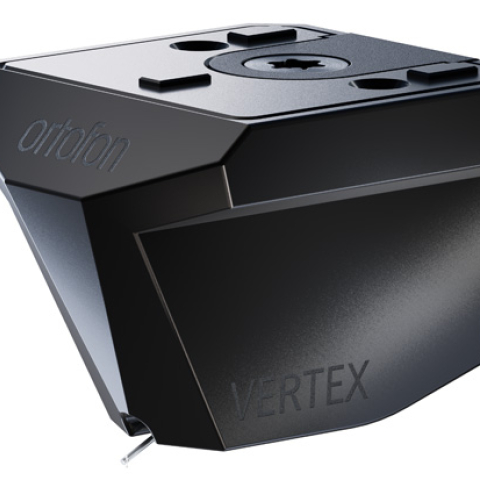
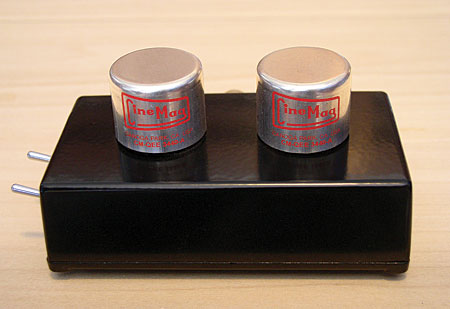
On a fair day last summer, 35 years after the last collision between my forklift and a stack of fencing material, I received my first review sample from Bob's Devices: a phono step-up built around a pair of CineMag 3440 transformers, switchable between low-gain (16x) and high-gain (30x) settings. Bob Sattin suggested the latter for use with my Ortofon SPU 90th Anniversary pickup head, with its very low (2 ohms) coil impedance.
As with all of Bob's phono step-ups that I've seen so far, my CineMag device was built into a rugged little cast-alloy box, with a toggle switch for gain selection and another that allowed me to either float the signal ground or connect it to the chassis and ground lug. Build quality was excellent: All electrical joints are made using an American Beauty resistive soldering station (crucial, Sattin says, to protecting and preserving the fragile coils inside the twin transformer covers), while the exterior is nicely finished in black enamel. And those CineMag cans look wonderful, emblazoned as they are with a logo that I assumed is a modern attempt at retro chic—until I learned that the company's roots, and those of owner Tom Reichenbach, go all the way back to the 1940s, when Tom's father designed and built transformers for Altec's groundbreaking cinema gear.
Some background: In recent months I've remained thrilled by the Hommage T1 step-up transformer, which I wrote about in Stereophile's October 2007 issue. (Although I have yet to purchase one for myself, Jonathan Halpern of Tone Imports has allowed the review sample to stay for a while on a long-term loan.) But throughout that time, the sound of my Shindo Masseto preamplifier's own built-in phono step-up—a custom-wound Lundahl transformer that was itself designed around an Ortofon SPU—has appealed to me more and more. Do these things take that long to burn in?
Sattin also realizes the potential for the tiniest details of construction—a wire path here, the mass of a switch contact there—to make their presence known within the serene electrical space that separates his products' very few parts. He builds his phono step-ups carefully, putting into each the lessons learned making every one before it. As Sattin says on his website, "With very low voltages, minor changes make a big difference. I don't mean for this to sound like voodoo, but there is an art and a science to making each [of our products] sound [its] best."
On a fair day last summer, 35 years after the last collision between my forklift and a stack of fencing material, I received my first review sample from Bob's Devices: a phono step-up built around a pair of CineMag 3440 transformers, switchable between low-gain (16x) and high-gain (30x) settings. Bob Sattin suggested the latter for use with my Ortofon SPU 90th Anniversary pickup head, with its very low (2 ohms) coil impedance.
As with all of Bob's phono step-ups that I've seen so far, my CineMag device was built into a rugged little cast-alloy box, with a toggle switch for gain selection and another that allowed me to either float the signal ground or connect it to the chassis and ground lug. Build quality was excellent: All electrical joints are made using an American Beauty resistive soldering station (crucial, Sattin says, to protecting and preserving the fragile coils inside the twin transformer covers), while the exterior is nicely finished in black enamel. And those CineMag cans look wonderful, emblazoned as they are with a logo that I assumed is a modern attempt at retro chic—until I learned that the company's roots, and those of owner Tom Reichenbach, go all the way back to the 1940s, when Tom's father designed and built transformers for Altec's groundbreaking cinema gear.
Some background: In recent months I've remained thrilled by the Hommage T1 step-up transformer, which I wrote about in Stereophile's October 2007 issue. (Although I have yet to purchase one for myself, Jonathan Halpern of Tone Imports has allowed the review sample to stay for a while on a long-term loan.) But throughout that time, the sound of my Shindo Masseto preamplifier's own built-in phono step-up—a custom-wound Lundahl transformer that was itself designed around an Ortofon SPU—has appealed to me more and more. Do these things take that long to burn in?
A North Carolina firm called Bob's Devices has joined my list of favorite phono step-up suppliers. That's because proprietor Bob Sattin understands the transformer's rightness for the job, as well as the need for careful matching between step-up and pickup, based on the latter's output voltage, internal resistance/impedance, compliance, and overall sonic character. Bob selects new and vintage transformers from a number of sources—CineMag, Sowter, Altec—and offers them in various configurations, with the assurance that one will likely tower over the others when it comes to making believable music with your phono gear.
Sattin also realizes the potential for the tiniest details of construction—a wire path here, the mass of a switch contact there—to make their presence known within the serene electrical space that separates his products' very few parts. He builds his phono step-ups carefully, putting into each the lessons learned making every one before it. As Sattin says on his website, "With very low voltages, minor changes make a big difference. I don't mean for this to sound like voodoo, but there is an art and a science to making each [of our products] sound [its] best."
On a fair day last summer, 35 years after the last collision between my forklift and a stack of fencing material, I received my first review sample from Bob's Devices: a phono step-up built around a pair of CineMag 3440 transformers, switchable between low-gain (16x) and high-gain (30x) settings. Bob Sattin suggested the latter for use with my Ortofon SPU 90th Anniversary pickup head, with its very low (2 ohms) coil impedance.
As with all of Bob's phono step-ups that I've seen so far, my CineMag device was built into a rugged little cast-alloy box, with a toggle switch for gain selection and another that allowed me to either float the signal ground or connect it to the chassis and ground lug. Build quality was excellent: All electrical joints are made using an American Beauty resistive soldering station (crucial, Sattin says, to protecting and preserving the fragile coils inside the twin transformer covers), while the exterior is nicely finished in black enamel. And those CineMag cans look wonderful, emblazoned as they are with a logo that I assumed is a modern attempt at retro chic—until I learned that the company's roots, and those of owner Tom Reichenbach, go all the way back to the 1940s, when Tom's father designed and built transformers for Altec's groundbreaking cinema gear.