I'm old enough to remember my family's first table radio that was made out of plastic. It was cream-colored, and it sat on the rearmost edge of our kitchen table: a less-than-timeless design in its own right, destined to be discarded at the end of one era and treasured again at the dawn of another, for more or less the same reason. But in 1958, a cream-colored plastic radio looked fresh, clean, and right, and its cheap wooden predecessor seemed dowdy and sad by comparison. That would all change in later years, of course. Then it would all change again.
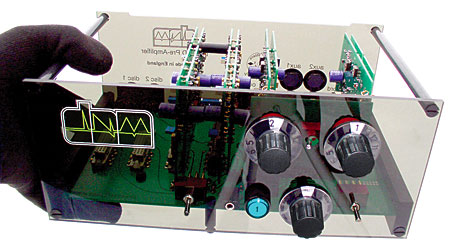
 The plastic timeline affected the way I look at things, I suppose. When I first saw DNM Design's solid-state Series 3 preamplifier back in 1986, with its odd shape, its funky skirted knobs, and its casework built entirely from translucent acrylic, I was won over on the spot: I wanted one, almost regardless of how it sounded. (Don't be shocked: I'm sure there are thousands of men out there whose enthusiasm for the Infinity IRS loudspeaker was driven solely by the fact that they recognized it as the thing they had sketched on the backs of their notebooks all through junior high.) Luckily, I didn't have to grade on the curve: Judging by the sound of the system it graced, that first DNM Series 3 was a brilliant performer (footnote 1).
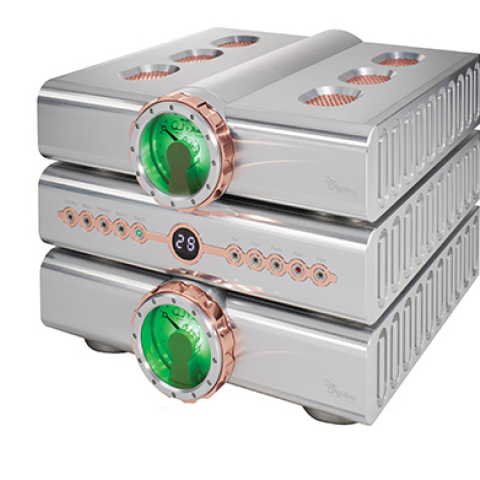
In 1986, the plastic-bodied DNM stood well apart from the crowd—unsurprisingly, you might think, given that the electronics of the day were so predominantly big and heavy and conventional and aluminum. (Plus ça change, eh, Stimpy?) But Denis N. Morecroft moves to his own beat, and every one of his preamp's uniquenesses was there for a well-thought-out reason. So it goes today, with the latest step in the evolution of Morecroft's core design: the DNM 3D preamplifier, available in three different versions, which vary with their quality of power supply: Primus ($7995), Twin ($10,595), and Six ($13,995).
I recently borrowed a sample of the 3D Primus—my second DNM preamp in about four years—from the company's US distributor, Concert Sound, who also supplied a current sample of the DNM PA3ΔS amplifier ($7195). The combination drove my ca-1959 Quad ESL loudspeakers beautifully well, producing some of the purest and altogether most listenable playback I've enjoyed at home. The DNMs were kind to dense old records, such as the famous 1932 recording made by Yehudi Menuhin and Edward Elgar of the latter's Violin Concerto (CD, EMI 66994 2). With the DNM preamp and amp at its heart, my system brought a better sense of ease to the Elgar: It's impossible to respond to the tension in the music when the playback gear creates an artificial tension of its own—and the DNM electronics seemed unusually free of such artifice, leaving the music's natural drama unscathed.
The DNM combination also brought a new level of smooth, rounded clarity to the elderly Elgar: The lines carried by the cellos and string basses were consistently fathomable, even when the conductor's preferred location for the beat was not (as in the C.A.E. variation from the same disc's Enigma Variations). The sonic presentation was never the least bit bright or mechanical.
I dare say, howsoever unscientifically, that the new preamp deserves more than half the credit. Even when the DNM amp was replaced with my rebuilt Quad IIs—delightful old monoblocks that have a higher-than-average fuzz potential, notwithstanding their acknowledged musical strengths—the DNM 3D preamp brought its calm, nonfussy explicitness to many of my favorite recordings. For example, I'd never before noticed Billy Preston's very subtle electric piano touches on the un-Spectorized "The Long and Winding Road," from the Beatles' Anthology 3 (Apple CDP 834451 2)—including the arpeggios that Paul McCartney himself (I'm still reasonably sure it wasn't John) would ape in later recorded versions.
Thinking back to my previous in-home experience with a DNM preamplifier—the 3C Primus, which I wrote about in this column in May 2004 (Vol.27 No.5)—I remember the same general qualities: Listenability. Smoothness. Detail without fuss. Openness without brightness. The new 3D had all of those things, but to an even greater degree (or at least I think it did: recollection is a poor substitute for comparison, especially when the listener's youth is itself just a memory). Yet the 3D, for all intents and purposes, appeared identical to its predecessor. Physically, I mean.
So I called Denis Morecroft and asked him to account for the differences. He explained that his preamplifier's distinctive plastic casework is virtually the only thing that hasn't changed. "Just about everything else is different," he said, "beginning with its power supply..."
Batteries & Supplies
The plastic timeline affected the way I look at things, I suppose. When I first saw DNM Design's solid-state Series 3 preamplifier back in 1986, with its odd shape, its funky skirted knobs, and its casework built entirely from translucent acrylic, I was won over on the spot: I wanted one, almost regardless of how it sounded. (Don't be shocked: I'm sure there are thousands of men out there whose enthusiasm for the Infinity IRS loudspeaker was driven solely by the fact that they recognized it as the thing they had sketched on the backs of their notebooks all through junior high.) Luckily, I didn't have to grade on the curve: Judging by the sound of the system it graced, that first DNM Series 3 was a brilliant performer (footnote 1).
In 1986, the plastic-bodied DNM stood well apart from the crowd—unsurprisingly, you might think, given that the electronics of the day were so predominantly big and heavy and conventional and aluminum. (Plus ça change, eh, Stimpy?) But Denis N. Morecroft moves to his own beat, and every one of his preamp's uniquenesses was there for a well-thought-out reason. So it goes today, with the latest step in the evolution of Morecroft's core design: the DNM 3D preamplifier, available in three different versions, which vary with their quality of power supply: Primus ($7995), Twin ($10,595), and Six ($13,995).
I recently borrowed a sample of the 3D Primus—my second DNM preamp in about four years—from the company's US distributor, Concert Sound, who also supplied a current sample of the DNM PA3ΔS amplifier ($7195). The combination drove my ca-1959 Quad ESL loudspeakers beautifully well, producing some of the purest and altogether most listenable playback I've enjoyed at home. The DNMs were kind to dense old records, such as the famous 1932 recording made by Yehudi Menuhin and Edward Elgar of the latter's Violin Concerto (CD, EMI 66994 2). With the DNM preamp and amp at its heart, my system brought a better sense of ease to the Elgar: It's impossible to respond to the tension in the music when the playback gear creates an artificial tension of its own—and the DNM electronics seemed unusually free of such artifice, leaving the music's natural drama unscathed.
The DNM combination also brought a new level of smooth, rounded clarity to the elderly Elgar: The lines carried by the cellos and string basses were consistently fathomable, even when the conductor's preferred location for the beat was not (as in the C.A.E. variation from the same disc's Enigma Variations). The sonic presentation was never the least bit bright or mechanical.
I dare say, howsoever unscientifically, that the new preamp deserves more than half the credit. Even when the DNM amp was replaced with my rebuilt Quad IIs—delightful old monoblocks that have a higher-than-average fuzz potential, notwithstanding their acknowledged musical strengths—the DNM 3D preamp brought its calm, nonfussy explicitness to many of my favorite recordings. For example, I'd never before noticed Billy Preston's very subtle electric piano touches on the un-Spectorized "The Long and Winding Road," from the Beatles' Anthology 3 (Apple CDP 834451 2)—including the arpeggios that Paul McCartney himself (I'm still reasonably sure it wasn't John) would ape in later recorded versions.
Thinking back to my previous in-home experience with a DNM preamplifier—the 3C Primus, which I wrote about in this column in May 2004 (Vol.27 No.5)—I remember the same general qualities: Listenability. Smoothness. Detail without fuss. Openness without brightness. The new 3D had all of those things, but to an even greater degree (or at least I think it did: recollection is a poor substitute for comparison, especially when the listener's youth is itself just a memory). Yet the 3D, for all intents and purposes, appeared identical to its predecessor. Physically, I mean.
So I called Denis Morecroft and asked him to account for the differences. He explained that his preamplifier's distinctive plastic casework is virtually the only thing that hasn't changed. "Just about everything else is different," he said, "beginning with its power supply..."
Batteries & Supplies
Early in its history—in 1981, to be precise—DNM Design became one of the first companies to sell a high-quality domestic preamplifier that was powered by batteries. "We thought we were the first company in England to make a battery-supply preamp," Morecroft says. "Come to find out, Farad Azima of Mission beat us to it by about one month."
For a variety of reasons, Morecroft stopped offering battery supplies in 1984 or so. "We can't find the enthusiasm or the will to revert to battery supplies," he says, "but because I continue to service those units, I still have a chance to go back and listen to them from time to time. And in spite of the advancements we've made, when I go back and listen to the battery-supply units, there always seems to be a little something extra there." That, among other things, drove Morecroft to try to make his newest power supplies better than their predecessors.
"The work I've done led me to go back and view the power supply as what it is," he says, "which is an amp: a DC amp with AC characteristics. And I did find that by treating it as an amp—introducing output resistance, for one thing, which goes in the face of what some people believe—the performance could be changed for the better."
The operating voltages of Morecroft's preamplifiers have also changed: "When we first went to Series 3 some years ago, we went from ±12V to ±30V: Preamps never have to swing more than ±1V, or even ±0.75V—but if you're not swinging too much compared to the rail, you'll be more linear." The new 3D and its power supply represent something of a course correction, at ±25V.
Moving on to the preamp unit itself, Morecroft began by calling my attention to the power-supply distribution board: an 8" by 5" circuit board on the underside of the slightly larger motherboard, held in place using only nylon nuts and bolts. As Morecroft sees it, the use of metal fasteners would raise the potential for interference with the delicate audio signal: "I know that sounds extreme, and some people think I'm crackers. But how can you expect to carry an analog signal through anything without degradation due to the back-EMF effect?
"In early physics they taught us that, yes, back-EMF exists, although they taught it only with regard to transformers and the like. But a magnetic field is formed along a wire as current passes through it, and that field has the potential to oppose the current—to cause a new current to flow, which opposes the original." Consequently, all DNM products strive to eliminate unnecessary metals, to avoid the interactions that can degrade the original signal in that manner.
The design of both the double-sided power-supply distribution board and the motherboard itself point to another facet of Morecroft's thinking on magnetic fields: the need for precisely consistent spacing between audio-signal conductors, in cables and circuit boards alike. Again, the idea is to eliminate variables that interfere with naturally occurring magnetic fields. DNM's execution of this concept is a treat to look at, too: It's impossible to gaze inside a Series 3 preamp and not be impressed by the obvious difficulty of designing such a thing.
The 3D's motherboard, which contains no active parts, is home to various sub-boards, some of which vary depending on the customer's choice of features and power supply. Common to all is the volume-control board, which contains the preamp's custom-made potentiometers—plastic body, single wiper, and an interior layout with precise conductor spacing all the way through—and six pairs of trimmer pots, used to match the levels of the various sources without any of them having to suffer a penalty in terms of compression.
Footnote 1: DNM Design, 18 Hartford Road, Huntingdon, Cambridgeshire PE29 3QD, England, UK. Tel: (+44) (0)1480-457989. Fax: (+44) (0)1480-457989. Web: www.dnm.co.uk. US distributor: Concert Sound, 830 W. Third, Suite 1138, Austin, TX 78701. Tel: (512) 236-9100. Web: www.concertsoundusa.com.
The plastic timeline affected the way I look at things, I suppose. When I first saw DNM Design's solid-state Series 3 preamplifier back in 1986, with its odd shape, its funky skirted knobs, and its casework built entirely from translucent acrylic, I was won over on the spot: I wanted one, almost regardless of how it sounded. (Don't be shocked: I'm sure there are thousands of men out there whose enthusiasm for the Infinity IRS loudspeaker was driven solely by the fact that they recognized it as the thing they had sketched on the backs of their notebooks all through junior high.) Luckily, I didn't have to grade on the curve: Judging by the sound of the system it graced, that first DNM Series 3 was a brilliant performer (footnote 1).
In 1986, the plastic-bodied DNM stood well apart from the crowd—unsurprisingly, you might think, given that the electronics of the day were so predominantly big and heavy and conventional and aluminum. (Plus ça change, eh, Stimpy?) But Denis N. Morecroft moves to his own beat, and every one of his preamp's uniquenesses was there for a well-thought-out reason. So it goes today, with the latest step in the evolution of Morecroft's core design: the DNM 3D preamplifier, available in three different versions, which vary with their quality of power supply: Primus ($7995), Twin ($10,595), and Six ($13,995).
Early in its history—in 1981, to be precise—DNM Design became one of the first companies to sell a high-quality domestic preamplifier that was powered by batteries. "We thought we were the first company in England to make a battery-supply preamp," Morecroft says. "Come to find out, Farad Azima of Mission beat us to it by about one month."
Footnote 1: DNM Design, 18 Hartford Road, Huntingdon, Cambridgeshire PE29 3QD, England, UK. Tel: (+44) (0)1480-457989. Fax: (+44) (0)1480-457989. Web: www.dnm.co.uk. US distributor: Concert Sound, 830 W. Third, Suite 1138, Austin, TX 78701. Tel: (512) 236-9100. Web: www.concertsoundusa.com.