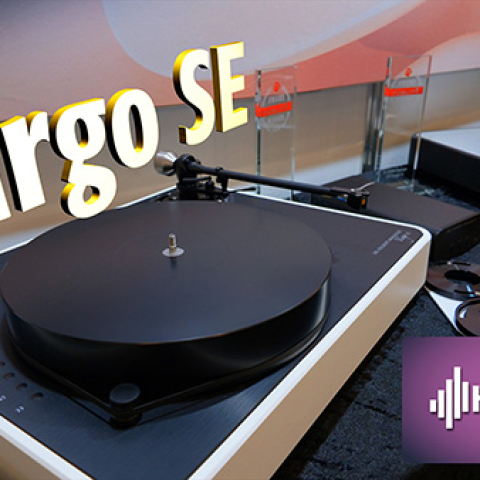
As audio enters its second digital decade, it gives me great pleasure to proclaim a great audio truth: to groove is divine, to error-correct ain't so benign.
To my mind, analog is audio. I'm tired of the digital-processor-of-the-month parade, in which each new contender pretends to massage the same old bits more therapeutically into a gentler and kinder organic whole. What we really need is more bits. Will we ever see a super CD format based on, say, a 96kHz sampling rate? My gut feeling is probably that we will. Sadly, it would come to pass as a marketing ploy to rejuvenate sales once CD players saturate the market, in the same way that Super VHS was thrust at the public. In the meantime, it is my opinion that the illusion of live music is most convincingly created where the stylus hits the groove.
Not only is the turntable the foundation—the basis—of any phono system, but the phono system is the basis of any audio system. Even the Simpsons could tell you that the veracity of any audio system is limited by the integrity of the input signal; you know, garbage in, garbage out. The turntable lays the foundation for what follows. Without proper engineering at the source, the battle is lost: errors at the fountainhead are not correctable downstream.
Technology
The Ovation represents the result of two years of effort on the part of high-end turntable designer and manufacturer A.J. Conti directed at applying the design principles of his Basis Debut Gold Standard turntable (footnote 1) to a more affordable product. Both turntables are the culmination of a "systems approach" to design in which all aspects of performance were broken down and analyzed separately. After each subsystem was optimized, they were brought together to form the final product. I'll focus on three crucial design elements: the drive system, the platter, and the suspension. The concept that turntables affect sound or have a sound of their own was popularized in the 1970s. Superficially, the 'table appears to be nothing more than a convenient platform for spinning the record—why should it have a sound of its own? After all, isn't the cartridge the only transducer in the phono system's front end? Ahh! The key to the puzzle is to realize that the stylus is blind. It cannot discriminate between the mechanical vibration of the groove, motor rumble, and other external vibrational energy. It faithfully outputs an electrical signal that is the analog of the sum of the vibrational energy that displaces it. The perfect 'table would therefore completely isolate the stylus/groove interface from the drive system and external environmental effects.
The Basis's platter is belt-driven; a true and tested method of isolating the platter from the motor's vibrational energy. To further isolate the platter, the Swiss-made AC synchronous motor is housed separately and stands on its own four feet next to the main subchassis. Removing the motor from the subchassis entirely eliminates the subchassis/armboard/tonearm pathway of transferring rumble energy to the stylus. However, Basis doesn't provide a fancy, variable-speed power supply à la the Linn Lingo; speeds are changed by the rather inconvenient route of changing the belt pulley. I've heard the Linn LP-12 with and without the Lingo (See JA's review of the Lingo in Vol.14 No.1), and the improvement wrought by the latter is obvious and worthwhile.
The Lingo works for a good reason. Minute speed fluctuations (flutter) during each rotational cycle of the record induce frequency modulation and lead to waveform distortion of music transients. The major causes of flutter are the motor and non-linear frictional effects in the bearing. That the Lingo works by addressing the motor issue implies that the LP-12's bearing is also of a very high quality. Otherwise, the bearing-induced flutter would mask the Lingo's effects.
Another important means of isolating the drive system from the stylus is to increase the platter's mass. This increases the platter's moment of inertia, making it a better flywheel. This technique was known as far back as the '50s: The September 1957 issue of Audiocraft (which featured J. Gordon Holt as a Contributing Editor) included an article by Frank Bertolotti on "Weighting an Inexpensive Turntable"—a DIY project which told how to mass-load a cheap platter by adding a ring of cement (yes, cement) at its periphery (footnote 2).
Despite Sam Tellig's infatuation with the Acoustic Research turntable as a sound budget-minded device, I don't find it to be sonically competitive with 'tables featuring more massive and inert platters. The AR's aluminum platter, for example, rings like a doorbell (footnote 3).
The Ovation's platter is, I'm happy to report, quite heavy, due in great part to the incorporation of a series of lead weights. Though not as massive as the Debut's 28-lb hunk of platter, at 15 lbs it's certainly no lightweight. In addition to its mass, the platter is also well damped so as to suppress internal resonances. The acoustic impedance of the platter is similar to that of vinyl, the intent being to couple the record as intimately as possible to the platter and thus dissipate resonant energy transmitted to the vinyl by the action of the stylus. If the record/platter interface produces an acoustic impedance mismatch, then acoustic energy would be reflected back to the record rather than transmitted to the platter.
Footnote 1: Reviewed for Stereophile by Arnis Balgalvis in Vol.13 No.12. Footnote 2: Mr. Bertolotti confessed in print that a lead rim would have been preferable, but that he chose a more "convenient" (the accompanying pictures prove that Frank knows cement) course of action.
Footnote 3: But only when you lift it off the sub-platter. When in position, it is better damped.—John Atkinson
The Ovation represents the result of two years of effort on the part of high-end turntable designer and manufacturer A.J. Conti directed at applying the design principles of his Basis Debut Gold Standard turntable (footnote 1) to a more affordable product. Both turntables are the culmination of a "systems approach" to design in which all aspects of performance were broken down and analyzed separately. After each subsystem was optimized, they were brought together to form the final product. I'll focus on three crucial design elements: the drive system, the platter, and the suspension. The concept that turntables affect sound or have a sound of their own was popularized in the 1970s. Superficially, the 'table appears to be nothing more than a convenient platform for spinning the record—why should it have a sound of its own? After all, isn't the cartridge the only transducer in the phono system's front end? Ahh! The key to the puzzle is to realize that the stylus is blind. It cannot discriminate between the mechanical vibration of the groove, motor rumble, and other external vibrational energy. It faithfully outputs an electrical signal that is the analog of the sum of the vibrational energy that displaces it. The perfect 'table would therefore completely isolate the stylus/groove interface from the drive system and external environmental effects.
Footnote 1: Reviewed for Stereophile by Arnis Balgalvis in Vol.13 No.12. Footnote 2: Mr. Bertolotti confessed in print that a lead rim would have been preferable, but that he chose a more "convenient" (the accompanying pictures prove that Frank knows cement) course of action.