Oh, I talk a good game when it comes to the whole music-lover-vs-audiophile thing. But I admit that when it comes to record players, I'm just another hardware junkie. I love turntables and tonearms for more than the musical enjoyment they give me. Turntables and tonearms are my favorite toys. 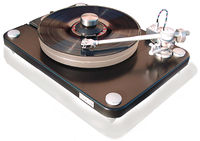 I'm endlessly fascinated with the science behind them—at least partly because, as with theology and frankfurters, the real essence of the thing I'm trying to know is in fact unknowable. Given the subjectivity we bring to music appreciation and the fact that we can't see what's really going on in the groove during record play, theories and guesswork are all we have to go on in the world of phonography, notwithstanding some tedious and unintentionally funny claims to the contrary. Like it or not, wherever two or more people gather to write or read reviews of record players, faith is always close at hand. So here goes: How It's Done
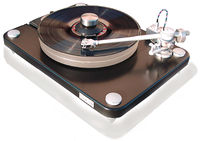
Designer Harry Weisfeld has whapped the ball so far out of the park with this one, it isn't funny. There's a glorious sense of completeness—of wholeness and rightness—in the way the Aries Scout/JMW-9 combination of turntable and tonearm plays music, echoed and underscored by those same qualities in the player's appearance and ease of use. The Scout and JMW-9 are serenely well-designed, as opposed to being just a frantic collection of the latest analog fads and follies, and their construction quality is nothing short of astounding for the price. The solid-plinth Scout starts life as a sheet of 1 1/8"-thick MDF, machined to shape and finished in semigloss black. Most of its underside is covered with a thin steel plate for rigidity and damping, the latter thanks also to a thin layer of silicone sealant. The right-rear corner is drilled with a 1"-diameter hole for VPI's standard arm-mount collar. A Rega RB-300, with its pillar diameter of 22mm (or just over 7/8"), will fit, but the VPI's platter is way too tall for the Rega arm by itself, even with the usual 1/16" spacer: If that's what you have in mind, you'll have to get a machinist to make you something special.
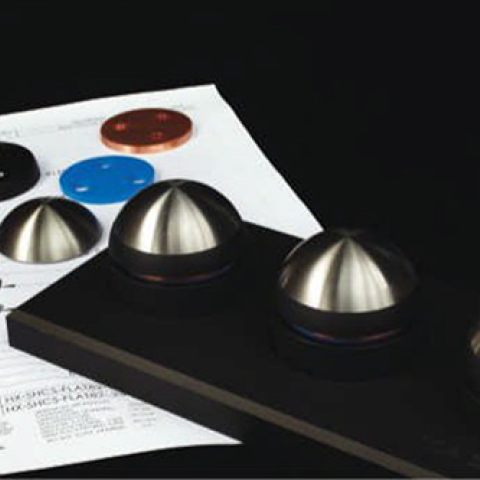
Four aluminum cones support the plinth, although these aren't quite as simple as they appear: A steel ball is pressed into each point, à la Bic, for enhanced isolation from outside vibrations, and the thick, spongy washers—made of something called Poron—between the cones and the underside of the plinth ensure that the feet can be adjusted for height without losing contact. The Scout has an inverted bearing, the well of which is machined from sintered bronze (a graphite-based lubricant is contained in pores in the alloy itself) with a Teflon thrust disc on top. This is a departure from VPI's recent standard practice of making bearing wells out of a thermoplastic called Rulon—designer Weisfeld says that sintered bronze can be machined more accurately with fewer operations, thus keeping comparative costs down. The Scout's bearing shaft, massively bolted to the plinth, is case-hardened tool steel, meaning it's actually somewhat softer at its core than its outer surface: Theoretically, at least, this could aid in damping vibrations. The business end of the shaft encapsulates a chrome steel ball whose hardness is 60 on the Rockwell scale. VPI chose a Hurst 5.5W AC synchronous motor for the Scout, which is less torquey than the ones used for the company's other models—but then, at just 4 lbs, the Scout's acrylic platter is less massive than most, including those in the rest of VPI's line. Other than the shelf they'll sit on, a thin, round drive belt is the only mechanical link between motor and turntable—the motor enclosure is a structure separate from the rest of the plinth. That chunky little steel box also contains a pushbutton switch, an AC cord socket, and two capacitors, one of which is used to "phase" the motor, the other to suppress turn-on thumps (at which it is only partly successful). The motor armature is topped with a two-speed Delrin pulley, which is both grooved and slightly tapered (1.5 degrees), allowing the user to make minor speed adjustments by choosing lower or higher positions for the belt. The pulley is so free from visible run-out error that you might have to touch it to know if it's turning.
I'm endlessly fascinated with the science behind them—at least partly because, as with theology and frankfurters, the real essence of the thing I'm trying to know is in fact unknowable. Given the subjectivity we bring to music appreciation and the fact that we can't see what's really going on in the groove during record play, theories and guesswork are all we have to go on in the world of phonography, notwithstanding some tedious and unintentionally funny claims to the contrary. Like it or not, wherever two or more people gather to write or read reviews of record players, faith is always close at hand. So here goes: How It's Done Designer Harry Weisfeld has whapped the ball so far out of the park with this one, it isn't funny. There's a glorious sense of completeness—of wholeness and rightness—in the way the Aries Scout/JMW-9 combination of turntable and tonearm plays music, echoed and underscored by those same qualities in the player's appearance and ease of use. The Scout and JMW-9 are serenely well-designed, as opposed to being just a frantic collection of the latest analog fads and follies, and their construction quality is nothing short of astounding for the price. The solid-plinth Scout starts life as a sheet of 1 1/8"-thick MDF, machined to shape and finished in semigloss black. Most of its underside is covered with a thin steel plate for rigidity and damping, the latter thanks also to a thin layer of silicone sealant. The right-rear corner is drilled with a 1"-diameter hole for VPI's standard arm-mount collar. A Rega RB-300, with its pillar diameter of 22mm (or just over 7/8"), will fit, but the VPI's platter is way too tall for the Rega arm by itself, even with the usual 1/16" spacer: If that's what you have in mind, you'll have to get a machinist to make you something special.