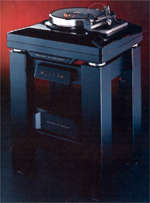
Andy Payor hurls a briefcase full of engineering and scientific mumbo-jumbo at in an attempt to justify the $73,750 price of the latest and greatest edition of his Rockport Technologies turntable, but really—isn't this all-air-driven design a case of analog overkill? After all, defining a turntable's job seems rather easy: rotate the record at an exact and constant speed, and, for a linear tracker, put the stylus in play across the record surface so that it maintains precise tangency to a radius described across the groove surface. By definition, a pivoted arm can't do that, so the goal there is to minimize the deviation. That's basically it. Right? 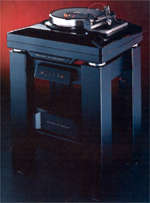 We love those LPs, and we know they can sound good—certainly better than CDs—but can a stone dragged through a vinyl drainage ditch ever sound $73,750 worth of good? With its air-suspension isolation stand, air-bearing platter (both the axial and radial loads are supported by air), captured air-bearing arm, and direct-drive brushless motor, the System III Sirius's only mechanical contact is that of stylus and record. No belt, no springs, no thrust plate and ball bearing, no bushings—and, unfortunately, no way most of us will ever be able to afford the thing. Isn't the +185-lb, epoxy-composite plinth—fiber-reinforced, resin-shelled, lead-ballasted, and mineral-filled—another example, however sleek and shiny, of the design's overkill? Payor describes the plinth's "monocoque" construction as resulting in "an immensely stiff beam section with the high-tensile members at the outermost region of the composite, separated by a virtually inert core with extremely high compressive strength." (Fans of the Jaguar Type E remember "monocoque," which means a design in which the skin absorbs all or most of the stresses to which the body is subjected. And an immensely stiff beam is what I got just from looking at the Sirius III.) But isn't that just descriptive overkill? A verbally expensive way of saying "this thing's heavy and it's gonna cost you big bucks"?
How about an exquisitely constructed, 62-lb, constrained-layer-damped five-piece platter machined from solid 303 stainless-steel bar stock and including a recessed top section in which is embedded a "high-hysteresis, mineral-filled PVC alloy coated with a proprietary material with a unique combination of properties essential for the elimination of unwanted vibration at the record surface"? Isn't that a gobbledegook way of saying the platter's coated with energy-sucking goop? Yes, it is...but in the engineering-centric world of designer Andy Payor, such correct and technically elegant descriptions of the turntable's guts are essential for understanding how the System III works, why it sounds the way it does, the meticulous care that went into its design and construction, why Payor thinks it mechanically and sonically superior to every other turntable out there, why it costs so much, why he thinks it worth every penny, and why he insists it's a better turntable value than any other—even at $73,750.
We love those LPs, and we know they can sound good—certainly better than CDs—but can a stone dragged through a vinyl drainage ditch ever sound $73,750 worth of good? With its air-suspension isolation stand, air-bearing platter (both the axial and radial loads are supported by air), captured air-bearing arm, and direct-drive brushless motor, the System III Sirius's only mechanical contact is that of stylus and record. No belt, no springs, no thrust plate and ball bearing, no bushings—and, unfortunately, no way most of us will ever be able to afford the thing. Isn't the +185-lb, epoxy-composite plinth—fiber-reinforced, resin-shelled, lead-ballasted, and mineral-filled—another example, however sleek and shiny, of the design's overkill? Payor describes the plinth's "monocoque" construction as resulting in "an immensely stiff beam section with the high-tensile members at the outermost region of the composite, separated by a virtually inert core with extremely high compressive strength." (Fans of the Jaguar Type E remember "monocoque," which means a design in which the skin absorbs all or most of the stresses to which the body is subjected. And an immensely stiff beam is what I got just from looking at the Sirius III.) But isn't that just descriptive overkill? A verbally expensive way of saying "this thing's heavy and it's gonna cost you big bucks"?
How about an exquisitely constructed, 62-lb, constrained-layer-damped five-piece platter machined from solid 303 stainless-steel bar stock and including a recessed top section in which is embedded a "high-hysteresis, mineral-filled PVC alloy coated with a proprietary material with a unique combination of properties essential for the elimination of unwanted vibration at the record surface"? Isn't that a gobbledegook way of saying the platter's coated with energy-sucking goop? Yes, it is...but in the engineering-centric world of designer Andy Payor, such correct and technically elegant descriptions of the turntable's guts are essential for understanding how the System III works, why it sounds the way it does, the meticulous care that went into its design and construction, why Payor thinks it mechanically and sonically superior to every other turntable out there, why it costs so much, why he thinks it worth every penny, and why he insists it's a better turntable value than any other—even at $73,750.
We love those LPs, and we know they can sound good—certainly better than CDs—but can a stone dragged through a vinyl drainage ditch ever sound $73,750 worth of good? With its air-suspension isolation stand, air-bearing platter (both the axial and radial loads are supported by air), captured air-bearing arm, and direct-drive brushless motor, the System III Sirius's only mechanical contact is that of stylus and record. No belt, no springs, no thrust plate and ball bearing, no bushings—and, unfortunately, no way most of us will ever be able to afford the thing. Isn't the +185-lb, epoxy-composite plinth—fiber-reinforced, resin-shelled, lead-ballasted, and mineral-filled—another example, however sleek and shiny, of the design's overkill? Payor describes the plinth's "monocoque" construction as resulting in "an immensely stiff beam section with the high-tensile members at the outermost region of the composite, separated by a virtually inert core with extremely high compressive strength." (Fans of the Jaguar Type E remember "monocoque," which means a design in which the skin absorbs all or most of the stresses to which the body is subjected. And an immensely stiff beam is what I got just from looking at the Sirius III.) But isn't that just descriptive overkill? A verbally expensive way of saying "this thing's heavy and it's gonna cost you big bucks"?