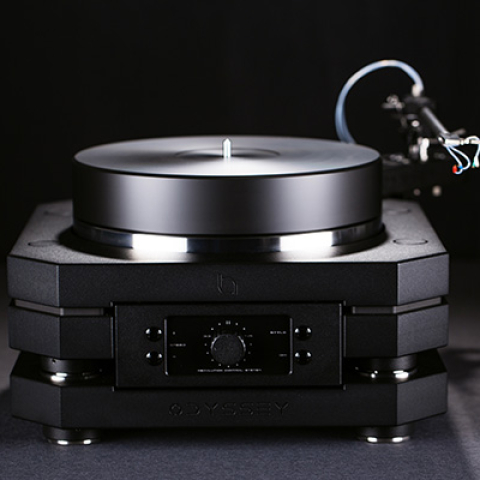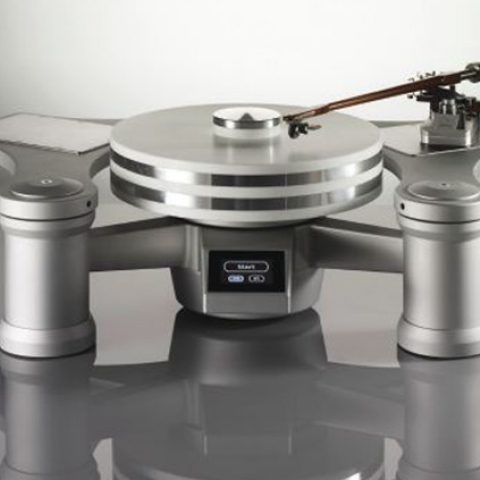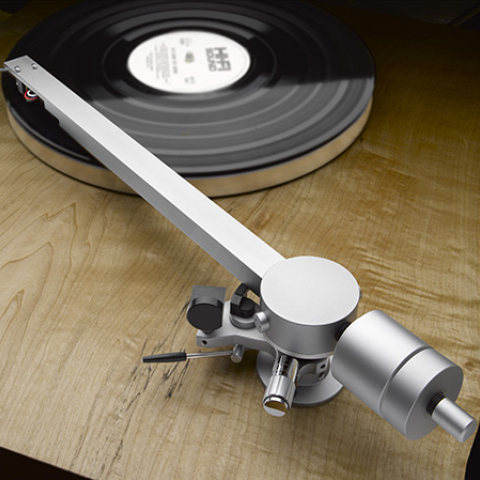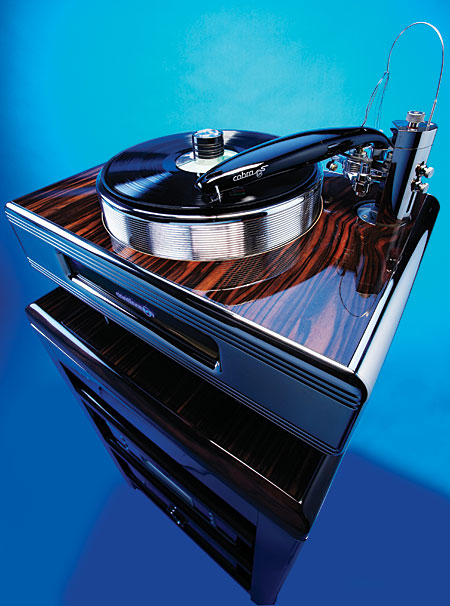
Part New Jersey diner, part Wurlitzer jukebox, with a snakelike tonearm that at certain angles looks vaguely lewd, this boxy, man-sized creation from Australia seems to have been built around its distinctive looks rather than for any functional purpose. Combine that with its sky-high price—itself almost obscene—and the result is apparently the sort of product that envious, cynical, self-loathing audiophiles love to hate, and reviewers love to write about.
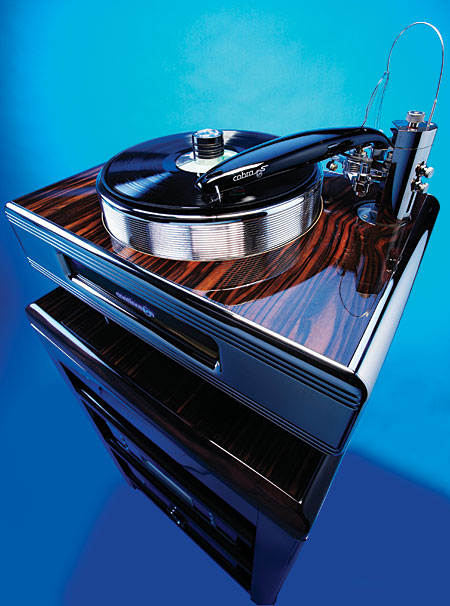 But a glance under the Caliburn's shiny skin reveals a clever, purposeful design based on rigorous scientific methodology using finite-element analysis computer programs, including Patran and Nastran from mscsoftware. You can watch animated visualizations of their application in the Caliburn's design on Continuum's website. But, as with any tool or musical instrument, the results obtained from using a computer program will be only as good as the ability to grasp, interpret, and implement the data.
The Caliburn turntable, Cobra tonearm, and Castellon turntable stand are the brainchildren of Mark Doehmann, who brings to the project backgrounds in aeronautical engineering, engineering software development, turntable design—and a passion for music. In the 1980s, as a hobby, Doehmann began building for himself and his friends one-off turntables—all of which are still in use today. Through his love of music and audio—especially analog sound—he made the acquaintance of David Payes, another audiophile and analog fanatic, who had made his fortune in the digital domain, with computers. A few years ago, Payes asked Doehmann what he would do, if cost were not an issue, to improve his already high-performance custom turntable. Doehmann suggested replacing the acrylic platter with one that would provide a more silent, inert foundation.
With his background in aeronautical engineering, Doehmann had the Rolodex to get the job done. Collaborating with materials engineer John Vietz, Doehmann chose to cast the platter from a unique magnesium alloy. Using computer modeling, Neil McLachlan aided in the development of a novel "nested platter" design. David Payes was overwhelmed by the sonic improvements wrought by the new platter, and four years ago offered to fund the development of a cost-no-object turntable.
Thus was born both the $89,999 Caliburn-Cobra-Castellon turntable system (less costly products will follow) and Continuum Audio Labs, with Payes as chairman, Doehmann as chief designer, and Dr. Murali Murugasu overseeing general development. Murugasu, an expatriate Briton with both MD and MBA degrees, was not permitted to practice medicine in Australia when he moved there with his Australian-born wife, so he began importing and distributing high-end audio gear. He provides the interface between Doehmann's theoretical world and the real world of audio manufacturing, import/export, system compatibility, and marketing.
Despite the system's fancifully retro look, the design concept is technologically sophisticated, though the execution makes consistent use of traditional turntable architecture: the suspension is passive, the drive is O-ring, the platter bearing is the familiar hardened shaft, ball, and thrust plate, and the tonearm is pivoted. Unlike the Rockport System III Sirius, its only serious competition in price (competitive in quality are the less expensive Brinkmann Balance, Kuzma Stabi XL, and SME 30/2), the Caliburn-Cobra has no air-flotation devices, no air bearings, no carbon fiber, and only one use of a space-age composite material.
From the bottom up
But a glance under the Caliburn's shiny skin reveals a clever, purposeful design based on rigorous scientific methodology using finite-element analysis computer programs, including Patran and Nastran from mscsoftware. You can watch animated visualizations of their application in the Caliburn's design on Continuum's website. But, as with any tool or musical instrument, the results obtained from using a computer program will be only as good as the ability to grasp, interpret, and implement the data.
The Caliburn turntable, Cobra tonearm, and Castellon turntable stand are the brainchildren of Mark Doehmann, who brings to the project backgrounds in aeronautical engineering, engineering software development, turntable design—and a passion for music. In the 1980s, as a hobby, Doehmann began building for himself and his friends one-off turntables—all of which are still in use today. Through his love of music and audio—especially analog sound—he made the acquaintance of David Payes, another audiophile and analog fanatic, who had made his fortune in the digital domain, with computers. A few years ago, Payes asked Doehmann what he would do, if cost were not an issue, to improve his already high-performance custom turntable. Doehmann suggested replacing the acrylic platter with one that would provide a more silent, inert foundation.
With his background in aeronautical engineering, Doehmann had the Rolodex to get the job done. Collaborating with materials engineer John Vietz, Doehmann chose to cast the platter from a unique magnesium alloy. Using computer modeling, Neil McLachlan aided in the development of a novel "nested platter" design. David Payes was overwhelmed by the sonic improvements wrought by the new platter, and four years ago offered to fund the development of a cost-no-object turntable.
Thus was born both the $89,999 Caliburn-Cobra-Castellon turntable system (less costly products will follow) and Continuum Audio Labs, with Payes as chairman, Doehmann as chief designer, and Dr. Murali Murugasu overseeing general development. Murugasu, an expatriate Briton with both MD and MBA degrees, was not permitted to practice medicine in Australia when he moved there with his Australian-born wife, so he began importing and distributing high-end audio gear. He provides the interface between Doehmann's theoretical world and the real world of audio manufacturing, import/export, system compatibility, and marketing.
Despite the system's fancifully retro look, the design concept is technologically sophisticated, though the execution makes consistent use of traditional turntable architecture: the suspension is passive, the drive is O-ring, the platter bearing is the familiar hardened shaft, ball, and thrust plate, and the tonearm is pivoted. Unlike the Rockport System III Sirius, its only serious competition in price (competitive in quality are the less expensive Brinkmann Balance, Kuzma Stabi XL, and SME 30/2), the Caliburn-Cobra has no air-flotation devices, no air bearings, no carbon fiber, and only one use of a space-age composite material.
From the bottom up
While the Castellon stand ($25,000) is optional, I recommend it to support the Caliburn's 160 lbs—and that's not including the motor. That kind of money will buy you a good new car, I know, but if you're thinking about spending $65,000 for a turntable and tonearm, you can afford the extra $25k—and if you're just dreaming, you may as well dream about the stand, too. If you're outraged by such extravagance, read Consumer Reports and leave me alone. The ultrarigid Castellon, made of chromed, aircraft-grade aluminum, is cross-braced for added rigidity, and tensioned with nautical turnbuckles secured to a central ring bearing the company's S-shaped logo. The stand's 176 lbs include two heavy, opposed magnetic plates, which levitate the reinforced-MDF shelf on which the turntable sits. Continuum has devised a way to accomplish levitation without the mechanical contact used in some other designs to prevent the opposing plates from literally flying apart. A horizontal air stabilizer (a sort of rectangular inner tube) arranged along the perimeter of the magnetic sandwich isolates it from the aluminum frame. With the turntable in place, the top shelf almost touches the top of the aluminum frame. This is deliberate. According to Doehmann, he chose magnetic levitation over active air because air grows stiffer the more it is compressed, causing the resonant frequency to increase—the opposite of the desired effect. With magnetic levitation, the closer the field is to collapsing, the lower the resonant frequency. By having the two magnetic plates almost touch, the resonant frequency is said to be around the ideal 2–3Hz.
Below the top shelf are three more shelves of MDF, one each for the heavy vacuum pump and the main control mechanisms (both encased in the finest diner chrome), and one intended for small accessories such as record brushes, stylus cleaners, and the like. The three shelves slide in and out, resting on thick aluminum plates secured to the uprights via beefy aluminum bars that run the depth of the stand. The Castellon is a turntable stand, not an equipment rack meant to hold delicate, vibration-prone sound-producing electronics, which is why no attempt was made to isolate them from the stand's aluminum supports.
Perhaps you're asking yourself what $25,000 buys you. This is the only stand in my experience that simply did not move no matter how hard I tried. It was like a rock.
Mag wheels come standard
According to Mark Doehmann, the magnesium alloy used in the Caliburn's complex, 1"-thick, one-piece chassis contains a specific concentration of zirconium crystals that raises the damping factor to 40 times that of commercial aerospace magnesium alloys. He declares that this and the chassis' shape—which he and his team determined using computer modeling—mean that it's essentially dead.
The 84-lb platter also benefited from computer-aided design. Continuum's position is that it's impossible to isolate the playing surface of a spinning one-piece platter from its own flexing and vibrating modes. The Caliburn platter's heavy outer rim of cast magnesium is attached to the bearing structure, but the inner, playing surface is completely isolated from it in "a proprietary manner" Doehmann would not discuss.
But a glance under the Caliburn's shiny skin reveals a clever, purposeful design based on rigorous scientific methodology using finite-element analysis computer programs, including Patran and Nastran from mscsoftware. You can watch animated visualizations of their application in the Caliburn's design on Continuum's website. But, as with any tool or musical instrument, the results obtained from using a computer program will be only as good as the ability to grasp, interpret, and implement the data.
The Caliburn turntable, Cobra tonearm, and Castellon turntable stand are the brainchildren of Mark Doehmann, who brings to the project backgrounds in aeronautical engineering, engineering software development, turntable design—and a passion for music. In the 1980s, as a hobby, Doehmann began building for himself and his friends one-off turntables—all of which are still in use today. Through his love of music and audio—especially analog sound—he made the acquaintance of David Payes, another audiophile and analog fanatic, who had made his fortune in the digital domain, with computers. A few years ago, Payes asked Doehmann what he would do, if cost were not an issue, to improve his already high-performance custom turntable. Doehmann suggested replacing the acrylic platter with one that would provide a more silent, inert foundation.
While the Castellon stand ($25,000) is optional, I recommend it to support the Caliburn's 160 lbs—and that's not including the motor. That kind of money will buy you a good new car, I know, but if you're thinking about spending $65,000 for a turntable and tonearm, you can afford the extra $25k—and if you're just dreaming, you may as well dream about the stand, too. If you're outraged by such extravagance, read Consumer Reports and leave me alone. The ultrarigid Castellon, made of chromed, aircraft-grade aluminum, is cross-braced for added rigidity, and tensioned with nautical turnbuckles secured to a central ring bearing the company's S-shaped logo. The stand's 176 lbs include two heavy, opposed magnetic plates, which levitate the reinforced-MDF shelf on which the turntable sits. Continuum has devised a way to accomplish levitation without the mechanical contact used in some other designs to prevent the opposing plates from literally flying apart. A horizontal air stabilizer (a sort of rectangular inner tube) arranged along the perimeter of the magnetic sandwich isolates it from the aluminum frame. With the turntable in place, the top shelf almost touches the top of the aluminum frame. This is deliberate. According to Doehmann, he chose magnetic levitation over active air because air grows stiffer the more it is compressed, causing the resonant frequency to increase—the opposite of the desired effect. With magnetic levitation, the closer the field is to collapsing, the lower the resonant frequency. By having the two magnetic plates almost touch, the resonant frequency is said to be around the ideal 2–3Hz.
According to Mark Doehmann, the magnesium alloy used in the Caliburn's complex, 1"-thick, one-piece chassis contains a specific concentration of zirconium crystals that raises the damping factor to 40 times that of commercial aerospace magnesium alloys. He declares that this and the chassis' shape—which he and his team determined using computer modeling—mean that it's essentially dead.