It takes more than passing courage to make another assault on building the world's best tube preamplifier. You face stiff competition from well-established firms like Audio Research, Conrad Johnson, and Counterpoint. Such units can't be made inexpensively, and you face the steadily growing problem of tube supply: it is getting harder and harder to get tubes that are stable, have predictable sound and performance characteristics, and are long-lived. And you have to show audiophiles who have been burned before that you will still be around when they need service.  You also have to convince a jaundiced pack of reviewers that you and your product are serious, and do so regardless of what UPS may do to your review samples. Further, you have to persevere in defending tube designs even when reviewers receive irresponsible products like the Jadis—a tube amplifier which should never have been marketed in the US because of its apparently failure-prone design, and which seems destined to make life an audio and financial hell for its buyers. No sane reviewer is now going to rush out to praise how well any tube unit works until he or she has seen how long it works. Well, Ken Stevens seems well on his way to succeeding in spite of all these obstacles. His latest version of the Convergent Audio Technology SL-1 preamp is the most interesting pure-tube design to enter the market since the Audio Research SP-10 Mark II, with good features and excellent overall performance. It is also available at the highly competitive price of $3495 (footnote 1).
Convergent Audio Technology has already made it through the difficult start-up period where manufacturers are most prone to fail, and has done well enough to have a power amp entering production. Ken has had his shipping and review sample problems, but the latest review sample has functioned perfectly after taking hard use and a considerable beating from a defective airline luggage belt during shipping. Talks with several SL-1 owners have revealed that they, too, have had few problems, and that the manufacturer has been very responsive. Features: More than the Usual Roundup of Suspects
You also have to convince a jaundiced pack of reviewers that you and your product are serious, and do so regardless of what UPS may do to your review samples. Further, you have to persevere in defending tube designs even when reviewers receive irresponsible products like the Jadis—a tube amplifier which should never have been marketed in the US because of its apparently failure-prone design, and which seems destined to make life an audio and financial hell for its buyers. No sane reviewer is now going to rush out to praise how well any tube unit works until he or she has seen how long it works. Well, Ken Stevens seems well on his way to succeeding in spite of all these obstacles. His latest version of the Convergent Audio Technology SL-1 preamp is the most interesting pure-tube design to enter the market since the Audio Research SP-10 Mark II, with good features and excellent overall performance. It is also available at the highly competitive price of $3495 (footnote 1).
Convergent Audio Technology has already made it through the difficult start-up period where manufacturers are most prone to fail, and has done well enough to have a power amp entering production. Ken has had his shipping and review sample problems, but the latest review sample has functioned perfectly after taking hard use and a considerable beating from a defective airline luggage belt during shipping. Talks with several SL-1 owners have revealed that they, too, have had few problems, and that the manufacturer has been very responsive. Features: More than the Usual Roundup of Suspects
As might be expected in any product competing for top honors, the SL-1 has the kind of special features one demands in a high-quality, high-end product. Perhaps the most striking of these features is the SL-1's incredible signal/noise ratio with moving-coil cartridges. This is not a preamp for the Audionote or Ortofon MC-2000 fancier, but what preamp is? You should be able to get excellent performance with nearly any other moving coil, and no other tube preamp offers this combination of gain and S/N ratio. The manufacturer's specification says the SL-1 will work with cartridges with only 0.2mV output at 5cm/s (the Ortofon MC-2000 puts out only 0.05mV), and it will. Where the Audio Research SP-10/II tends to dry out the sound and lose some of its dynamics and transient life with cartridges like the Dynavectors, the SL-1 does just fine. In fact, it is roughly equivalent in gain vs. S/N to the Conrad-Johnson Premier Three plus the Conrad-Johnson nuvistor head amp (the Premier Six). If anything, the Convergent Audio Technology is slightly more quiet, and it certainly works better with very low impedance loads.
The other features also go beyond the normal roundup of the usual high-end suspects, matching what you would expect in a luxury product:
• A separate, complex high-voltage power supply, and three fully regulated independent filament power supplies to reduce noise and compression caused by filament crosstalk.
• Slow filament warmup to extend tube life.
• Exceptionally low open-loop distortion, with low feedback ratios used to reduce RFI and allow good performance without precise tube matching.
• A combination of active and passive RIAA equalization to reduce tube aging effects.
• Custom proprietary capacitors (will Peter Moncrieff ever forgive Ken Stevens? Will Bobby Ewing return from the dead?) are used throughout.
• Precision metal resistors used throughout, even—according to the manufacturer—where such quality is not necessary. (We are still working on an A/B testing method to determine the statistical importance of unnecessary quality. Our new editor has volunteered for extended listening tests.)
• OFHC wire used because it is felt to be superior to LC and MC-OFC wire. (Has Martin Colloms tested 100% oxygen-present copper wire recently?)
• Gold-plated and Teflon-insulated phono jacks.
• High quality selector switches and switched balance and volume controls.
• Hand-selected tubes personally tested by Stevens.
• Silver solder. (But can it be used with Vampire interconnects?)
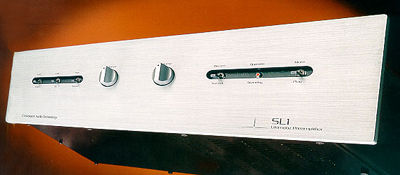
• Front-panel muting switch with automatic muting for 30 seconds after turn-on to eliminate thumps. In short, a look inside reveals that this is an extremely sophisticated, well-engineered, well-built unit. The styling is early Bauhaus, with form following function a bit too closely, but certainly in keeping with the price tag. The choice of signal input, tape, and muting is accomplished through varying combinations of long-throw lever switches, and takes a bit of getting used to.
Footnote 1: The reader should be aware that this review is of the SL-1 "Mark II." This is not a formal designation, but it is easy to tell which model is involved. The twin volume controls on the original have been replaced with a volume and a balance control (though the looks from a distance are the same, the labels of the two controls have changed).—Anthony H. Cordesman
You also have to convince a jaundiced pack of reviewers that you and your product are serious, and do so regardless of what UPS may do to your review samples. Further, you have to persevere in defending tube designs even when reviewers receive irresponsible products like the Jadis—a tube amplifier which should never have been marketed in the US because of its apparently failure-prone design, and which seems destined to make life an audio and financial hell for its buyers. No sane reviewer is now going to rush out to praise how well any tube unit works until he or she has seen how long it works. Well, Ken Stevens seems well on his way to succeeding in spite of all these obstacles. His latest version of the Convergent Audio Technology SL-1 preamp is the most interesting pure-tube design to enter the market since the Audio Research SP-10 Mark II, with good features and excellent overall performance. It is also available at the highly competitive price of $3495 (footnote 1). As might be expected in any product competing for top honors, the SL-1 has the kind of special features one demands in a high-quality, high-end product. Perhaps the most striking of these features is the SL-1's incredible signal/noise ratio with moving-coil cartridges. This is not a preamp for the Audionote or Ortofon MC-2000 fancier, but what preamp is? You should be able to get excellent performance with nearly any other moving coil, and no other tube preamp offers this combination of gain and S/N ratio. The manufacturer's specification says the SL-1 will work with cartridges with only 0.2mV output at 5cm/s (the Ortofon MC-2000 puts out only 0.05mV), and it will. Where the Audio Research SP-10/II tends to dry out the sound and lose some of its dynamics and transient life with cartridges like the Dynavectors, the SL-1 does just fine. In fact, it is roughly equivalent in gain vs. S/N to the Conrad-Johnson Premier Three plus the Conrad-Johnson nuvistor head amp (the Premier Six). If anything, the Convergent Audio Technology is slightly more quiet, and it certainly works better with very low impedance loads.
• A separate, complex high-voltage power supply, and three fully regulated independent filament power supplies to reduce noise and compression caused by filament crosstalk.
• Slow filament warmup to extend tube life.
• Exceptionally low open-loop distortion, with low feedback ratios used to reduce RFI and allow good performance without precise tube matching.
• A combination of active and passive RIAA equalization to reduce tube aging effects.
• Custom proprietary capacitors (will Peter Moncrieff ever forgive Ken Stevens? Will Bobby Ewing return from the dead?) are used throughout.
• Precision metal resistors used throughout, even—according to the manufacturer—where such quality is not necessary. (We are still working on an A/B testing method to determine the statistical importance of unnecessary quality. Our new editor has volunteered for extended listening tests.)
• OFHC wire used because it is felt to be superior to LC and MC-OFC wire. (Has Martin Colloms tested 100% oxygen-present copper wire recently?)
• Gold-plated and Teflon-insulated phono jacks.
• High quality selector switches and switched balance and volume controls.
• Hand-selected tubes personally tested by Stevens.
• Silver solder. (But can it be used with Vampire interconnects?)
• Front-panel muting switch with automatic muting for 30 seconds after turn-on to eliminate thumps. In short, a look inside reveals that this is an extremely sophisticated, well-engineered, well-built unit. The styling is early Bauhaus, with form following function a bit too closely, but certainly in keeping with the price tag. The choice of signal input, tape, and muting is accomplished through varying combinations of long-throw lever switches, and takes a bit of getting used to.
Footnote 1: The reader should be aware that this review is of the SL-1 "Mark II." This is not a formal designation, but it is easy to tell which model is involved. The twin volume controls on the original have been replaced with a volume and a balance control (though the looks from a distance are the same, the labels of the two controls have changed).—Anthony H. Cordesman