Although I retain a firm hold on the established audio world, and recognize and value all that it has achieved, I feel inexorably driven to make some space in my life for single-ended amplifiers—more especially, those that eschew negative feedback (footnote 1). A classic if costly example of the art is the Cary CAD-805C, which, to my ears, has earned the right to teach audiophiles what negative feedback really sounds like, and what damage it can do to the musical message when poorly handled. This shouldn't be taken as an out-of-hand dismissal of those many great pieces of electronics and amplification that use negative feedback—it is simply an acknowledgment, or even an assertion that negative feedback generates a sound of its own.
Bel Canto
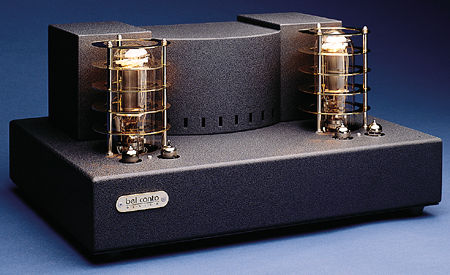
Bel Canto has dedicated itself to the minimalist, single-ended amplifier design philosophy for some years now (Dick Olsher reviewed the Bel Canto Orfeo SE2 monoblock for Stereophile in July 1994). The Minneapolis-based company has successfully managed to encompass a complex mix of innovation, modernity, and classicism in its designs. The Bel Canto SET 80 is an all-triode monoblock selling for $6500/pair, plus the cost of some gold-plated trim rings ($500) and a protection cage ($100, and necessary if you've got small children or nosy pets). Without sacrificing the sweetness typical of SE designs, the amplifier is claimed to deliver over 70W of unclipped power (distortion unspecified) into nominal 8 ohm or 4 ohm loadings, with a simple lever responsible for selecting the optimum match. As fairly high input levels are required (2V for 30W, for example), passive drive is not possible unless high-voltage sources are available—say, 6V at full CD modulation. A preamplifier with 12dB or more of voltage gain is generally necessary. Each SET 80 weighs 85 lbs and sits on castellated synthetic rubber feet. If the amp is placed on a carpeted floor, subplinths of glass or stone will improve air flow and aid performance. Operated in class-A, the SET 80's standing power draw is 800W; the awkwardly placed rear-panel switch acts as a standby feature operating a relay to turn off the class-A output tubes. The chassis is thus ready to run after a few minutes' warmup, while resting at a few tens of watts. The low-level tubes remain on more or less permanently, never fully powered down until the power plug is pulled.
More surprises: Unusual in an SE design, the rear panel has double speaker outlets: metal binding posts (Cardas) supplied with removable rubber insulating jackets. Signal input is possible in both balanced (XLR) and unbalanced (RCA) formats, adding more than a touch of useful versatility for sources and cabling.
With the more stressful 50Hz AC-supply frequency here in the UK, I experienced some rather audible mechanical hum from the power transformers. I expect that in the US, the 20%-higher frequency would result in less core stress and very likely a lot less hum. But check this out for yourself.
The appearance is utilitarian, especially without the gold rings; the small gold-plated Bel Canto badge is insufficient to lift the gloom of the expanse of black crackle-finish enamel. And how can I forget the strong odor, even after a few weeks' use, of hot varnish and paint after the SET 80s had been powered up for a few hours?
Technical story
Each SET 80 weighs 85 lbs and sits on castellated synthetic rubber feet. If the amp is placed on a carpeted floor, subplinths of glass or stone will improve air flow and aid performance. Operated in class-A, the SET 80's standing power draw is 800W; the awkwardly placed rear-panel switch acts as a standby feature operating a relay to turn off the class-A output tubes. The chassis is thus ready to run after a few minutes' warmup, while resting at a few tens of watts. The low-level tubes remain on more or less permanently, never fully powered down until the power plug is pulled.
More surprises: Unusual in an SE design, the rear panel has double speaker outlets: metal binding posts (Cardas) supplied with removable rubber insulating jackets. Signal input is possible in both balanced (XLR) and unbalanced (RCA) formats, adding more than a touch of useful versatility for sources and cabling.
With the more stressful 50Hz AC-supply frequency here in the UK, I experienced some rather audible mechanical hum from the power transformers. I expect that in the US, the 20%-higher frequency would result in less core stress and very likely a lot less hum. But check this out for yourself.
The appearance is utilitarian, especially without the gold rings; the small gold-plated Bel Canto badge is insufficient to lift the gloom of the expanse of black crackle-finish enamel. And how can I forget the strong odor, even after a few weeks' use, of hot varnish and paint after the SET 80s had been powered up for a few hours?
Technical story
Bel Canto is committed to single-ended triode technology. Their SET amplifiers all use 845R power triodes at the output, a two-stage triode input amplifier, and zero negative feedback, whether it be local or global loop. Additional features include thick, custom-made, metal-foil coupling capacitors in the output stage, plus the ability to drive 4 or 8 ohm speaker loads equally well. Total harmonic distortion is specified at 0.05% at 1W, with a wide power bandwidth of 5Hz–35kHz, –3dB—perhaps the state of this genre's art. I found two aspects comforting. Despite the use of a necessary 1.2kV of anode voltage, the big, Chinese, solid-graphite–plate output triodes are rated at some 8000 hours, ensuring many years of use. Moreover, they're not that expensive to replace. Nor are the small-signal triodes. The close relationship between Bel Canto's SET 40 stereo amplifier and the SET 80 monoblock is evident in components and parts—and the virtually identical chassis. Ingenious use of a high-quality, studio-grade input-matching transformer transforms the stereo chassis into a monoblock with the additional versatility of balanced and unbalanced inputs. This is a function of the center-tapped, balanced winding of the input transformer, while its secondaries allow phase inversion of one amplifier channel relative to the other.
At the loudspeaker outputs of what was the stereo chassis, we now have a balanced signal that—if appropriately connected and ratio-matched via the secondary windings of the output transformers—provides doubled output power in monoblock mode. Conceptually, the result is an oddball—it doesn't fall neatly into the usual class-A, SE, push-pull, or bridge categories, as it contains elements of all of them. I have drawn a few block diagrams to try to explain this.
Fig.1 shows a generic view of a stereo SE triode amplifier, with the signal phases shown at each stage. The output transformer is continuously magnetized by the standing class-A current flowing in the primary winding. In fig.2 a push-pull derivative is shown: the output tubes share the output transformer with an alternating, or push-pull, current flow across the entire output loop, modes, and winding. For this to work, the output triodes must operate in antiphase—hence the additional phase-splitter stage in the path. The tubes may be operated in full-bias class-A or lower-bias class-A/B, but regardless—the magnetizing currents cancel in the core, leaving it unbiased, magnetically speaking.
 Fig.1 Block diagram, generic single-ended triode (SET) power amplifier.
 Fig.2 Block diagram, generic push-pull amplifier with class-A or class-A/B output stage.
Finally, in fig.3, the SET 80 monoblock version of the SET 40 stereo unit is shown. While the output transformers remain separate, the loudspeaker connection is made via a loop containing both secondary windings arranged as a bridge connection. As in the push-pull design, the tubes operate in antiphase, but no phase splitter is required. This task is accomplished by Bel Canto's addition of the balanced/unbalanced input transformer. The amplifier does have a differential topology that will help reject noise on the high-voltage line. This is run in class-A so that each output transformer is magnetically biased; this is said to improve the incremental linearity of the magnetic material. The cross-connected output infers bridge mode, yet the floating transformer secondaries allow the output to be ground-based, avoiding connection difficulties with subwoofers and headphone adapters.
Fig.2 Block diagram, generic push-pull amplifier with class-A or class-A/B output stage.
Finally, in fig.3, the SET 80 monoblock version of the SET 40 stereo unit is shown. While the output transformers remain separate, the loudspeaker connection is made via a loop containing both secondary windings arranged as a bridge connection. As in the push-pull design, the tubes operate in antiphase, but no phase splitter is required. This task is accomplished by Bel Canto's addition of the balanced/unbalanced input transformer. The amplifier does have a differential topology that will help reject noise on the high-voltage line. This is run in class-A so that each output transformer is magnetically biased; this is said to improve the incremental linearity of the magnetic material. The cross-connected output infers bridge mode, yet the floating transformer secondaries allow the output to be ground-based, avoiding connection difficulties with subwoofers and headphone adapters.
 Fig.3 Block diagram, Bel Canto SET 80, balanced, bridged SET with class-A output stage.
Those four triodes at the input (two 12AX7s) are connected as a differential pair. SRPP mode is achieved by the second pair, the stage said to deliver a low-distortion signal up to 100V rms from a low 1k ohm output impedance, which will fully drive the 400k ohm input grid resistor of the output triode.
Build quality is very good, with high-quality details including polypropylene power-supply decoupling, choke-filtered high-voltage rails, a special grid-coupling capacitor, as well as such nice touches as the vibration-rejecting molded feet and the heavy-duty, vibration-decoupled circuit board. The amplifier's automatic biasing is uncritical of tube selection.
Sound
Fig.3 Block diagram, Bel Canto SET 80, balanced, bridged SET with class-A output stage.
Those four triodes at the input (two 12AX7s) are connected as a differential pair. SRPP mode is achieved by the second pair, the stage said to deliver a low-distortion signal up to 100V rms from a low 1k ohm output impedance, which will fully drive the 400k ohm input grid resistor of the output triode.
Build quality is very good, with high-quality details including polypropylene power-supply decoupling, choke-filtered high-voltage rails, a special grid-coupling capacitor, as well as such nice touches as the vibration-rejecting molded feet and the heavy-duty, vibration-decoupled circuit board. The amplifier's automatic biasing is uncritical of tube selection.
Sound
As I had found with the Cary CAD-805C (see Hi-Fi News & Record Review, March 1998), some patience is needed when you first power up big triodes. The Bel Canto monoblocks take a little time for all parts to reach thermal equilibrium, and for the chunky, milled-from-solid graphite plates to acquire that faintest tinge of cherry red. Sounds were still getting clearer 30 minutes later, and were improving still more, if more slowly, after an hour. Such waiting aside, the velvety tonal purity of this amplifier was available almost from the start, so strong was this inherent aspect of its character.
Little difference was observed between balanced and single-ended input drive, and that's how it should be, given the transformer-coupled input configuration. Working a range of speakers with the SET 80s was interesting, as was the effect of the matching impedance switch on the rear panel. With normal 8 ohm loads, this amplifier's output impedance was high enough to generate audible changes in tonal balance and character with familiar speakers. With power amplifiers, it is most helpful when such load-dependent variations are held to a minimum, allowing the reviewer to assess the perceived distribution of frequency balance and coloration intrinsic to an amplifier's topology, technology, and build. In the case of the Cary 805C, for example, its output impedance was sufficiently low for that amplifier's inherent sound to take adequate command of the listening event.
Footnote 1: See my "A Future Without Feedback?" (January '98, p.87).
Bel Canto has dedicated itself to the minimalist, single-ended amplifier design philosophy for some years now (Dick Olsher reviewed the Bel Canto Orfeo SE2 monoblock for Stereophile in July 1994). The Minneapolis-based company has successfully managed to encompass a complex mix of innovation, modernity, and classicism in its designs. The Bel Canto SET 80 is an all-triode monoblock selling for $6500/pair, plus the cost of some gold-plated trim rings ($500) and a protection cage ($100, and necessary if you've got small children or nosy pets). Without sacrificing the sweetness typical of SE designs, the amplifier is claimed to deliver over 70W of unclipped power (distortion unspecified) into nominal 8 ohm or 4 ohm loadings, with a simple lever responsible for selecting the optimum match. As fairly high input levels are required (2V for 30W, for example), passive drive is not possible unless high-voltage sources are available—say, 6V at full CD modulation. A preamplifier with 12dB or more of voltage gain is generally necessary.
Each SET 80 weighs 85 lbs and sits on castellated synthetic rubber feet. If the amp is placed on a carpeted floor, subplinths of glass or stone will improve air flow and aid performance. Operated in class-A, the SET 80's standing power draw is 800W; the awkwardly placed rear-panel switch acts as a standby feature operating a relay to turn off the class-A output tubes. The chassis is thus ready to run after a few minutes' warmup, while resting at a few tens of watts. The low-level tubes remain on more or less permanently, never fully powered down until the power plug is pulled.
Bel Canto is committed to single-ended triode technology. Their SET amplifiers all use 845R power triodes at the output, a two-stage triode input amplifier, and zero negative feedback, whether it be local or global loop. Additional features include thick, custom-made, metal-foil coupling capacitors in the output stage, plus the ability to drive 4 or 8 ohm speaker loads equally well. Total harmonic distortion is specified at 0.05% at 1W, with a wide power bandwidth of 5Hz–35kHz, –3dB—perhaps the state of this genre's art. I found two aspects comforting. Despite the use of a necessary 1.2kV of anode voltage, the big, Chinese, solid-graphite–plate output triodes are rated at some 8000 hours, ensuring many years of use. Moreover, they're not that expensive to replace. Nor are the small-signal triodes. The close relationship between Bel Canto's SET 40 stereo amplifier and the SET 80 monoblock is evident in components and parts—and the virtually identical chassis. Ingenious use of a high-quality, studio-grade input-matching transformer transforms the stereo chassis into a monoblock with the additional versatility of balanced and unbalanced inputs. This is a function of the center-tapped, balanced winding of the input transformer, while its secondaries allow phase inversion of one amplifier channel relative to the other.
Fig.1 Block diagram, generic single-ended triode (SET) power amplifier.
Fig.2 Block diagram, generic push-pull amplifier with class-A or class-A/B output stage.
Finally, in fig.3, the SET 80 monoblock version of the SET 40 stereo unit is shown. While the output transformers remain separate, the loudspeaker connection is made via a loop containing both secondary windings arranged as a bridge connection. As in the push-pull design, the tubes operate in antiphase, but no phase splitter is required. This task is accomplished by Bel Canto's addition of the balanced/unbalanced input transformer. The amplifier does have a differential topology that will help reject noise on the high-voltage line. This is run in class-A so that each output transformer is magnetically biased; this is said to improve the incremental linearity of the magnetic material. The cross-connected output infers bridge mode, yet the floating transformer secondaries allow the output to be ground-based, avoiding connection difficulties with subwoofers and headphone adapters.
Fig.3 Block diagram, Bel Canto SET 80, balanced, bridged SET with class-A output stage.
Those four triodes at the input (two 12AX7s) are connected as a differential pair. SRPP mode is achieved by the second pair, the stage said to deliver a low-distortion signal up to 100V rms from a low 1k ohm output impedance, which will fully drive the 400k ohm input grid resistor of the output triode.
Build quality is very good, with high-quality details including polypropylene power-supply decoupling, choke-filtered high-voltage rails, a special grid-coupling capacitor, as well as such nice touches as the vibration-rejecting molded feet and the heavy-duty, vibration-decoupled circuit board. The amplifier's automatic biasing is uncritical of tube selection.
Sound
As I had found with the Cary CAD-805C (see Hi-Fi News & Record Review, March 1998), some patience is needed when you first power up big triodes. The Bel Canto monoblocks take a little time for all parts to reach thermal equilibrium, and for the chunky, milled-from-solid graphite plates to acquire that faintest tinge of cherry red. Sounds were still getting clearer 30 minutes later, and were improving still more, if more slowly, after an hour. Such waiting aside, the velvety tonal purity of this amplifier was available almost from the start, so strong was this inherent aspect of its character.
Footnote 1: See my "A Future Without Feedback?" (January '98, p.87).