Based in the Czech Republic, KR Enterprise is headed by an occasionally gruff Dr. Riccardo Kron and his American-born wife, Eunice, who operate the company out of a partially abandoned factory that was once part of the state-owned Tesla High Vacuum Technology facility in Prague. The Swiss-funded company is unique in that it manufactures both amplifiers and the tubes that power them. KR's tubes have found favor with other amplifier makers as well—especially the 300BXS, electrically identical to a standard 300B but rated at 25W in class-A.
 Dr. Kron is driven to build tubes that are not replicas of old models, but new designs that, while electrically similar to the old ones, are capable of uniform performance, higher output and longer life. He's also come up with a very new kind of tube, the "vacuum transducer."
How often does someone come along claiming to have built something new and totally unique in a vacuum tube? Dr. Kron claims just that for his "vacuum transducer," and he's not shy about proclaiming the superiority of it or, indeed, the other tubes he manufactures.
The first KR amp I heard was the smaller VT600 MK, a single-ended "vacuum transistor" monoblock rated at 25W class-A RMS. Jeremy Bryan, who at that imported the Danish Bow Technology line, brought a pair over for me to hear, along with the BowTech ZZ-8 CD player that I subsequently reviewed in the August 1998 issue of Stereophile. I was stunned by the amplifier's vanishingly open, natural sound, and the prodigious power emanating from the single vacuum transistor output tube. But where was the bass? Clearly it wasn't the amp for the Audio Physic Virgo speakers.
At the 1999 International CES the Krons were showing the much more powerful, much more expensive ($25,000/pair) VT8000s driving a pair of large Von Schweikert speakers. The sound was, to my ears, among the best, if not the best at the Show—particularly impressive given that the room was one of the smaller shoeboxes.
I asked for a review sample, and, much to my surprise, the Krons were happy to comply. Surprise? The Krons came with more baggage than an airport carousel. I'd heard they were "difficult," "paranoid," you name it. I'd also heard that they'd felt they'd been burned by some reviewers and were therefore less than anxious to put product in our hands. But in an industry rife with rumor-mongering (and worse), I let such characterizations slide—after all, if I were to believe some of the things I've heard said about me, I'd have stuck my finger in a live AC socket a long time ago. And if what Dr. Kron was saying about his "vacuum transducer" was true, he really had created something new, something that was worth coverage in this magazine.
KR's lineup includes, among other designs, single-ended triode amps, which he builds to fulfill the desires of the marketplace, But I gathered that Dr. Kron is convinced the VT8000 both measures and sounds the best of all the amplifiers his company manufactures.
The Product
Dr. Kron is driven to build tubes that are not replicas of old models, but new designs that, while electrically similar to the old ones, are capable of uniform performance, higher output and longer life. He's also come up with a very new kind of tube, the "vacuum transducer."
How often does someone come along claiming to have built something new and totally unique in a vacuum tube? Dr. Kron claims just that for his "vacuum transducer," and he's not shy about proclaiming the superiority of it or, indeed, the other tubes he manufactures.
The first KR amp I heard was the smaller VT600 MK, a single-ended "vacuum transistor" monoblock rated at 25W class-A RMS. Jeremy Bryan, who at that imported the Danish Bow Technology line, brought a pair over for me to hear, along with the BowTech ZZ-8 CD player that I subsequently reviewed in the August 1998 issue of Stereophile. I was stunned by the amplifier's vanishingly open, natural sound, and the prodigious power emanating from the single vacuum transistor output tube. But where was the bass? Clearly it wasn't the amp for the Audio Physic Virgo speakers.
At the 1999 International CES the Krons were showing the much more powerful, much more expensive ($25,000/pair) VT8000s driving a pair of large Von Schweikert speakers. The sound was, to my ears, among the best, if not the best at the Show—particularly impressive given that the room was one of the smaller shoeboxes.
I asked for a review sample, and, much to my surprise, the Krons were happy to comply. Surprise? The Krons came with more baggage than an airport carousel. I'd heard they were "difficult," "paranoid," you name it. I'd also heard that they'd felt they'd been burned by some reviewers and were therefore less than anxious to put product in our hands. But in an industry rife with rumor-mongering (and worse), I let such characterizations slide—after all, if I were to believe some of the things I've heard said about me, I'd have stuck my finger in a live AC socket a long time ago. And if what Dr. Kron was saying about his "vacuum transducer" was true, he really had created something new, something that was worth coverage in this magazine.
KR's lineup includes, among other designs, single-ended triode amps, which he builds to fulfill the desires of the marketplace, But I gathered that Dr. Kron is convinced the VT8000 both measures and sounds the best of all the amplifiers his company manufactures.
The Product
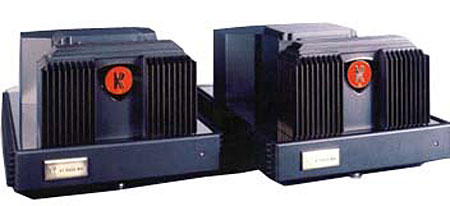
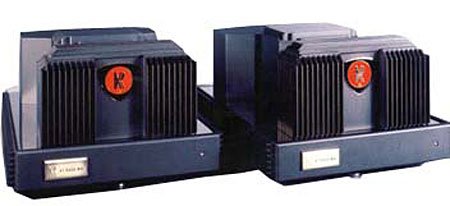
Let's leave the Krons' collection of Samsonite aside for a moment and deal with the VT8000s. Each $12,500 amp is a 92-lb heavyweight dominated by three large structures mounted on the chassis top surface: a large power transformer, a somewhat smaller but still quite large output transformer, and, in front, an aluminum edifice of a finned heatsink. The VT8000 is a zero-feedback, class-A, push-pull hybrid design rated at 75W RMS. It features solid-state power supply, input, driver, and phase-splitter stages, but the key to the design is the output stage: a single automatically biased pair of hand-built (as are all KR tubes), mechanically complex, ultra-high-vacuum "vacuum transducers" that produce both high voltage (normal for tubes) and high current (not normal for tubes). The amps are sold in "carefully" matched sets.
Kron claims the vacuum transducer's output is remarkably linear. The response for the amplifier is spec'd at 30Hz–20kHz (–0.5dB), with the low-frequency –3dB point lying at an impressive 15Hz. The class-A–biased pair of output devices certainly generates an amazing amount of heat—so much so that, like a conventional output transistor, the devices must be cooled via a massive heatsink sheath. Also like a transistor, a heat-transferring silicone grease is needed as an interface between the device and the heatsink surface. Otherwise, the tube would overheat and fail (implode)—as would an output transistor. The company had to develop a special silicone gel to coat the glass surface of the vacuum transducer before it is inserted into a hole machined out of the heatsink, which is fabricated from a solid block of aluminum.
When Kron, a longtime audiophile and Philips Electronics employee, visited me, he turned the amp over and removed the chassis bottom plate. I was surprised by both the seeming simplicity of the circuit and the unusual (for audiophile gear) construction: printed circuit boards linked via the kind of push-on connectors you find in automobile electronics. When I waxed incredulous, Kron's gruff, impatient side emerged. He told me that a) the amplifier's sound speaks for itself, and b) that these connectors are used in all sorts of military applications and in vehicles. They don't fall off or have problems in those applications, so why should I be concerned about their use in a sedentary product like an amplifier?
Indeed, most of the company's employees formerly worked in the research division of the Tesla High Vacuum Technology facility, where their expertise was used for military projects, mostly for the Soviet Union. Working with Kron, the military men set out to conquer what they saw as the problems inherent in audio-related vacuum-tube technology. Much of the company's vacuum-tube production equipment was procured from the shut-down military line.
Virtually every part in the amplifier is custom-made in-house or sourced from associated facilities, including the metal fabrication, the transformers, and the circuit boards. The internal wiring is Swiss in origin. And, of course, the vacuum transducers themselves are made in-house by hand, and that includes all of the tiny internal components, which are stamped out one at a time by hand on dies custom-machined in-house. Even the glass for the tubes is turned and formed by hand. If I hadn't seen all of this with my own eyes, I wouldn't have believed it.
The vacuum transducer itself has standard triode tube components—anode, cathode, and grid—but the patented construction (32 cathodes), ultra-high vacuum, and the way in which the tube is biased and driven are what allow it to pass sufficent current to produce the high specified power. Yet in achieving these results, the tubes are not taxed—they're actually coasting, according to Dr. Kron. He claims the life of the vacuum transducer is approximately 40,000 hours. When it comes time to replace the pair, or should one fail, you simply open the bottom and disconnect a few clips. Then you unscrew the entire heatsink assembly from the chassis and replace it with the new one. (The replacement cost is currently $1000 per monoblock.)
So right away, single-ended purists, "all-tube" devotees, and those made uncomfortable by construction methodologies that differ from the "purist" approach (point-to-point wiring, hard-soldered joints, etc.) will be uncomfortable with the VT8000—especially given its cost. But those audiophiles should judge the product by how it sounds.
Though he says he has no "secrets" and there are no mysteries—he did give block and circuit diagrams—Dr. Kron really wasn't interested in giving me a detailed account of the circuit topology or the particulars of the output-transformer construction or the power supply. He's just a no-BS kind of guy.
Dr. Kron is driven to build tubes that are not replicas of old models, but new designs that, while electrically similar to the old ones, are capable of uniform performance, higher output and longer life. He's also come up with a very new kind of tube, the "vacuum transducer."
How often does someone come along claiming to have built something new and totally unique in a vacuum tube? Dr. Kron claims just that for his "vacuum transducer," and he's not shy about proclaiming the superiority of it or, indeed, the other tubes he manufactures.
Let's leave the Krons' collection of Samsonite aside for a moment and deal with the VT8000s. Each $12,500 amp is a 92-lb heavyweight dominated by three large structures mounted on the chassis top surface: a large power transformer, a somewhat smaller but still quite large output transformer, and, in front, an aluminum edifice of a finned heatsink. The VT8000 is a zero-feedback, class-A, push-pull hybrid design rated at 75W RMS. It features solid-state power supply, input, driver, and phase-splitter stages, but the key to the design is the output stage: a single automatically biased pair of hand-built (as are all KR tubes), mechanically complex, ultra-high-vacuum "vacuum transducers" that produce both high voltage (normal for tubes) and high current (not normal for tubes). The amps are sold in "carefully" matched sets.