Just who does Bruce Rozenblit think he is? And why is he saying those things about the late Julius Futterman? Rozenblit, relying heavily for guidance on his Electrical Engineering degree, has crafted an OTL (output-transformerless) amplifier that flies in the face of contemporary design dogma. To hear Bruce tell it, he's tamed the breed—this is how OTLs should have been done to start with, Futterman notwithstanding.
 Ah yes, Futterman; the looming father-figure of contemporary OTL designs. Most audiophiles have heard of Father Futterman's amplifiers and their reputation for instability and self-immolation. Yet the idea of eliminating the output transformer and driving the speakers right off the power tubes is a compelling one. Of course, nothing's without cost. OTLs are usually powered by a forest of hot-running tubes, such as the triple-nippled Russian 6C33C, necessary to reduce the output impedance to give a reasonable interface with the speakers.
Nevertheless, Futterman-type designs have a difficult time driving moving-coil loudspeakers. On typical dynamic designs (4 to 6 ohms, three-point-something or lower in the bass) they can sound grainy, lightweight, thin, and bloated on the bottom end. As a result, OTLs are often partnered with electrostatics, which require voltage but not much current. This would be ideal if not for the punishingly low impedance of many 'stats at very high frequencies; OTLs make less power as the impedance load drops. (The T8 monoblocks put out 80Wpc into 8 ohms, dropping to 50Wpc into 4 ohms.)
Obviating these concerns, Rozenblit asserts that his design works with many "real world" dynamic speakers. Indeed, he claims that most of his customers use commonly available moving-coils. (See the accompanying interview for details.) In any case, as we'd had such success driving the Joseph Audio RM-50s with the Graaf GM 200 OTL, we decided to stick with the Josephs. (For the full hoopy-scoopy on the RM-50s, see the "Speaker Matters" Sidebar in September's review of the Graaf.) Whatever the T8's capabilities, there's nothing like a high, reasonably flat impedance curve to keep an OTL happy and on the boil.
We're hot, but we're cool
Ah yes, Futterman; the looming father-figure of contemporary OTL designs. Most audiophiles have heard of Father Futterman's amplifiers and their reputation for instability and self-immolation. Yet the idea of eliminating the output transformer and driving the speakers right off the power tubes is a compelling one. Of course, nothing's without cost. OTLs are usually powered by a forest of hot-running tubes, such as the triple-nippled Russian 6C33C, necessary to reduce the output impedance to give a reasonable interface with the speakers.
Nevertheless, Futterman-type designs have a difficult time driving moving-coil loudspeakers. On typical dynamic designs (4 to 6 ohms, three-point-something or lower in the bass) they can sound grainy, lightweight, thin, and bloated on the bottom end. As a result, OTLs are often partnered with electrostatics, which require voltage but not much current. This would be ideal if not for the punishingly low impedance of many 'stats at very high frequencies; OTLs make less power as the impedance load drops. (The T8 monoblocks put out 80Wpc into 8 ohms, dropping to 50Wpc into 4 ohms.)
Obviating these concerns, Rozenblit asserts that his design works with many "real world" dynamic speakers. Indeed, he claims that most of his customers use commonly available moving-coils. (See the accompanying interview for details.) In any case, as we'd had such success driving the Joseph Audio RM-50s with the Graaf GM 200 OTL, we decided to stick with the Josephs. (For the full hoopy-scoopy on the RM-50s, see the "Speaker Matters" Sidebar in September's review of the Graaf.) Whatever the T8's capabilities, there's nothing like a high, reasonably flat impedance curve to keep an OTL happy and on the boil.
We're hot, but we're cool
Speaking of cooking, OTLs traditionally run murderously hot, no doubt stressing the electronics to some extent. (Although I think Rozenblit's claim that most OTLs "devour themselves" is a bit lurid.) The Transcendent T8 addresses many of these issues. The large, perforated enclosures allow the amps to breathe; as claimed, they ran remarkably cool for an OTL. Rozenblit asserts that the lower internal temperatures greatly extend component life. (I'd find that hard to argue with.) The circuit uses a minimum of parts; as Bruce puts it, "If it isn't there, it can't break." The output stage runs in low-heat class-AB, biased to run at a very low idle current. This allows for a "thermal reserve" with which to handle peak currents when the music calls for it. The output stage is truly direct-coupled; there's nothing between the speaker and the output tubes but wire. The bipolar power supply (providing both positive and negative voltage rails) is fused and current-limited with passive devices. Rozenblit: "In the unlikely event of a short in an output tube, a fuse blows and the fault clears. There's no damage to the tubes, the amplifier circuitry, or your speakers. Most people don't know that an arced tube often isn't fatal."
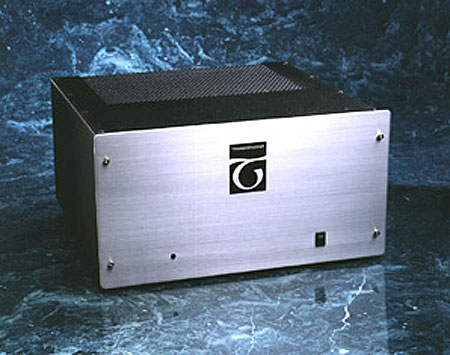
In spite of (because of?) the glitzy ingotlike gold logo up front, I found the boxy T8 rather uninspiring to gaze upon. In fact, the overall build—made in Missouruh—looks rather crude, especially in comparison to the elegant and exquisitely appointed Graaf GM 200 (at more than twice the price, it's fair to point out). But the T8 isn't homely just for the sake of it. Both the stereo and monoblock versions use the same enclosure, amp circuitry, and power supplies. By simply changing out the various subchassis, stereo units can be upgraded to monoblock specs in a jiffy. How can I criticize a small manufacturer for creating an intelligent, easy-to-build and -service amplifier? I can live with it. Repeat after me: It's the sound that counts...
Tubes & bias, emotional & otherwise
The T8 monoblock uses a single 12AX7 for the input gain stage. A pair of 12AU7s follow: the first splits the phase, the second functions as a cathode follower. Most OTLs these days (and several push-pull designs) make excellent use of the MIG-sourced Russian 6C33C. Rozenblit much prefers the Svetlana EL-509, finding it a more consistent, reliable, sweeter-sounding output tube. The 509's plate rating is 35W. At idle, the T8 loads them at a cool-running 10–15W, thus permitting the "thermal reserve" needed for Ellington or Elgar. If pushed, the plates will dissipate a hefty 70–75W of thermal energy. Of course, peak requirements of a typical music signal are usually short in duration. So while the T8s become rather toasty when pumping out Beck or Mahler, they handle big musical moments with aplomb. The rear panel houses line- and output-stage fuses, a standard IEC mains-in, Edison-Price binding posts, and RCA input jacks. There's also a simple bias-control adjuster augmented with a cute yellow voltmeter packed with the amps. Five minutes after power-on you're looking for a reading of less than 50mV across the speaker terminals (no signal, speaker cables attached). Check it again after an hour. After the tubes have run in and stabilized, the manual suggests leaving obsessiveness behind and checking the bias only every few months.
The burning bush
In the context of this review, I'll give, for the moment, OTLs (that I've heard) and some of the best single-ended amps (ditto) the credit for having a top end that's more open, alive, nuanced, detailed, and communicative than any push-pull or solid-state nutcracker has ever managed chez 10. I'm still a push-pull kinda guy, and I'll likely remain so. I'm not throwing everything out the window for single-ended or OTL technology. Yet...the wonders of this "job" are those special moments of what I'll call high-end cognition, when the music enters the mind and polarizes the soul. In this way, the Transcendents spoke eloquently. The T8 may appear rather crudely constructed, but its sound was at all times refinement personified. How to adequately describe that special openness in the highs that OTLs seem to embody? The Graaf certainly has it, seductive, ravishing thing it is. And the T8s had it, if in a slightly different way.
The first time I heard such delicate, lovely "light from within"—especially evident on female vocals—was during our single-ended spree last year. With appropriate speakers, the single-ended experience can be musically compelling, even (especially?) in the context of contemporary high-end audio. But the T8s' upper range wasn't lit so brightly from within as those of the single-ended/OTL amps we've heard. Rather, its musical light shone from deep inside, the flame itself glimpsed only beneath the glow. It smoldered from within, you might say.
In this way, the T8s were entirely more self-effacing about their presentation of the upper frequencies than the Graaf, which flaunts a more glamorous, ritzy top end. (The Graaf can splash a bit if over-driven, something the Transcendents never did.) This wondrous delicacy in the highs (and throughout the rest of the frequency band) was born of extremely fine detail existing down near and interlaced into the noise floor. Repeatedly, as I listened to many LPs and even CDs, I heard the Transcendents "grain down" to the level of the master tape. This was a subtle effect; it actually took some time to fully appreciate.
In fact, some listeners thought, at first, that the T8s were slightly rolled-off in the highs. This was not so. Checking one recording after another while listening for various high-frequency cues, I realized...they're in there. The treble was presented naturally, much like what I hear at live music events. The extraordinary level of unforced detail, tonal shading, and "color depth" put many a push-pull design to shame. The sense of openness was much enhanced by a superbly natural, fast-paced presentation—not blazingly fast, but rather with a speed that powered the music along with natural timing and transient snap.
Paradoxically, to fully understand the highs, we have to look at the midrange and below. Somewhere around the mid-lower midrange lies what I'd characterize as a powerband hinge of sorts. From there to the bottom the T8s seemed to shelve back slightly in their power response. This didn't sound discontinuous or unmusical in any way. On the contrary.
Another way to characterize it would be to say that the amps possessed great transparency above, and especially below, the "hinge." We'll look at the bass in more detail shortly, but the important element here was the effect on voices: female and especially male vocals sounded fundamentally less chesty and—to use once again the most descriptive word for the T8s—natural.
Importantly, this didn't create a disembodied "mouth in space" effect, but there was definitely less of the heavy, chesty stuff coming through. A fine example of this is on the vinyl of Cassandra Wilson's New Moon Daughter (Blue Note 8 37183 1). Now New Moon is anything but a high-end recording. In fact, I've always found it to be rather murky and overblown. But Cassandra's music is compelling, her voice and range amazing. If you cue up "Strange Fruit," there's plenty of time—unlike with the CD—to run back to the listening chair to catch the well-known match ignition at the beginning of the piece. My notes: "Smokin'! The soundstage is so huge and acoustic, so breathing and liquid, so tight and fast, so open in the highs...its really a transcendent experience." (Had to say that at least once in the review.) I thought—as I did listening to a number of female vocal recordings—that I'd never had it so good.
This lack of chestiness worked wonders on the boys as well. I listened to my two favorite songs on vinyl: "Moon Maiden" on The Intimate Ellington (Pablo 2310-787) and "Follow Me" by Sinatra on Francis A. & Edward K. (Reprise FS-1024). Really, it was captivating. Running fully differential to the amps with the BAT phono front-end, I tapped out the following as I listened: "That's it! They're here! The natural, light, open quality of their voices is incredible. The sound envelops me in an almost physical way. I can't 'break away' to dissect the sound, it's just washing over me in a wave of pleasure. I think I'm having an eargasm."
This lighter, transparent touch in the lower midband and down affected the entire midrange, of course. It was always...just right. It didn't ravish me, as can the Graaf or the single-ended amps we auditioned—but on those occasions when I turned my attention to it, I never found it wanting.
While the T8 had that OTL-like clarity of the Graaf GM 200, it was an altogether more subtle form of it. And this clarity was no better revealed than when listening to a lovely LP called It Don't Mean a Thing If You Can't Tap Your Foot To It, with Milt Jackson, Ray Brown, Cedar Walton, and Mickey Roker (Pablo 2310-909). (What's up with that title, I wonder?) I cued up "Stress and Trauma," recorded in July '84 here in New York—beautifully open, airy, layered, and spacious. I felt again that higher-order closeness to the music that I never tire of experiencing. Clarity in perfect union with musicality, not one at the expense of the other, as is often the case. The midrange was just beautiful, integrating perfectly with the rest of the frequency spectrum, alive with fine detail, harmonics, and realistic transient snap.
I then stepped back 11 years to another favorite Pablo, The Timekeepers (2310-896), this one featuring Basie and Ellington and recorded on the West Coast. I was amazed; it sounded as if it was made on the same day in the same studio as It Don't Mean a Thing...! Both evinced a straightforward, clear, open, musically compelling presentation with a beautiful balance of initial transients, harmonics, bloom, and space. I really dug it.
So how does Rozenblit's equal forward-voltage-gain fix work in the bass? Very well indeed. Both Pablos feature acoustic bass, and the nether regions were excellent in every way. My notes: "We go down, we go down well, we go down deep. While wonderfully acoustic and pitch-differentiated, the bass range comes off as a trifle light. But, importantly, not lacking in musicality."
Tackling the all-important lower-midrange on down, I spun my favorite track on Echos of Enja (Special Sampler 4000): "Round about Midnight" by the Bennie Wallace Trio. It's one of the most brooding, contemplative takes on this contemporary jazz classic that I've ever heard. Very film noir. The T8s captured the acoustic bass extraordinarily well. The sound remained tight, full-bodied, pitch-differentiated, and authentically acoustic at all times.
Looking for Rilly Big Bass, I set up the latest release from the evocative English group Dead Can Dance, Spiritchaser, on both CD (4AD 46230-2) and LP (4AD DAD 6008). It sounded magnificent turned way up (Kathleen always likes to crank it). For the record, when you turn the T8s up, they deliver. The bass sounded large and in charge, always in perfect control. The sense of lightness was less noticeable at really high spls, where the transparency, definition, and air really made my day.
The T8s aren't power power amps, in the mold of the GM 200 or a pair of big VTLs. Yet when turned up, their thermal reserve works well at reproducing larger musical efforts. The T8s may be clippable, but despite some fairly concerted efforts, I couldn't get them to do so. For example, try Shostakovich's "The Street" on Russian Pops, the new Mark Gorenstein release from PopeMusic (PMG2015-2). In the back of the hall there's a timpani that powerfully energized our listening room. The T8s handled these mighty dynamics, both micro and macro, with a natural grace and assurance that belied their modest power rating.
Their imaging was also completely first-rate. The second side of Spiritchaser transplanted me in a visceral, very virtual-reality way directly into the Middle-Eastern atmosphere that DCD conjures up. The circumaural effect was stunning, participatory, and downright fun.
Imaging specificity was also excellent. Take Steve Hoffman's terrific remastering of Bags Meets Wes! (DCC GZS-1093), featuring Milt Jackson and Wes Montgomery, of course. I couldn't believe how great it sounded. Notes: "I've never heard the vibes so well recorded. Bags' vibraharp is unambiguously positioned in space, the Great Man poised above, flying mallets in hand. It's involving (and perfectly easy) to follow him as he glides back and forth, hammering away at his instrument. The initial transient and harmonic wave-launch are in perfect balance, so acoustic and wonderful that it's giving me wood!"
Power to the people
You might say the T8 is the push-pull amp for single-ended crazies, forgetting for the moment that it's an OTL. I found myself enchanted by the monoblocks right from the start. Their refined, transparent, ultradetailed, and, above all, natural presentation always got the best out of any material I threw at them. They were, at all times, effortlessly musical. At the price, I'm licking my pencil point and marking them down as a real bargain. Highly recommended.
Ah yes, Futterman; the looming father-figure of contemporary OTL designs. Most audiophiles have heard of Father Futterman's amplifiers and their reputation for instability and self-immolation. Yet the idea of eliminating the output transformer and driving the speakers right off the power tubes is a compelling one. Of course, nothing's without cost. OTLs are usually powered by a forest of hot-running tubes, such as the triple-nippled Russian 6C33C, necessary to reduce the output impedance to give a reasonable interface with the speakers.
Nevertheless, Futterman-type designs have a difficult time driving moving-coil loudspeakers. On typical dynamic designs (4 to 6 ohms, three-point-something or lower in the bass) they can sound grainy, lightweight, thin, and bloated on the bottom end. As a result, OTLs are often partnered with electrostatics, which require voltage but not much current. This would be ideal if not for the punishingly low impedance of many 'stats at very high frequencies; OTLs make less power as the impedance load drops. (The T8 monoblocks put out 80Wpc into 8 ohms, dropping to 50Wpc into 4 ohms.)
Speaking of cooking, OTLs traditionally run murderously hot, no doubt stressing the electronics to some extent. (Although I think Rozenblit's claim that most OTLs "devour themselves" is a bit lurid.) The Transcendent T8 addresses many of these issues. The large, perforated enclosures allow the amps to breathe; as claimed, they ran remarkably cool for an OTL. Rozenblit asserts that the lower internal temperatures greatly extend component life. (I'd find that hard to argue with.) The circuit uses a minimum of parts; as Bruce puts it, "If it isn't there, it can't break." The output stage runs in low-heat class-AB, biased to run at a very low idle current. This allows for a "thermal reserve" with which to handle peak currents when the music calls for it. The output stage is truly direct-coupled; there's nothing between the speaker and the output tubes but wire. The bipolar power supply (providing both positive and negative voltage rails) is fused and current-limited with passive devices. Rozenblit: "In the unlikely event of a short in an output tube, a fuse blows and the fault clears. There's no damage to the tubes, the amplifier circuitry, or your speakers. Most people don't know that an arced tube often isn't fatal."
The T8 monoblock uses a single 12AX7 for the input gain stage. A pair of 12AU7s follow: the first splits the phase, the second functions as a cathode follower. Most OTLs these days (and several push-pull designs) make excellent use of the MIG-sourced Russian 6C33C. Rozenblit much prefers the Svetlana EL-509, finding it a more consistent, reliable, sweeter-sounding output tube. The 509's plate rating is 35W. At idle, the T8 loads them at a cool-running 10–15W, thus permitting the "thermal reserve" needed for Ellington or Elgar. If pushed, the plates will dissipate a hefty 70–75W of thermal energy. Of course, peak requirements of a typical music signal are usually short in duration. So while the T8s become rather toasty when pumping out Beck or Mahler, they handle big musical moments with aplomb. The rear panel houses line- and output-stage fuses, a standard IEC mains-in, Edison-Price binding posts, and RCA input jacks. There's also a simple bias-control adjuster augmented with a cute yellow voltmeter packed with the amps. Five minutes after power-on you're looking for a reading of less than 50mV across the speaker terminals (no signal, speaker cables attached). Check it again after an hour. After the tubes have run in and stabilized, the manual suggests leaving obsessiveness behind and checking the bias only every few months.
In the context of this review, I'll give, for the moment, OTLs (that I've heard) and some of the best single-ended amps (ditto) the credit for having a top end that's more open, alive, nuanced, detailed, and communicative than any push-pull or solid-state nutcracker has ever managed chez 10. I'm still a push-pull kinda guy, and I'll likely remain so. I'm not throwing everything out the window for single-ended or OTL technology. Yet...the wonders of this "job" are those special moments of what I'll call high-end cognition, when the music enters the mind and polarizes the soul. In this way, the Transcendents spoke eloquently. The T8 may appear rather crudely constructed, but its sound was at all times refinement personified. How to adequately describe that special openness in the highs that OTLs seem to embody? The Graaf certainly has it, seductive, ravishing thing it is. And the T8s had it, if in a slightly different way.
You might say the T8 is the push-pull amp for single-ended crazies, forgetting for the moment that it's an OTL. I found myself enchanted by the monoblocks right from the start. Their refined, transparent, ultradetailed, and, above all, natural presentation always got the best out of any material I threw at them. They were, at all times, effortlessly musical. At the price, I'm licking my pencil point and marking them down as a real bargain. Highly recommended.