Alright already, quit shoving. I know I don't belong here. This magazine already has a place for manufacturers---in the back, where those large egos are squeezed into small column inches so they can't hurt you. Not that I'm exactly proud of my job. On social occasions, if pressed as to my profession, I will usually admit to some honest toil such as mortician or hodcarrier. Speaker design is downright devious work. As proof, examine the specifications for the 1376 models in Audio's 1988 equipment directory. Much of this data, when compared with each described system's real-world performance, looks like Joe Isuzu wrote it on a bad day. Of course, there are no standards for loudspeaker measurements, just a few conventions for recording perhaps an aggregate of amplitude responses or an occasional modulus of impedance. Hell, there aren't even standards for listening to loudspeakers. Which is why I'm here. You see, I don't really want to design speakers for a living, I'd rather review them. Reviewing, instead of doing, offers distinct advantages: no startup costs, troublesome engineering decisions, vexatious production problems, or withering exposure to the consumer's frequent disappointment in one's best efforts. A reviewer need only possess a good stick, a hungry ear, and a forum for his most considered opinions. However, my manufacturing experiences have led me to compose a list of criteria for reviewing loudspeakers. Don't ask me about amplifiers, I haven't a clue how to build good ones and sure as heck cannot describe differences between them in less than Wretched Subjectivist terms (a W.S. being, of course, an individual who hears differences where none should exist, in the opinion of the Wretched Objectivists who populate mainstream audio criticism). Over the past several years I have had occasion to visit the abodes of nearly a dozen audio critics, persons whose bylines grace the gentle journal you now behold, as well as other "undergrounds" of good repute. I bet you'd like to know how these fellows hear! I'll tell you: on the occasions I have shared critical auditions with reviewers whose evaluation of said gear later appeared in print, I can reveal that, invariably, these gentlemen described what they, and I, heard on that occasion with accurate perception and in clear detail.
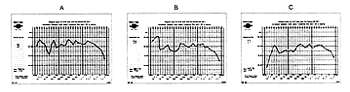
Wherein lies the rub. To illustrate, I submit for your attention the three amplitude-response curves in fig.1.  Fig.1Speaker A sounds pretty rough. With discontinuities in the lower treble, a rising top, and sharp notches here and there, Speaker A could fairly be described as an earstrain. Speaker B, on the other hand, sounds distinctly dull, with relatively smooth, restricted output of excessively warm character. Now Speaker C is a champ. The reviewer of this system enjoys hump-free bass, uncolored midrange, an extended, clear, but unfatiguing treble, and says so. Of course, all three curves were made with the same measurement techniques on the same speaker system; only the environments differed. This revelation is no surprise to any experienced audio journalist; the curves mirror those taken by the estimable Harry F. Olson over 35 years ago. So, as I am to take up the reviewer's task, I would make life easier, and more repeatable ("If you can't repeat it, it ain't physics"), by adhering to the following guidelines:
1) Listen in a good environment. The best, most helpful listening environment known to me is the full live-end/dead-end treatment where the speaker end is as acoustically dead as possible, covers perhaps the first third of the room, then gives way to a very reflective live end equipped with diffusors and virtually no absorptive components. This means damping walls, floors, and ceiling with 3" to 4" of linearly absorptive material such as Sonex. In a pinch, a heavy rug will do for floor damping, but elsewhere, make it thick, and make it dead! And no furniture or equipment racks between, behind, beside, or close in front of the speakers---all this stuff goes in the live end. Among reviewers of my acquaintance, Audio's longtime Associate Editors Bert Whyte and Barney Pisha [both now deceased.---Ed.] share the prize for best listening room. Bert's was one of the first residential LEDE rooms in the country (constructed in 1980), a good 25'-long rectangular space on a concrete slab (concrete on mother earth is best for floors; anything less rigid becomes a sounding board for the music). Barney's listening room, much smaller than the pictures published recently in Audio would suggest, is a calibrated LEDE environment complete with elaborate diffusors in the live end. Worst reviewing environment in my experience belongs to a regular contributor to that other big-circulation underground, whose room forces one to place speakers in front of a stone fireplace, complete with brass poker/shovel set singing sympathetic accompaniment to the high notes. Ugh.
Fig.1Speaker A sounds pretty rough. With discontinuities in the lower treble, a rising top, and sharp notches here and there, Speaker A could fairly be described as an earstrain. Speaker B, on the other hand, sounds distinctly dull, with relatively smooth, restricted output of excessively warm character. Now Speaker C is a champ. The reviewer of this system enjoys hump-free bass, uncolored midrange, an extended, clear, but unfatiguing treble, and says so. Of course, all three curves were made with the same measurement techniques on the same speaker system; only the environments differed. This revelation is no surprise to any experienced audio journalist; the curves mirror those taken by the estimable Harry F. Olson over 35 years ago. So, as I am to take up the reviewer's task, I would make life easier, and more repeatable ("If you can't repeat it, it ain't physics"), by adhering to the following guidelines:
1) Listen in a good environment. The best, most helpful listening environment known to me is the full live-end/dead-end treatment where the speaker end is as acoustically dead as possible, covers perhaps the first third of the room, then gives way to a very reflective live end equipped with diffusors and virtually no absorptive components. This means damping walls, floors, and ceiling with 3" to 4" of linearly absorptive material such as Sonex. In a pinch, a heavy rug will do for floor damping, but elsewhere, make it thick, and make it dead! And no furniture or equipment racks between, behind, beside, or close in front of the speakers---all this stuff goes in the live end. Among reviewers of my acquaintance, Audio's longtime Associate Editors Bert Whyte and Barney Pisha [both now deceased.---Ed.] share the prize for best listening room. Bert's was one of the first residential LEDE rooms in the country (constructed in 1980), a good 25'-long rectangular space on a concrete slab (concrete on mother earth is best for floors; anything less rigid becomes a sounding board for the music). Barney's listening room, much smaller than the pictures published recently in Audio would suggest, is a calibrated LEDE environment complete with elaborate diffusors in the live end. Worst reviewing environment in my experience belongs to a regular contributor to that other big-circulation underground, whose room forces one to place speakers in front of a stone fireplace, complete with brass poker/shovel set singing sympathetic accompaniment to the high notes. Ugh.
Note about the author: author Brian Cheney, when not making his VMPS loudspeakers somewhere in Northern California, fancies himself a journalist.
Fig.1Speaker A sounds pretty rough. With discontinuities in the lower treble, a rising top, and sharp notches here and there, Speaker A could fairly be described as an earstrain. Speaker B, on the other hand, sounds distinctly dull, with relatively smooth, restricted output of excessively warm character. Now Speaker C is a champ. The reviewer of this system enjoys hump-free bass, uncolored midrange, an extended, clear, but unfatiguing treble, and says so. Of course, all three curves were made with the same measurement techniques on the same speaker system; only the environments differed. This revelation is no surprise to any experienced audio journalist; the curves mirror those taken by the estimable Harry F. Olson over 35 years ago. So, as I am to take up the reviewer's task, I would make life easier, and more repeatable ("If you can't repeat it, it ain't physics"), by adhering to the following guidelines: Note about the author: author Brian Cheney, when not making his VMPS loudspeakers somewhere in Northern California, fancies himself a journalist.