Ars-Sonum is a Spanish audio company that, as far as I can tell, makes only one product—but it's a doozy (footnote 1). The Filarmonía SE is a tube integrated amplifier that is, in many ways, an homage to Dynaco's iconic Stereo 70 power amplifier of 1959, but the Filarmonía is by no means a slavish copy. Get down to specifics, and it's actually more of a clean-sheet-of-paper design.
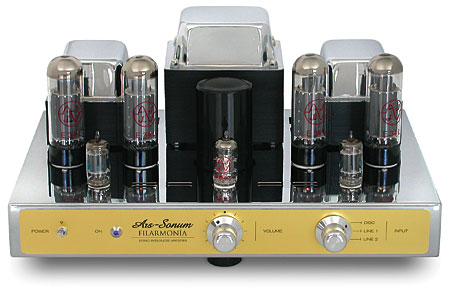 I first saw the Ars-Sonum Filarmonía some years ago, in a hotel-room bathroom at a Home Entertainment Show in New York; perhaps it was 2004. (That venue was not chosen for its acoustics, I can assure you.) Bobby Palkovic, of loudspeaker manufacturer Merlin Music Systems, wanted to give journalists a quick, eyes-only sneak preview of the amplifier.
On the basis of its drop-dead-gorgeous looks alone, the Filarmonía seemed to justify its (at that time) $3500 price. However, an audition would have to wait until the order-backlog situation improved—which, owing to the Filarmonía's essentially hand-built nature and robust word-of-mouth sales, turned out to be some length of time. The relevance is that the Filarmonía SE is now a mature and successful product that has been in production for some years, and that has been improved (hence the SE designation) in the course of its marketplace development.
Bobby Palkovic sent me a new unit with minimal break-in time on it in early 2007. At Home Entertainment 2007 in New York City, he included the Filarmonía in a system showcasing his own Merlin speakers. That system won plaudits from other Stereophile writers at the "Ask the Editors" panel discussion, as well as from a broad cross section of e-zine writers covering the Show. A bonus at HE2007 was the avuncular presence of Ars-Sonum's genial factotum Ricardo Hernandez.
For those of you not in the hobby during the relevant years (1959–1990), a few words about Dynaco's Stereo 70 are in order. David Hafler's first company, Acrosound, which he founded in 1950, was dedicated to making audio-output transformers. Although Acrosound's products were well respected, the company was reportedly not very profitable. So perhaps it's not unfair to infer that Hafler turned to selling audio kits as a way to sell more audio transformers. He founded Dynaco in 1955.
Dynaco's first product was the Mk.II, a 50W monophonic tube power amplifier. I could not locate any source explaining why their first product was called "Mk.II." Perhaps Hafler wanted people to think that all the bugs had been worked out. With the advent of commercialized stereo, Dynaco offered a one-chassis stereo power amplifier of somewhat less power, and, to indicate that it was not a mono unit, included stereo in its name: the Stereo (ST-) 70.
While the Stereo 70 employed Hafler's basic amplifier-circuit design, which itself consisted of refinements to earlier designs by D.T.N. Williamson and Alan Blumlein, the Stereo 70 was actually designed by Bob Tucker and Hafler's partner Ed Laurent, while Hafler himself was away on a business trip.
I first saw the Ars-Sonum Filarmonía some years ago, in a hotel-room bathroom at a Home Entertainment Show in New York; perhaps it was 2004. (That venue was not chosen for its acoustics, I can assure you.) Bobby Palkovic, of loudspeaker manufacturer Merlin Music Systems, wanted to give journalists a quick, eyes-only sneak preview of the amplifier.
On the basis of its drop-dead-gorgeous looks alone, the Filarmonía seemed to justify its (at that time) $3500 price. However, an audition would have to wait until the order-backlog situation improved—which, owing to the Filarmonía's essentially hand-built nature and robust word-of-mouth sales, turned out to be some length of time. The relevance is that the Filarmonía SE is now a mature and successful product that has been in production for some years, and that has been improved (hence the SE designation) in the course of its marketplace development.
Bobby Palkovic sent me a new unit with minimal break-in time on it in early 2007. At Home Entertainment 2007 in New York City, he included the Filarmonía in a system showcasing his own Merlin speakers. That system won plaudits from other Stereophile writers at the "Ask the Editors" panel discussion, as well as from a broad cross section of e-zine writers covering the Show. A bonus at HE2007 was the avuncular presence of Ars-Sonum's genial factotum Ricardo Hernandez.
For those of you not in the hobby during the relevant years (1959–1990), a few words about Dynaco's Stereo 70 are in order. David Hafler's first company, Acrosound, which he founded in 1950, was dedicated to making audio-output transformers. Although Acrosound's products were well respected, the company was reportedly not very profitable. So perhaps it's not unfair to infer that Hafler turned to selling audio kits as a way to sell more audio transformers. He founded Dynaco in 1955.
Dynaco's first product was the Mk.II, a 50W monophonic tube power amplifier. I could not locate any source explaining why their first product was called "Mk.II." Perhaps Hafler wanted people to think that all the bugs had been worked out. With the advent of commercialized stereo, Dynaco offered a one-chassis stereo power amplifier of somewhat less power, and, to indicate that it was not a mono unit, included stereo in its name: the Stereo (ST-) 70.
While the Stereo 70 employed Hafler's basic amplifier-circuit design, which itself consisted of refinements to earlier designs by D.T.N. Williamson and Alan Blumlein, the Stereo 70 was actually designed by Bob Tucker and Hafler's partner Ed Laurent, while Hafler himself was away on a business trip.
 The ST-70 originally cost $99 for the kit version, which included a preassembled and tested circuit board; the builder need only wire the chassis and assemble the hardware. The fully assembled version cost $129. The original ST-70 design had an open area toward the front of the chassis, through which the audio circuit board stood proud. I dimly (and perhaps incorrectly) recall the brown metal tube cage as having been optional. People were less touchy about product safety back then, or perhaps society expected parents both to put electronics where children could not mess with them, and to teach their children prudent avoidance—or at least buy the tube cage. This memory of the tube cage is from an early-1960s Allied Radio catalog that was my audio "wish book" when I was a tyke.
The cultural relevance of the tube cage is this: With the cage installed, the ST-70 looked like a cinderblock someone had painted with a brown crinkle finish. But with the cage off and music playing, the ST-70 had the look that, for millions of people, for decades, said "hi-fi." That iconic ST-70 look was two pairs of power tubes in front, one pair on each side of some juice-can–sized thingies, and three transformers at the rear: a larger power transformer, with smaller output transformers on either side. This is the look that the Ars-Sonum Filarmonía SE pays tribute to, and updates and improves on. The Stereo 70's audio performance was good enough to make it known as "the poor man's McIntosh."
Owing to the large numbers in which it was produced—reportedly more than 300,000 units—and the comparatively low prices that built kits that were only average in build quality fetched on the used market, the ST-70 became a popular "mule" for experimenters and modifiers from the 1970s on. Audio Research Corporation and Audio by Van Alstine were two of the many companies that have offered ST-70 modifications. I had not been previously aware, however, of a commercial firm's offering a from-scratch designed and built ST-70 "tribute" amplifier (footnote 2).
Suddenly, it's 2007!
The ST-70 originally cost $99 for the kit version, which included a preassembled and tested circuit board; the builder need only wire the chassis and assemble the hardware. The fully assembled version cost $129. The original ST-70 design had an open area toward the front of the chassis, through which the audio circuit board stood proud. I dimly (and perhaps incorrectly) recall the brown metal tube cage as having been optional. People were less touchy about product safety back then, or perhaps society expected parents both to put electronics where children could not mess with them, and to teach their children prudent avoidance—or at least buy the tube cage. This memory of the tube cage is from an early-1960s Allied Radio catalog that was my audio "wish book" when I was a tyke.
The cultural relevance of the tube cage is this: With the cage installed, the ST-70 looked like a cinderblock someone had painted with a brown crinkle finish. But with the cage off and music playing, the ST-70 had the look that, for millions of people, for decades, said "hi-fi." That iconic ST-70 look was two pairs of power tubes in front, one pair on each side of some juice-can–sized thingies, and three transformers at the rear: a larger power transformer, with smaller output transformers on either side. This is the look that the Ars-Sonum Filarmonía SE pays tribute to, and updates and improves on. The Stereo 70's audio performance was good enough to make it known as "the poor man's McIntosh."
Owing to the large numbers in which it was produced—reportedly more than 300,000 units—and the comparatively low prices that built kits that were only average in build quality fetched on the used market, the ST-70 became a popular "mule" for experimenters and modifiers from the 1970s on. Audio Research Corporation and Audio by Van Alstine were two of the many companies that have offered ST-70 modifications. I had not been previously aware, however, of a commercial firm's offering a from-scratch designed and built ST-70 "tribute" amplifier (footnote 2).
Suddenly, it's 2007!
The first thing to get out of the way is that the Ars-Sonum Filarmonía's suggested retail price is now $4000, which I attribute not to venality or cupidity on the part of its builder or importer but to the weakness of the US dollar against European currencies. That price will be good at least through the end of 2007. The Filarmonía SE arrived in a sturdy corrugated carton plus inner carton, with several inches of resilient foam padding all around. No worries on that account. The tubes came in a wooden box with a brass clasp. In addition to a complete and well-written (and well-translated) owner's manual, there is a microfiber dusting cloth, and a single cotton glove to wear while installing the tubes. US importer Bobby Palkovic feels so strongly about the need for a high-quality, well-chosen power cord that he includes a hefty Cardas Golden Reference AC cord with the units he sells; I used that for most of my listening.
Setup and operation were trouble free. The Filarmonía runs somewhat hot, so proper ventilation is a concern; this is no amplifier to shut up in a closed cabinet. The power tubes are in complementary pairs with a claimed 98% matching factor, and therefore are numbered corresponding to their sockets on the chassis. (Bias is not user-adjustable.) The Filarmonía is another amplifier, similar to the darTZeel NHB-108, whose owner's manual warns in the strongest possible terms of extremely dire consequences if the unit is operated without loudspeakers connected.
The Filarmonía does have one quirk. For best break-in results, Ars-Sonum strongly recommends that, for the first 50 or so hours of operation, the amplifier be used for a period of three hours, then turned off for one hour, then turned on again for three, etc. This is claimed to optimize the curing of the paint on the transformer laminations. The unit I received had some time on it, and I followed the three-hours-on/one-hour-off regimen until at least 50 hours had passed. The owner's manual cites 100 hours as the point when you're out of the woods, but also cautions that completely stable operation will not be reached until 500 hours.
That was my experience, in that there was a small amount of transformer hum at the outset, inaudible when most music was playing. I hasten to assure that this was a mechanical hum from the unit itself, not through the speakers. The hum stayed around and stayed around, and then, suddenly, one day it was more than half gone—not a linear process at all. A few more discrete ratchets-down and it was totally gone.
Footnote 1: In contemporary usage and spelling, doozy is often used ironically to mean something inappropriate, out of order, or otherwise exasperating. However, the original spelling of Duesie, which I prefer, shows its derivation from the name of the Duesenberg automobile company, and the original connotation was of ne plus ultra quality. Footnote 2: The ST-70 was covered in Stereophile by J. Gordon Holt (Jan.–Feb. 1963, Vol.1 No.3) and Sam Tellig (May 1988, Vol.11 No.5). The Dynaco Stereo 70 II, produced by Dynaco's corporate successor, Panor, was assessed in controversy-engendering fashion by Corey Greenberg in September 1992 (Vol.15 No.9). Barry Willis' online obituary of David Hafler can be found here.
I first saw the Ars-Sonum Filarmonía some years ago, in a hotel-room bathroom at a Home Entertainment Show in New York; perhaps it was 2004. (That venue was not chosen for its acoustics, I can assure you.) Bobby Palkovic, of loudspeaker manufacturer Merlin Music Systems, wanted to give journalists a quick, eyes-only sneak preview of the amplifier.
On the basis of its drop-dead-gorgeous looks alone, the Filarmonía seemed to justify its (at that time) $3500 price. However, an audition would have to wait until the order-backlog situation improved—which, owing to the Filarmonía's essentially hand-built nature and robust word-of-mouth sales, turned out to be some length of time. The relevance is that the Filarmonía SE is now a mature and successful product that has been in production for some years, and that has been improved (hence the SE designation) in the course of its marketplace development.
The ST-70 originally cost $99 for the kit version, which included a preassembled and tested circuit board; the builder need only wire the chassis and assemble the hardware. The fully assembled version cost $129. The original ST-70 design had an open area toward the front of the chassis, through which the audio circuit board stood proud. I dimly (and perhaps incorrectly) recall the brown metal tube cage as having been optional. People were less touchy about product safety back then, or perhaps society expected parents both to put electronics where children could not mess with them, and to teach their children prudent avoidance—or at least buy the tube cage. This memory of the tube cage is from an early-1960s Allied Radio catalog that was my audio "wish book" when I was a tyke.
The cultural relevance of the tube cage is this: With the cage installed, the ST-70 looked like a cinderblock someone had painted with a brown crinkle finish. But with the cage off and music playing, the ST-70 had the look that, for millions of people, for decades, said "hi-fi." That iconic ST-70 look was two pairs of power tubes in front, one pair on each side of some juice-can–sized thingies, and three transformers at the rear: a larger power transformer, with smaller output transformers on either side. This is the look that the Ars-Sonum Filarmonía SE pays tribute to, and updates and improves on. The Stereo 70's audio performance was good enough to make it known as "the poor man's McIntosh."
The first thing to get out of the way is that the Ars-Sonum Filarmonía's suggested retail price is now $4000, which I attribute not to venality or cupidity on the part of its builder or importer but to the weakness of the US dollar against European currencies. That price will be good at least through the end of 2007. The Filarmonía SE arrived in a sturdy corrugated carton plus inner carton, with several inches of resilient foam padding all around. No worries on that account. The tubes came in a wooden box with a brass clasp. In addition to a complete and well-written (and well-translated) owner's manual, there is a microfiber dusting cloth, and a single cotton glove to wear while installing the tubes. US importer Bobby Palkovic feels so strongly about the need for a high-quality, well-chosen power cord that he includes a hefty Cardas Golden Reference AC cord with the units he sells; I used that for most of my listening.
Footnote 1: In contemporary usage and spelling, doozy is often used ironically to mean something inappropriate, out of order, or otherwise exasperating. However, the original spelling of Duesie, which I prefer, shows its derivation from the name of the Duesenberg automobile company, and the original connotation was of ne plus ultra quality. Footnote 2: The ST-70 was covered in Stereophile by J. Gordon Holt (Jan.–Feb. 1963, Vol.1 No.3) and Sam Tellig (May 1988, Vol.11 No.5). The Dynaco Stereo 70 II, produced by Dynaco's corporate successor, Panor, was assessed in controversy-engendering fashion by Corey Greenberg in September 1992 (Vol.15 No.9). Barry Willis' online obituary of David Hafler can be found here.