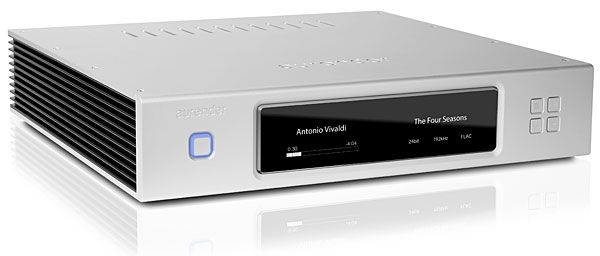
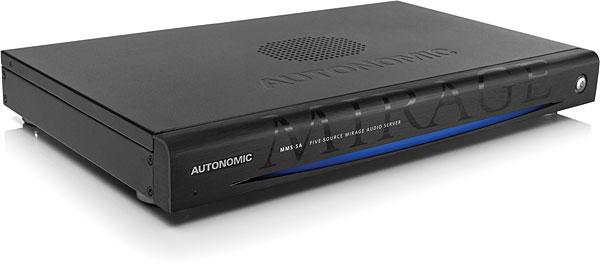
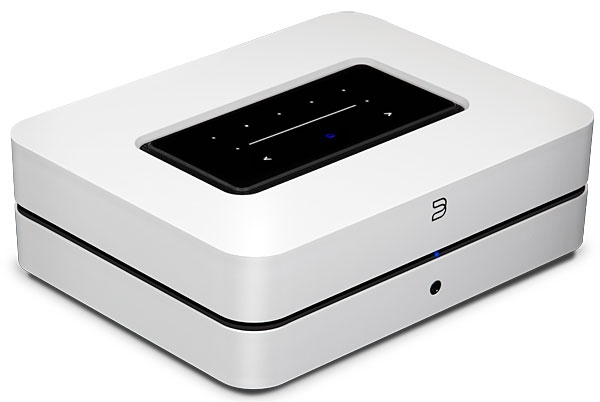
Media Server Reviews
Sort By: Post Date | Title | Publish Date
Wes Phillips Oct 05, 2003 0 comments
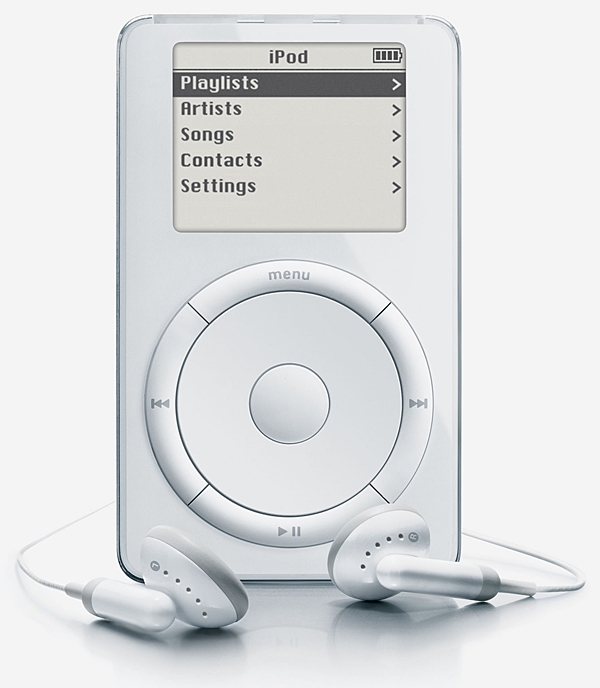
It was John Atkinson, that legendary ornithologist, who first pointed it out: "Have you noticed how frequently you see women using the iPod?"
Media Server Reviews
John Atkinson Apr 09, 2013 2 comments
I bought a Slim Devices Squeezebox network player in the spring of 2006 and my life changed. Having audio files on a server and being able to play them through my high-end rig via the Squeezebox's S/PDIF output liberated my music from the tyranny of a physical medium. As I wrote in my review, "physical discs seem so 20th century!" After Wes Phillips reviewed the Squeezebox's big brother, the Transporter, in February 2007, I bought the review sample and lived happily ever after in the world of bits rather than atoms—at least until the summer of 2010, when Slim Devices' new owner, Logitech, brought out the Squeezebox Touch. The Touch did everything the Transporter did, with a full-color display, at one-eighth the price!
Media Server Reviews
Larry Greenhill Jun 15, 2011 1 comments
James Tanner, VP of marketing at Bryston Ltd., was frustrated. He'd borrowed a Music Vault 4000 music server to play high-resolution digital music files at Bryston's exhibit at the 2009 Consumer Electronics Show. Most of the time, the server delivered some of the best sound at that event. The rest of the time, there were dropouts and crashes. Tanner later experienced similar dropouts and crashes when he streamed hi-rez digital files over his home network to a Bryston BDA-1 digital-to-analog converter (see my review in the February 2010 issue).

I found a more relaxed Tanner at the 2010 CES. This time, he'd borrowed an Auraliti L-1000 digital file server ($3000 at www.auraliti.com), a box with no front-panel controls, no display, no hard drive, no fans, and no CD drive. Instead of a Windows operating system, the L-1000 ran a stripped-down version of the Linux open-source operating system. Its simplicity of design solved the reliability problems Tanner had encountered the year before.

Then and there, Tanner decided to ask Auraliti to help Bryston create a simple digital music file player. The result is the BDP-1.

Stephen Mejias May 09, 2011 4 comments
Head-Direct's HiFiMan HM-602 is the second in a growing line of perfectionist-quality portable music players designed by Fang Bian, a 31-year-old audiophile and student of nanotechnology at the City University of New York's Hunter College. Bian's first HiFiMan design was the larger, heavier, more versatile HM-801 ($790; see my review here). In building the HM-602, Fang sacrificed the '801's removable amplifier module, 15V rechargeable battery, and coaxial input, thus creating a smaller, more portable product. Much sleeker and less substantial than the '801, the HM-602 measures approximately 4" L by 2.5" W by 1" D and weighs just 7oz—it can rest comfortably in the palm of a hand or a coat's inner pocket.

Overall, the HM-602 has a handsome, rather serious appearance: With its gold controls and its fine metallic finish, which at times seems a deep green and at others takes on a smoky charcoal, the HM-602, like its predecessor, exhibits an air of elegance and sophistication. And while the HM-801 proudly takes after Sony's famed Walkman—Fang Bian once owned every available model of the now-discontinued portable cassette player—the HM-602 much more closely resembles Apple's iPod Classic. On its front panel, below the 2" LCD screen, the HM-602 has a four-way control ring similar to the iPod's scroll wheel, and three sliding switches: Power, Hold (deactivates controls while music is playing), and DAP/USB.

Wes Phillips Mar 12, 2008 1 comments
Even the most savvy Stereophile reader might wonder what a "network music player" is. Linn rightly considers a music server to be a combination of 1) stored digital files, 2) music-management software, and 3) a device that uses #2 to transfer #1 to your hi-fi. What Linn's Klimax DS is is a high-quality digital-to-analog converter (DAC) that receives digital data through an Ethernet connection rather than optical or electrical S/PDIF or AES/EBU inputs.
Media Server Reviews
John Atkinson Dec 20, 2001 1 comments
My friend Ed (not necessarily his name) used to be an audiophile. Ed had a great-sounding pair of floorstanding Joseph speakers, optimally placed so as to create a magic soundstage when he sat in the sweet spot. His component rack featured such famous high-end names as Mark Levinson, Meridian, and Z-Systems. But then Ed went DSL and discovered MP3s. Pretty soon, he was hanging as many hard drives on his PC as he could manage. His Josephs and his Levinson CD player gathered dust. Ed was enjoying his music sitting in front of his high-end Dell, with an active NHT Pro mini on either side of the monitor.
Art Dudley Mar 18, 2011 1 comments
My quandary on receiving for review the Linn Majik DS-I: What, precisely, is it supposed to do? Does the Majik DS-I contain a hard disk and music-ripping software, so I can use it to store all the music in my CD collection? Does it have a graphical user interface (GUI) that at least matches the one provided by the endearingly free Apple iTunes? Does it include a DAC that allows it to play the music files I've already put on my computer?
Kalman Rubinson Oct 11, 2010 0 comments
When it comes to ripping CDs and downloading music, I've been sitting on the sidelines feeling more than a bit of envy. Stereophile's reviews of various media servers have whetted my appetite, but not so much as to overcome my timidity about getting into a new realm of technology in which I would be a beginner all over again. Still, I've sneaked a few peeks.
Media Server Reviews
Wes Phillips Jan 22, 2008 0 comments
It has a fan, it won't work without a monitor, and it contains a 750GB hard drive—for some audiophiles, that's a trifecta of reasons not to buy the McIntosh MS750 music server ($6000).
John Atkinson Oct 24, 2008 0 comments
"Physical discs seem so 20th century!" That's how I ended my eNewsletter review of the Logitech (then Slim Devices) Squeezebox WiFi music server in April 2006, and it seems that increasing numbers of Stereophile readers agree with me. In our website poll of January 5, 2008, we asked, "Are you ready for an audiophile music server?" The response to that question was the highest we have experienced: 32% of respondents already listen to music via their computer networks, many using home-brewed solutions, and 44% intend to. We've published a lot of material on this subject in the last five years, and it seemed a good idea to sum it up in this article.
Jon Iverson Mar 08, 2012 1 comments
The taxonomy of audio products used to be easy. An amp, a preamp, speakers, a disc player or two—done. Now that hard drives, streaming clouds, and computers have entered the scene, unless your world revolves around only an iPod or a disc player, you have choices—lots of choices.
John Atkinson Apr 09, 2006 0 comments
How to integrate a computer into a high-end audio system is a hot topic these days. I'm getting more and more e-mails from readers asking for advice, Wes Phillips wrote about transferring his LPs to audio files in his October and November newsletters, and a lively thread on this topic ran on the forum at www.stereophile.com.
Larry Greenhill May 13, 2007 0 comments
My interest in wireless network music players began during David Hyman's keynote speech at Home Entertainment 2003. Then CEO of Gracenote, Inc. (footnote 1), Hyman stunned me with his opinion that CDs and DVDs were already obsolete. Rather than pursue discs with greater storage capacity, Hyman urged industry designers to design music-server units with large hard drives to allow instantaneous access to any digital music track. With all of your music stored on a central hard drive, you could, within seconds, locate a specific track among thousands just by knowing the name of the artist, song, group, composer, year of recording, or even recording venue. Music mixes could be instantly grouped into playlists by the owner.
John Atkinson Sep 09, 2006 0 comments
As readers of the Stereophile eNewsletter will be aware, the twin subjects of distributing music around my home and integrating my iTunes library of recordings into my high-end system have occupied much of my attention the past year. I bought an inexpensive Mac mini to use as a music server, using an Airport Express as a WiFi hub, which worked quite well, but my big step forward was getting a Squeezebox. I described this slim device in the mid-March and mid-April eNewsletters; I urge readers to read those reports to get the full background on this impressive device. In addition, the forums and Wiki pages on the Slim Devices website offer a wealth of information on getting the most from a Squeezebox.
Wes Phillips Feb 11, 2007 3 comments
Is a high-end music server the audio equivalent of polishing a turd?
Site Map / Direct Links