Reality check number one. Tired of reading about the latest and greatest $65,000 loudspeakers? Or even the current hot ticket at $2500? Such loudspeakers promise to bring you the audio truth, or the golly-gee-whiz, honest-to-gosh, absolutely positively real sound. And some of them do seem to come awfully close, though truth be told, we're still a long way from replicating reality—and will never do it with just two channels.
 The truth may be "out there," but we're in here. And the truth has always included the fact that, beyond a certain point, doubling the price buys an increasingly smaller upward increment in performance. (It may even buy you less, but that's another story!) But you won't get much agreement on where that point falls at which the price/quality curve begins to level out—the point beyond which going further into hock buys you more in prestige than in sound.
I would certainly argue that the breakpoint for loudspeakers is considerably higher than $700 per pair. But the Energy C-2, the smallest and least expensive model in Canadian manufacturer Energy's Connoisseur series, makes a powerful argument on behalf of that figure.
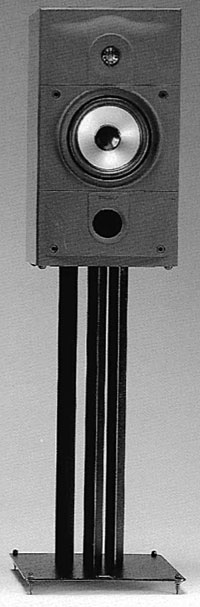
One look at the C-2 tells you that there is some new-think at work here, at least in the cosmetic department. The "Spherex (tm)" front baffle is injection-molded for low diffraction and integrates with an internal, multi-level bracing system. No screws are visible, and there is no readily apparent way to remove the drive-units (which was something of a problem in the course of this review—see below). The grille frame is lightweight and the grille is said to be acoustically transparent (I did my listening with the grilles off anyway), and dual, five-way binding posts are provided on the rear for bi-wiring, if desired. While the MDF cabinet is vinyl-wrapped, the look is definitely not cheap. Our samples had a gorgeous, polished rosewood finish; gloss black and black ash are also available.
Energy hasn't shortchanged on the technical side of the C-2's design, either. The aluminum-dome, cloth-suspension tweeter was originally designed for Energy's top-of-the-line Veritas v2.8 loudspeaker. It has a low fundamental resonance of 550Hz—allowing for a relatively low 1.8kHz crossover frequency—and ferrofluid cooling. The woofer has a sophisticated voice-coil/magnet structure and an injection-molded, aluminum/polypropylene cone with a composite butyl rubber surround. Both drivers are said to be smooth enough to allow for a relatively straightforward crossover network. The components in the latter are used only for the required high-pass/low-pass rolloffs, and not to correct for driver or enclosure anomalies.
Performance
The truth may be "out there," but we're in here. And the truth has always included the fact that, beyond a certain point, doubling the price buys an increasingly smaller upward increment in performance. (It may even buy you less, but that's another story!) But you won't get much agreement on where that point falls at which the price/quality curve begins to level out—the point beyond which going further into hock buys you more in prestige than in sound.
I would certainly argue that the breakpoint for loudspeakers is considerably higher than $700 per pair. But the Energy C-2, the smallest and least expensive model in Canadian manufacturer Energy's Connoisseur series, makes a powerful argument on behalf of that figure.
One look at the C-2 tells you that there is some new-think at work here, at least in the cosmetic department. The "Spherex (tm)" front baffle is injection-molded for low diffraction and integrates with an internal, multi-level bracing system. No screws are visible, and there is no readily apparent way to remove the drive-units (which was something of a problem in the course of this review—see below). The grille frame is lightweight and the grille is said to be acoustically transparent (I did my listening with the grilles off anyway), and dual, five-way binding posts are provided on the rear for bi-wiring, if desired. While the MDF cabinet is vinyl-wrapped, the look is definitely not cheap. Our samples had a gorgeous, polished rosewood finish; gloss black and black ash are also available.
Energy hasn't shortchanged on the technical side of the C-2's design, either. The aluminum-dome, cloth-suspension tweeter was originally designed for Energy's top-of-the-line Veritas v2.8 loudspeaker. It has a low fundamental resonance of 550Hz—allowing for a relatively low 1.8kHz crossover frequency—and ferrofluid cooling. The woofer has a sophisticated voice-coil/magnet structure and an injection-molded, aluminum/polypropylene cone with a composite butyl rubber surround. Both drivers are said to be smooth enough to allow for a relatively straightforward crossover network. The components in the latter are used only for the required high-pass/low-pass rolloffs, and not to correct for driver or enclosure anomalies.
Performance
For the past couple of years, a pair of Energy's own flagship speakers, the Veritas v2.8s, has spent more time in my reference system than have any other loudspeakers. It would be an understatement to say that they get the job done. And while the Veritases come on with a "this room is mine!" eagerness that the C-2s cannot quite match, the latter performed a surprisingly lusty imitation of their uptown cousins. My first experience with the C-2s, however, was cheerful but short. When I had to move the speakers temporarily to finish another, ongoing review, I cleverly set them face-to-face to protect the drive-units. The tweeters were thus nose to nose, and while I intended to place the speakers at least 1" apart, as I set the second one down it rocked slightly on the carpet before settling into position. This rocking caused the two tweeters to collide. Tweeter fratricide! While there are small, protective bars across the C-2's tweeter to protect it from UFOs of various sorts, these vestigial strips of plastic aren't much help against heavy and/or small, hard objects. And metal-dome tweeters cannot be repaired, but must be replaced. If you leave the grilles off the C-2s, exercise caution.
Since the drivers in the C-2 cannot be easily removed in the field, a second pair of speakers was sent to Santa Fe, and the review process finally got underway. From the start, the C-2s projected a big, open sound, with ambience, depth, and imaging to spare. The huge acoustic spaces surrounding the organs on The Mighty Wurlitzer (New World Records NW 227-2) enveloped my listening room. The live concert hall sound on The Chieftains' An Irish Evening (RCA 09026-60916-2) was convincing. Front-to-back layering was satisfying, lateral placement precise.
The bass of the C-2 is no match for that of larger loudspeakers with larger woofers capable of moving a lot of air. But the C-2 does produce a satisfying sense of low-end extension, an extension not bought at the expense of the midbass. The latter—clean, tight, and detailed—is arguably better balanced and in better proportion to the rest of the audible range than in many larger, more expensive loudspeakers. The percussive impact of the soundtrack from Patriot Games (RCA 66051-2) was striking—no wimpy minimonitor sound here. The double bass on Mokave's Afriqúe (AudioQuest AQ1024) was crisp and sharply defined. And if the bass on Dead Can Dance's Into the Labyrinth (4AD 9 45384-2) was a little rich, it sounds that way on other well-designed loudspeakers as well. But that didn't stop it from being punchy and surprisingly powerful. The midbass is one region where predicting the balance of any loudspeaker in your room and your system gets dicey, but the C-2s, in my room, had just the right amount of natural warmth and clarity.
I used the Carver AV-806x six-channel power amplifier for the bulk of my listening to the C-2s. Why choose a multi-channel amp when we are only dealing with two channels? Simple. The Carver not only sounds as good in its multi-channel role as any five- or six-channel amplifier I have used in my home theater system, but it sounds terrific in my two-channel reference system as well, even driving the big Energy Veritas v2.8s. I also drove the C-2s briefly with the Aragon 8008, and while it also performed well, it is unlikely that anyone will spend $1000/channel for amplification to drive the C-2s (the Carver costs less than $300/channel). And the slightly sweeter sound of the Carver seemed to form a better match with the C-2s.
That is not to say that the C-2 sounds bright or tipped-up. While it does appear to be a little brighter in the low- to mid-treble than Energy's Veritas v2.8 (which uses a similar tweeter but a different crossover network), in no way was the C-2 prominent in the treble. In fact, the more I listened, the better I liked the speaker's top end. It had an easy, open, detailed quality, neither crisp nor dark. And it will tell you what is happening on a recording. Mobile Fidelity's Ultradisc II CD remastering of Joan Baez's Diamonds and Rust (MFSL UDCD 646), for example, sounded much the way I remember the LP sounding—over-produced. It was not irritating, just a little chromium-plated. A fault, I am certain, of the original A&M master tape.
But put a good recording through the C-2 and the treble will simply tell it like it is. Listen to the subtle HF details on Oregon's Beyond Words (Chesky JD130), particularly the quirky but intriguing "Silver Suite." Or the impact of the transients on The All Star Percussion Ensemble II (Golden String GSCD 013). While I have heard more pristine top ends—particularly in their ability to hold together at very high levels—I found nothing in the Energy's treble to really sink my critical teeth into. Certainly, some will prefer a softer sound in a loudspeaker destined for use in a modestly priced system, or when playing marginal program material. I never felt, however, that the C-2 was exaggerating the flaws in mediocre or poor recordings, a problem with many loudspeakers (and not just modestly-priced ones).
The truth may be "out there," but we're in here. And the truth has always included the fact that, beyond a certain point, doubling the price buys an increasingly smaller upward increment in performance. (It may even buy you less, but that's another story!) But you won't get much agreement on where that point falls at which the price/quality curve begins to level out—the point beyond which going further into hock buys you more in prestige than in sound.
I would certainly argue that the breakpoint for loudspeakers is considerably higher than $700 per pair. But the Energy C-2, the smallest and least expensive model in Canadian manufacturer Energy's Connoisseur series, makes a powerful argument on behalf of that figure.
One look at the C-2 tells you that there is some new-think at work here, at least in the cosmetic department. The "Spherex (tm)" front baffle is injection-molded for low diffraction and integrates with an internal, multi-level bracing system. No screws are visible, and there is no readily apparent way to remove the drive-units (which was something of a problem in the course of this review—see below). The grille frame is lightweight and the grille is said to be acoustically transparent (I did my listening with the grilles off anyway), and dual, five-way binding posts are provided on the rear for bi-wiring, if desired. While the MDF cabinet is vinyl-wrapped, the look is definitely not cheap. Our samples had a gorgeous, polished rosewood finish; gloss black and black ash are also available.
For the past couple of years, a pair of Energy's own flagship speakers, the Veritas v2.8s, has spent more time in my reference system than have any other loudspeakers. It would be an understatement to say that they get the job done. And while the Veritases come on with a "this room is mine!" eagerness that the C-2s cannot quite match, the latter performed a surprisingly lusty imitation of their uptown cousins. My first experience with the C-2s, however, was cheerful but short. When I had to move the speakers temporarily to finish another, ongoing review, I cleverly set them face-to-face to protect the drive-units. The tweeters were thus nose to nose, and while I intended to place the speakers at least 1" apart, as I set the second one down it rocked slightly on the carpet before settling into position. This rocking caused the two tweeters to collide. Tweeter fratricide! While there are small, protective bars across the C-2's tweeter to protect it from UFOs of various sorts, these vestigial strips of plastic aren't much help against heavy and/or small, hard objects. And metal-dome tweeters cannot be repaired, but must be replaced. If you leave the grilles off the C-2s, exercise caution.