Beauty is in the eye of the beholder—but all too often there is little of beauty to be found in high-end audio. In these aesthetic dark ages, we have been indoctrinated to forsake grace and elegance; we all know that every underlying penny should be spent only in the pursuit of superior sonic performance.
 Bull! Where tradeoffs are necessary, sonic performance should indeed come first. Design decisions such as the ones which led to the inclusion of inconvenient dual volume pots on the Audible Illusions Modulus 3 preamp and to the innocuous grille/sock over the price/performance-leading Vandersteen 2ce loudspeaker make perfect sense. But when we are asked to pay $10k, $20k, or S70k for our audio gear, to downplay the role of aesthetics is preposterous. We can legitimately expect more attention to be paid to the appearance of our equipment, indeed, we should be demanding it.
I, for one, want my equipment to look as good as it sounds. Is that too much to ask? Can't audio designers and manufacturers build good looks into their products as readily as good ergonomics (or is that still another unrealistic expectation)? Don't we have a right to expect this stuff to look like we've actually spent some money on it? I want my audio equipment to make a statement even when it isn't turned on.
Diapason...
Bull! Where tradeoffs are necessary, sonic performance should indeed come first. Design decisions such as the ones which led to the inclusion of inconvenient dual volume pots on the Audible Illusions Modulus 3 preamp and to the innocuous grille/sock over the price/performance-leading Vandersteen 2ce loudspeaker make perfect sense. But when we are asked to pay $10k, $20k, or S70k for our audio gear, to downplay the role of aesthetics is preposterous. We can legitimately expect more attention to be paid to the appearance of our equipment, indeed, we should be demanding it.
I, for one, want my equipment to look as good as it sounds. Is that too much to ask? Can't audio designers and manufacturers build good looks into their products as readily as good ergonomics (or is that still another unrealistic expectation)? Don't we have a right to expect this stuff to look like we've actually spent some money on it? I want my audio equipment to make a statement even when it isn't turned on.
Diapason...
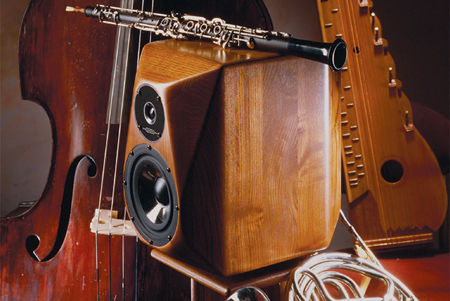
...apparently agrees. All of the speakers and stands from this Italian company are sumptuous-looking, tasteful, and fashionable. The subject of this review, the Adamantes II, is a two-way minimonitor. Its enclosure is apparently sculpted from solid hardwood, with a port on the rear. I will take the company's word for it that, to reduce standing waves, the interior of the box resembles the shape of an egg. Just sitting there, this speaker is as visually stunning as a piece of fine Italian furniture. Ah, but what of the speaker stands? Most minimonitors find themselves plopped down upon something that looks like misplaced girders from some small-scale urban high-rise. This is certainly not the case with the Diapason Adamantes. Its stand ($750/pair) is as technologically sophisticated and aesthetically remarkable as the loudspeaker itself. Internal metal plates on both top and bottom are fitted with spikes, while two full-length metal rods connect the top and bottom plates inside the three legs. All the visible metal pieces are finished in gold, while the internal rods and plates are covered in the same Italian ash as the speakers. Each wooden edge is beveled to further the curvaceous character of the speaker. The sound
The most striking sonic characteristic of the Adamantes IIs was their consistent ability to simply disappear into a large and distant soundstage. They precisely satisfied the design criterion of replicating music being performed in three-dimensional space, the music being set free as a result. However, the Adamantes could place an image in a specific location, when that was required. This proved true with the phasey, never-real-in-the-first-place environments such as "Occidenta" from Orb's Orbvs Terrarum (Island I2 24099).
On large-scale orchestral works, such as the splendid LP reissue of Rachmaninoff's Symphonic Dances (Athena ALSW-10001), the performers were placed upon a distant stage which developed well behind and around the speaker positions. On more intimate performances like Weather Report's Black Market (Columbia PC 34099), the stage remained very wide while again being located behind the speakers.
Nothing I listened to altered this basic description: a very wide stage that developed behind and around the speakers. Sounds could indeed come from places out in front of the speakers, but this was rare. Almost always, sounds came from well behind the cabinets on a very wide stage; it didn't matter if it was Michael Murray playing an organ in a church (Vierne, Symphony 3; Telarc CD-80329) or Ben Harper and his guitar on Welcome To The Cruel World (Virgin 39320-2). Since I tend to prefer a more distant perspective, especially one essentially free of the speakers, I generally enjoyed the presentation of the Diapasons.
But over time, I became concerned with the soundstaging, which was almost always distant. I began to feel something was amiss in the midrange. On very familiar music using either analog or digital front ends, there was often a hollowness, as in the Athena Rachmaninoff or Chris Isaak's San Francisco Days (Reprise 45116-1), or a boxiness, as in Dave Brubeck's Time Out (Columbia SBM CK 52860) and Sonic Fireworks Volume II (Crystal Clear CCS-7011).
Yet everything through the ever-critical midrange sounded clear and well-defined, though voices were slightly thin, harmonically. The lower in range on The Best Of Chris Rea (East West 98382), the more harmonic body there was. Higher up, on Ella Fitzgerald's Clap Hands, Here Comes Charlie! (Verve/Classic Records V6-4053), the overtone structure was less fulsome and rich. Overall, the Diapason sounded clean but a bit lightweight, which worked for me, given the distant perspective.
I couldn't help but hear problems at the boundary between the midrange and the upper bass. Relative to the midrange, certain bass areas sounded slower and somewhat sloppier. The mid-bass was heavier and slower, while true deep bass, as expected, wasn't reproduced with any power or authority. The Vierne organ recording mentioned earlier proved very revealing of the Adamantes' bass limitations; the fury and weight were simply missing. A good example of the low-frequency looseness was the typically propulsive bass line from Robert Cray's "1040 Blues" on Shame + a Sin (Mercury P2 18237). With my reference ProAc Response Fours, the track is energized by the speakers' mid/upper bass punch. With the Diapasons, the bass line sounded strong, but it was less well-defined, in stark contrast to the clarity of the Italian speakers' midrange.
The continuity between the upper midrange and the lower treble sounded appreciably more coherent. Both in this region and throughout the upper registers, the Adamantes sounded clean and clear, and offered quick transient speed. Cray's guitar solos provided a good illustration as he roamed all over his instrument's neck. But like the upper midrange, the Diapason's treble sounded lightweight harmonically, with an almost etched quality.
The more I listened to the Adamantes, the more I became aware of some dynamic compression. Music has sensationally varied levels and interplay of volume. Most audio gear fails miserably at reproducing much more than a fraction of these shadings. Having recently lived with the wonderfully dynamic JMlab Grand Utopias, I must admit to being more keenly aware of this shortcoming in other products. Once you have experienced close to natural dynamic performance from a loudspeaker, almost everything else sounds relatively lifeless. With that caveat in mind, it was the limited dynamic performance of the Adamantes that ultimately frustrated me the most. It wasn't that the Adamantes couldn't play loudly because that they could certainly do. But I kept finding myself wanting to pump up the volume in search of the missing dynamics. As is inevitable in such a situation, my attempts were for naught. What I did find was a hardening in the treble when the speakers were pushed too far.
Conclusion
The Diapason Adamantes II is drop-dead gorgeous from the tips of its stand's spikes to the top of its luxurious hardwood cabinet. It would be equally at home in a fine furniture store or in a high-end audio salon. Unfortunately, although its sonic faults are generally subtractive, the speaker's inner beauty failed to match its outward splendor.—Jack English
Bull! Where tradeoffs are necessary, sonic performance should indeed come first. Design decisions such as the ones which led to the inclusion of inconvenient dual volume pots on the Audible Illusions Modulus 3 preamp and to the innocuous grille/sock over the price/performance-leading Vandersteen 2ce loudspeaker make perfect sense. But when we are asked to pay $10k, $20k, or S70k for our audio gear, to downplay the role of aesthetics is preposterous. We can legitimately expect more attention to be paid to the appearance of our equipment, indeed, we should be demanding it.
I, for one, want my equipment to look as good as it sounds. Is that too much to ask? Can't audio designers and manufacturers build good looks into their products as readily as good ergonomics (or is that still another unrealistic expectation)? Don't we have a right to expect this stuff to look like we've actually spent some money on it? I want my audio equipment to make a statement even when it isn't turned on.
...apparently agrees. All of the speakers and stands from this Italian company are sumptuous-looking, tasteful, and fashionable. The subject of this review, the Adamantes II, is a two-way minimonitor. Its enclosure is apparently sculpted from solid hardwood, with a port on the rear. I will take the company's word for it that, to reduce standing waves, the interior of the box resembles the shape of an egg. Just sitting there, this speaker is as visually stunning as a piece of fine Italian furniture. Ah, but what of the speaker stands? Most minimonitors find themselves plopped down upon something that looks like misplaced girders from some small-scale urban high-rise. This is certainly not the case with the Diapason Adamantes. Its stand ($750/pair) is as technologically sophisticated and aesthetically remarkable as the loudspeaker itself. Internal metal plates on both top and bottom are fitted with spikes, while two full-length metal rods connect the top and bottom plates inside the three legs. All the visible metal pieces are finished in gold, while the internal rods and plates are covered in the same Italian ash as the speakers. Each wooden edge is beveled to further the curvaceous character of the speaker. The sound
The most striking sonic characteristic of the Adamantes IIs was their consistent ability to simply disappear into a large and distant soundstage. They precisely satisfied the design criterion of replicating music being performed in three-dimensional space, the music being set free as a result. However, the Adamantes could place an image in a specific location, when that was required. This proved true with the phasey, never-real-in-the-first-place environments such as "Occidenta" from Orb's Orbvs Terrarum (Island I2 24099).
The Diapason Adamantes II is drop-dead gorgeous from the tips of its stand's spikes to the top of its luxurious hardwood cabinet. It would be equally at home in a fine furniture store or in a high-end audio salon. Unfortunately, although its sonic faults are generally subtractive, the speaker's inner beauty failed to match its outward splendor.—Jack English