I always enjoy reviewing affordable loudspeakers from Polk Audio, who trumpet high value for the dollar with their philosophy of "Incredible Sound/Affordable Price." They also update their broad and deep product lines more frequently than do most manufacturers. I've always been intrigued by how much Polk has been able to deliver at the bottom of the price range. In fact, the first Polk speaker I reviewed, the RT25i (September 2001, Vol.24 No.9), is the only affordable speaker I've reviewed for Stereophile that I ended up buying (for my computer-based musical-composition system). So, when approached by Polk to review a speaker from their affordable RTi A series, I was interested in the least expensive of that line's five models: the RTi A1 ($349.95/pair).
 Isn't it good, Polk Audio wood
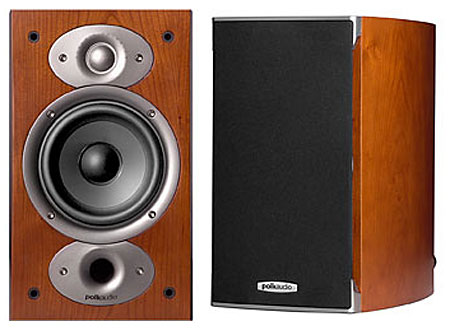
The RTi A1 is a two-way, front-ported bookshelf speaker that is biwirable and magnetically shielded. Its 1" silk/polymer-composite dome tweeter and 5¼" polymer/mineral-composite woofer were both designed using Polk's proprietary Dynamic Balance technology, which uses a full-field heterodyning laser interferometer system to analyze and minimize the resonances of speaker drive-units. Polk's Power Port technology minimizes "chuffing," or port noise, with a dispersing cone placed at the mouth of the port on the rear panel, this intended to promote laminar air flow to mimic the behavior of a long, flared port. The resulting lower turbulence at the mouth of the port is said to reduce distortion. With Polk's Acoustic Resonance Control technology, a second port on the front of the speaker resonates at the same frequency as the cabinet's internal depth resonance. As the radiation of the front and rear ports are out of phase with respect to the drive-unit output, any resonance peaks are claimed to be suppressed. The cabinet's curved and tapered back, aside from looking elegant, has a sonic function. The unusual dimensions, which produce what Polk calls Damped Asymmetric Hex Laminate Isolation, are intended to result in a stronger, more rigid, more acoustically inert enclosure, the curved walls of ¾" MDF producing fewer panel resonances and thus fewer audible colorations. My review samples' cherrywood veneer was gorgeous; said Polk's Mark Suskind, "We are the only American company with any serious market share that offers real wood at these price points."
The RTi A1's floating grilles are designed to minimize diffraction to provide a more realistic tonal balance and spacious imaging. As soon as I began listening, I knew that this aspect of the design had been successful: I noticed only a negligible difference in the sound, grilles off or on. As I always do when auditioning speakers, I placed the Polks on my Celestion Si stands, which are loaded with sand and lead shot.
Sound
The rich, holographic, uncolored, detailed midrange of the Polk RTi A1 made it a pleasure to mine classic recordings of rock singers. On "Southern Man" and "Till the Morning Comes," from After the Gold Rush (LP, Reprise 6383), Neil Young's voice was rich, organic, natural, and tactile. On Certified Live (LP, Columbia 34174), the Polks wrapped a coherent, well-paced rhythm section around Dave Mason's silky vocalizings on "Only You Know and I Know." Further up the audioband, I found the RTi A1's high-frequency presentation fascinating: extended, detailed, and clean, with excellent transient articulation and no trace of sharpness, but with very subtle highlighting of the high frequencies. Although this was technically a coloration, it produced a "lively" sound that I found very attractive with all recordings. I focused on Carol Wincenc's flute in the Santa Fe Chamber Music Festival performance of Tomiko Kohjiba's Transmigration of the Soul, from Festival (CD, Stereophile STPH007-2). The upper partials of the instrument were extended and airy; the vibrant and extended highs were lively and refreshing without sounding bright. At the opposite end of the audioband, a very slight bump in the mid- to upper bass added a sense of drama to most recordings—and probably made the RTi A1s seem to go deeper in the bass than they actually did (we'll see what John Atkinson's measurements reveal). But the combination of the midbass bump and the highlighted highs gave the RTi an extraordinary sense of balance and vibrance that I found captivating, despite the slight deviation from neutrality.
This balance also added to the coherent presentation of jazz recordings. On "I Heard It Through the Grapevine," from Bill Frisell's East/West (CD, Nonesuch 79863-2), the coherent integration of Frisell's guitar with Viktor Krauss's bass and Kenny Wollensen's drums gave the guitar an appropriately bright sound, and made the bass just a touch warm. Wollensen's ride cymbals had never sounded more natural, and the articulations of the transients produced by all three instruments was organic and involving.
Isn't it good, Polk Audio wood
The RTi A1 is a two-way, front-ported bookshelf speaker that is biwirable and magnetically shielded. Its 1" silk/polymer-composite dome tweeter and 5¼" polymer/mineral-composite woofer were both designed using Polk's proprietary Dynamic Balance technology, which uses a full-field heterodyning laser interferometer system to analyze and minimize the resonances of speaker drive-units. Polk's Power Port technology minimizes "chuffing," or port noise, with a dispersing cone placed at the mouth of the port on the rear panel, this intended to promote laminar air flow to mimic the behavior of a long, flared port. The resulting lower turbulence at the mouth of the port is said to reduce distortion. With Polk's Acoustic Resonance Control technology, a second port on the front of the speaker resonates at the same frequency as the cabinet's internal depth resonance. As the radiation of the front and rear ports are out of phase with respect to the drive-unit output, any resonance peaks are claimed to be suppressed. The cabinet's curved and tapered back, aside from looking elegant, has a sonic function. The unusual dimensions, which produce what Polk calls Damped Asymmetric Hex Laminate Isolation, are intended to result in a stronger, more rigid, more acoustically inert enclosure, the curved walls of ¾" MDF producing fewer panel resonances and thus fewer audible colorations. My review samples' cherrywood veneer was gorgeous; said Polk's Mark Suskind, "We are the only American company with any serious market share that offers real wood at these price points."
The rich, holographic, uncolored, detailed midrange of the Polk RTi A1 made it a pleasure to mine classic recordings of rock singers. On "Southern Man" and "Till the Morning Comes," from After the Gold Rush (LP, Reprise 6383), Neil Young's voice was rich, organic, natural, and tactile. On Certified Live (LP, Columbia 34174), the Polks wrapped a coherent, well-paced rhythm section around Dave Mason's silky vocalizings on "Only You Know and I Know." Further up the audioband, I found the RTi A1's high-frequency presentation fascinating: extended, detailed, and clean, with excellent transient articulation and no trace of sharpness, but with very subtle highlighting of the high frequencies. Although this was technically a coloration, it produced a "lively" sound that I found very attractive with all recordings. I focused on Carol Wincenc's flute in the Santa Fe Chamber Music Festival performance of Tomiko Kohjiba's Transmigration of the Soul, from Festival (CD, Stereophile STPH007-2). The upper partials of the instrument were extended and airy; the vibrant and extended highs were lively and refreshing without sounding bright. At the opposite end of the audioband, a very slight bump in the mid- to upper bass added a sense of drama to most recordings—and probably made the RTi A1s seem to go deeper in the bass than they actually did (we'll see what John Atkinson's measurements reveal). But the combination of the midbass bump and the highlighted highs gave the RTi an extraordinary sense of balance and vibrance that I found captivating, despite the slight deviation from neutrality.