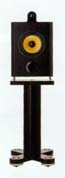
This compact, $1600/pair monitor employs many of the same design features found in the company's highly rated Matrix 801 system. Although the price is high for a two-way minimonitor, the 805 fits right into a growing high-end marketplace for such designs, one which emphasizes high quality in a small enclosure which will fit into most living-room environments without calling much attention to itself. 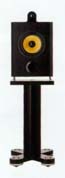 There are two versions of the 805: the vertical version reviewed here, and a model whose external tweeter is mounted on its long side so the speakers can be laid lengthwise on a bookshelf, or used as a center channel for video applications. Even though the 805 is much smaller than the full-sized B&W Matrix loudspeakers, its 10.5-liter volume is substantially more than the Sonus Faber Minima's 6 liters, or the Totem Model 1's 7.2 liters. The 805 is a reflex-tuned design by virtue of its flared ducted port, the 35mm orifice situated just below the woofer on the enclosure's front panel. The 805's cabinet features B&W's multi-cell Matrix cross-bracing, which gives the 805 great solidity and low cabinet coloration; when tapped, the speaker rings about as much as a granite boulder. Cabinet interactions are further reduced by mounting the metal-dome tweeter atop the cabinet in what Martin Colloms has called the "bullet" or "eyeball" tweeter configuration (Hi-Fi News & Record Review, June 1991, pp.42-45). The 805's drivers are top quality. The unit's midwoofer, manufactured in-house, is a long-throw, 130mm (5.4"), resin-bonded Kevlar-cone midrange/woofer with a rubber-based surround and a die-cast frame. Its 30mm voice-coil is wound on a high-temperature Kapton former. The HF unit is a recent-vintage, 25mm (1") B&W aluminum-dome tweeter, identical to the unit used in the $5500 B&W Matrix 801 Series 3 (Vol.10 No.9). The driver includes a corrective phase-plate to damp ultrasonic resonances and smooth the high treble response.
The 805's rear panel features heavy-duty gold-plated binding posts whose screws allow for bi-wiring and for very secure tightening on the spade lugs used with high-quality cables. The 805 can be supplied with a tiny AC-powered electronic low-frequency equalizer intended for a preamp's tape loop. Costing an additional $250, it cuts off all response below 10Hz, but boosts and cuts the 10-50Hz range. B&W labels this equalizer package the "800 Series Variable High Pass Alignment Filter." Its 3.5" by 2" by 2" chassis has a satin alloy finish, and is connected to a slightly larger power-supply module that delivers the 20V DC and 25mA needed to power the filter. The filter comes preset for the 805, though it's clear that it can be readjusted for use with other loudspeakers in the B&W line. The bass alignment has basically a fourth-order rollout, like any reflex system. With the addition of the accessory bass-alignment filter, however, the system has a sixth-order Butterworth alignment, which the manufacturer suggests extends the 805's -3dB-down point to 42Hz, the lowest note of the four-string double bass. The system has been time-aligned by the external tweeter's placement behind the driver panel. High-quality parts are utilized on the crossover circuit boards, including polypropylene film capacitors and hefty cored inductors. Overall, the build quality of this minimonitor is tops, with superb fit and finish. Sound
There are two versions of the 805: the vertical version reviewed here, and a model whose external tweeter is mounted on its long side so the speakers can be laid lengthwise on a bookshelf, or used as a center channel for video applications. Even though the 805 is much smaller than the full-sized B&W Matrix loudspeakers, its 10.5-liter volume is substantially more than the Sonus Faber Minima's 6 liters, or the Totem Model 1's 7.2 liters. The 805 is a reflex-tuned design by virtue of its flared ducted port, the 35mm orifice situated just below the woofer on the enclosure's front panel. The 805's cabinet features B&W's multi-cell Matrix cross-bracing, which gives the 805 great solidity and low cabinet coloration; when tapped, the speaker rings about as much as a granite boulder. Cabinet interactions are further reduced by mounting the metal-dome tweeter atop the cabinet in what Martin Colloms has called the "bullet" or "eyeball" tweeter configuration (Hi-Fi News & Record Review, June 1991, pp.42-45). The 805's drivers are top quality. The unit's midwoofer, manufactured in-house, is a long-throw, 130mm (5.4"), resin-bonded Kevlar-cone midrange/woofer with a rubber-based surround and a die-cast frame. Its 30mm voice-coil is wound on a high-temperature Kapton former. The HF unit is a recent-vintage, 25mm (1") B&W aluminum-dome tweeter, identical to the unit used in the $5500 B&W Matrix 801 Series 3 (Vol.10 No.9). The driver includes a corrective phase-plate to damp ultrasonic resonances and smooth the high treble response.
The 805's rear panel features heavy-duty gold-plated binding posts whose screws allow for bi-wiring and for very secure tightening on the spade lugs used with high-quality cables. The 805 can be supplied with a tiny AC-powered electronic low-frequency equalizer intended for a preamp's tape loop. Costing an additional $250, it cuts off all response below 10Hz, but boosts and cuts the 10-50Hz range. B&W labels this equalizer package the "800 Series Variable High Pass Alignment Filter." Its 3.5" by 2" by 2" chassis has a satin alloy finish, and is connected to a slightly larger power-supply module that delivers the 20V DC and 25mA needed to power the filter. The filter comes preset for the 805, though it's clear that it can be readjusted for use with other loudspeakers in the B&W line. The bass alignment has basically a fourth-order rollout, like any reflex system. With the addition of the accessory bass-alignment filter, however, the system has a sixth-order Butterworth alignment, which the manufacturer suggests extends the 805's -3dB-down point to 42Hz, the lowest note of the four-string double bass. The system has been time-aligned by the external tweeter's placement behind the driver panel. High-quality parts are utilized on the crossover circuit boards, including polypropylene film capacitors and hefty cored inductors. Overall, the build quality of this minimonitor is tops, with superb fit and finish. Sound
The 805s were broken-in by playing them for several weeks, though consideration of other family members ruled out using Tom Norton's method of breaking-in loudspeakers: driving the speakers face to face with high-level, out-of-phase pink noise for several days and nights. Unfortunately, the 28" Sound Anchor stands recommended by B&W for the 805 were not available for this review.
The B&W 805s passed all subjective listening tests with flying colors, doing equally well in both rooms. Pink noise was played to determine midband colorations and the optimum listening axis. The sound remained uniform during the sit-down, stand-up, walk-around test. Overall first impressions of the 805s were positive, based on their open, unrestrained top end. This quality stood out, particularly in comparison to the Quad ESL-63, the Sonus Faber Minima, and the Totem Model 1, all of which emphasized the midrange by comparison. The 805's bottom end was quite good. Test signals on Stereophile's Test CD 2 revealed that the 805s could produce clean bass down to 40Hz in my room, even without the accessory bass-alignment filter. With the filter inserted between the Classé DR-6 preamp and the Levinson No.27.5, the bass response attained greater solidity around 40Hz, rolling off more gradually below. There were only minimal traces of doubling at lower frequencies. For most music, this rolloff was so smooth that I found myself not missing the deep bass. Lyle Lovett's gospel tale on "Church" (on Joshua Judges Ruth, MCA MCAD-10475) had plenty of bass definition in the bass and drums. Jeff Beck's "Behind the Veil" (Jeff Beck's Guitar Shop, Epic EK 44313) had lots of bass slam and snap. I found the Mark Levinson No.27 and KSA-250 amplifiers to be best for reproducing the punch of a kickdrum when driving the 805s. The 805, with its larger cabinet, had more bass punch than the smaller-volume Sonus Faber Minima.
There are two versions of the 805: the vertical version reviewed here, and a model whose external tweeter is mounted on its long side so the speakers can be laid lengthwise on a bookshelf, or used as a center channel for video applications. Even though the 805 is much smaller than the full-sized B&W Matrix loudspeakers, its 10.5-liter volume is substantially more than the Sonus Faber Minima's 6 liters, or the Totem Model 1's 7.2 liters. The 805 is a reflex-tuned design by virtue of its flared ducted port, the 35mm orifice situated just below the woofer on the enclosure's front panel. The 805's cabinet features B&W's multi-cell Matrix cross-bracing, which gives the 805 great solidity and low cabinet coloration; when tapped, the speaker rings about as much as a granite boulder. Cabinet interactions are further reduced by mounting the metal-dome tweeter atop the cabinet in what Martin Colloms has called the "bullet" or "eyeball" tweeter configuration (Hi-Fi News & Record Review, June 1991, pp.42-45). The 805's drivers are top quality. The unit's midwoofer, manufactured in-house, is a long-throw, 130mm (5.4"), resin-bonded Kevlar-cone midrange/woofer with a rubber-based surround and a die-cast frame. Its 30mm voice-coil is wound on a high-temperature Kapton former. The HF unit is a recent-vintage, 25mm (1") B&W aluminum-dome tweeter, identical to the unit used in the $5500 B&W Matrix 801 Series 3 (Vol.10 No.9). The driver includes a corrective phase-plate to damp ultrasonic resonances and smooth the high treble response. The 805s were broken-in by playing them for several weeks, though consideration of other family members ruled out using Tom Norton's method of breaking-in loudspeakers: driving the speakers face to face with high-level, out-of-phase pink noise for several days and nights. Unfortunately, the 28" Sound Anchor stands recommended by B&W for the 805 were not available for this review.