I believe Ken Kantor said it first: a couple of years ago, in his September 1990 interview with Robert Harley (Vol.13 No.9), he remarked that "there's no reason why a two-way 6" loudspeaker can't be the equal of almost the best speaker out there from a certain frequency point upward, with the possible exception of dynamic range." When I read those words, they rang true. If you put to one side the need to reproduce low bass frequencies and can accept less-than-live playback levels, a small speaker can be as good as the best, and allow its owner to enjoy the benefits of its size—visual appeal, ease of placement in the room, and the often excellent imaging afforded by the use of a small front baffle.
 The subject of this review conforms to Ken Kantor's specification. It is typical of a peculiarly English genre: the small two-way speaker that nevertheless tries to be a sonic overachiever. It comes from a company that has become an up-and-coming contender for the crown: Monitor Audio.
Monitor Audio Studio 15
The subject of this review conforms to Ken Kantor's specification. It is typical of a peculiarly English genre: the small two-way speaker that nevertheless tries to be a sonic overachiever. It comes from a company that has become an up-and-coming contender for the crown: Monitor Audio.
Monitor Audio Studio 15
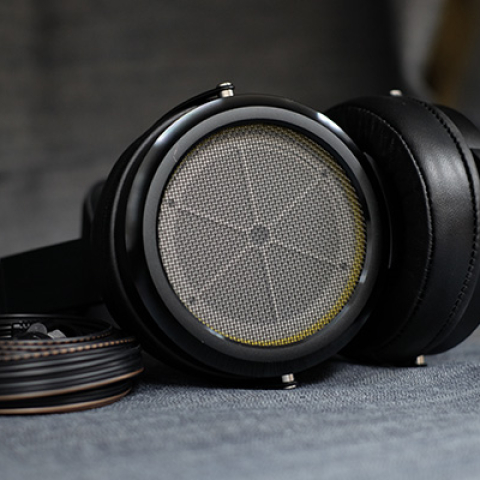
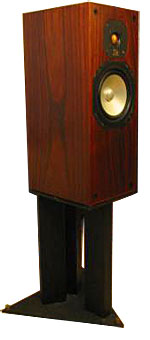
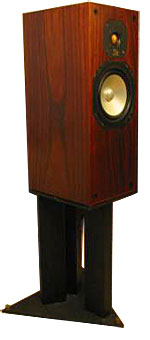
The Studio 15 is the second-to-top model in Monitor Audio's premium "Studio" line, the others being the floorstanding Studio 20 ($4499/pair, reviewed by Robert Harley last December, Vol.14 No.12), the stand-mounted Studio 10 ($3000/pair, reviewed by me in November 1990, Vol.13 No.11), and the tiny Studio 5. Finished either in painted or lacquered black, the 15 uses the same Monitor Audio–manufactured drive-units as the 20, but in a smaller enclosure. The tweeter is Monitor Audio's 1" aluminum-alloy unit with the dome anodized a golden color; though this looks similar to the unit used in the Celestion 100 that I also review this month, it uses a separate voice-coil former and is cooled with ferrofluid. The woofer is built on a diecast chassis and uses a 100µm-thick aluminum/magnesium cone, drawn in three stages with stress relief in between, with a metal dustcap and an inverted nitrile-rubber half-roll surround. Again, the cone is anodized, which results in the metal being coated with a tough layer of oxide on both sides. This both stiffens and protects the alloy underneath. The crossover is mounted on the inside of the terminal panel and is relatively simple, the tweeter being fed by a second-order network consisting of a series film capacitor and a shunt air-cored coil, while the woofer appears to be allowed to roll out naturally, apart from an LC notch filter (using a non-polarized electrolytic and a ferrite-cored coil) to help tame the metal cone's primary breakup mode at ca 6kHz. Internal wiring is with what appears to be 14-gauge cable, and the speaker connections are soldered. Electrical connection is via two pairs of knurled gold-plated binding posts just below the rear-mounted, profiled port. These are spaced too wide apart to take dual bananas, while the fact that they are mounted on an inset panel makes it hard to connect cables with spade lugs.
The Studio 15's black cloth grille is built upon a heavy frame, which would undoubtedly spoil the speaker's imaging precision. I left it off for all my auditioning, though this does leave the tweeter dome susceptible to damage from prying child-size fingers. While it might be thought that the Studio 15's size qualifies it as a "bookshelf" design, in true no-compromise fashion it must be used on a stand well away from room boundaries. Monitor Audio supplies a matching 21"-high ST-15 stand, which consists of three black-painted rectangular pillars made from lead-filled steel standing on a triangular base plate. Carpet-piercing spikes are fitted, as are small threaded cones to couple the speaker to the rectangular top plate. This stand weighs 62.5 lbs, transatlantic shipping charges undoubtedly contributing to its $875/pair price. But given the secure manner in which the ST-15s locate the speakers, as well as their acoustic inertness, I would suggest that those contemplating the Studio 15 make allowance in their budget for the stands.
Listening
The importer recommends a break-in period of at least a week for the 15s. I did my best by using Tom Norton's trick of driving the speakers face to face with high-level, out-of-phase pink noise for several days and nights (footnote 1). The stands, spiked through the carpet and pad to the tile-on-concrete floor beneath, placed the Studio 15's tweeter 38" from the floor, which was a couple of inches too high for my favorite listening chair. The Monitor Audio seemed more critical than the Celestion 100 regarding the optimum listening axis; I therefore tilted the speakers forward by unscrewing the rear top spikes a little. This didn't appear to compromise system rigidity; in fact, this speaker and stand combination are impressively stable. As usual, I first listened to pink noise to get a handle on midband colorations and to determine the optimum listening axis. Below the tweeter, the Studio 15 sounded rather hollow; on or just above the tweeter axis, the sound was smoothly balanced overall, but with a degree of emphasis near the crossover region. The bass balance seems very dependent on the amplifier used to drive the speaker. Whereas the smaller Studio 10 has a slightly under-damped upper bass that lends typical solid-state amplifiers a useful touch of warmth, the 15 tends to sound too lean, even with the awesome LF reach of the Mark Levinson. I ended up using either of the Audio Research amplifiers for most of my auditioning, with the speakers hooked up to the 8 ohm taps. This usefully fleshed out the midbass a little.
The lows extended in my room to 40Hz or so, pizzicato orchestral bass having sufficient body, though at high levels the sound could be heard to "fur up." Though I didn't measure bass distortion, I suspect it is higher than usual, as audible "doubling" could be heard on the warble tones on the second Stereophile Test CD at moderate levels. For a reflex design, however, the bass was quite rhythmic, and on hard-driving rock like Michael Jackson's "Beat It" track on Thriller, the sound boogied. This was not as true for "Billie Jean" 's low synthesizer grunts, which furred up at appropriately high playback levels. In fact, the main dynamic limitation of the 15s' sound was in the bass. While it seemed happy to party with rock music up to spls in the high '90s, asking for more than that clogged up the low frequencies.
Footnote 1: The out-of-phase wiring eliminates most but not all of the speakers' acoustic output, which caused some puzzlement for a visiting plumber who was repairing the bidet in the bathroom next to my listening room. He was sure there was a very expensive water leak in the locked listening room, but paradoxically couldn't find any pipes leading to it.
The subject of this review conforms to Ken Kantor's specification. It is typical of a peculiarly English genre: the small two-way speaker that nevertheless tries to be a sonic overachiever. It comes from a company that has become an up-and-coming contender for the crown: Monitor Audio.
Monitor Audio Studio 15
The Studio 15 is the second-to-top model in Monitor Audio's premium "Studio" line, the others being the floorstanding Studio 20 ($4499/pair, reviewed by Robert Harley last December, Vol.14 No.12), the stand-mounted Studio 10 ($3000/pair, reviewed by me in November 1990, Vol.13 No.11), and the tiny Studio 5. Finished either in painted or lacquered black, the 15 uses the same Monitor Audio–manufactured drive-units as the 20, but in a smaller enclosure. The tweeter is Monitor Audio's 1" aluminum-alloy unit with the dome anodized a golden color; though this looks similar to the unit used in the Celestion 100 that I also review this month, it uses a separate voice-coil former and is cooled with ferrofluid. The woofer is built on a diecast chassis and uses a 100µm-thick aluminum/magnesium cone, drawn in three stages with stress relief in between, with a metal dustcap and an inverted nitrile-rubber half-roll surround. Again, the cone is anodized, which results in the metal being coated with a tough layer of oxide on both sides. This both stiffens and protects the alloy underneath. The crossover is mounted on the inside of the terminal panel and is relatively simple, the tweeter being fed by a second-order network consisting of a series film capacitor and a shunt air-cored coil, while the woofer appears to be allowed to roll out naturally, apart from an LC notch filter (using a non-polarized electrolytic and a ferrite-cored coil) to help tame the metal cone's primary breakup mode at ca 6kHz. Internal wiring is with what appears to be 14-gauge cable, and the speaker connections are soldered. Electrical connection is via two pairs of knurled gold-plated binding posts just below the rear-mounted, profiled port. These are spaced too wide apart to take dual bananas, while the fact that they are mounted on an inset panel makes it hard to connect cables with spade lugs.
The importer recommends a break-in period of at least a week for the 15s. I did my best by using Tom Norton's trick of driving the speakers face to face with high-level, out-of-phase pink noise for several days and nights (footnote 1). The stands, spiked through the carpet and pad to the tile-on-concrete floor beneath, placed the Studio 15's tweeter 38" from the floor, which was a couple of inches too high for my favorite listening chair. The Monitor Audio seemed more critical than the Celestion 100 regarding the optimum listening axis; I therefore tilted the speakers forward by unscrewing the rear top spikes a little. This didn't appear to compromise system rigidity; in fact, this speaker and stand combination are impressively stable. As usual, I first listened to pink noise to get a handle on midband colorations and to determine the optimum listening axis. Below the tweeter, the Studio 15 sounded rather hollow; on or just above the tweeter axis, the sound was smoothly balanced overall, but with a degree of emphasis near the crossover region. The bass balance seems very dependent on the amplifier used to drive the speaker. Whereas the smaller Studio 10 has a slightly under-damped upper bass that lends typical solid-state amplifiers a useful touch of warmth, the 15 tends to sound too lean, even with the awesome LF reach of the Mark Levinson. I ended up using either of the Audio Research amplifiers for most of my auditioning, with the speakers hooked up to the 8 ohm taps. This usefully fleshed out the midbass a little.
Footnote 1: The out-of-phase wiring eliminates most but not all of the speakers' acoustic output, which caused some puzzlement for a visiting plumber who was repairing the bidet in the bathroom next to my listening room. He was sure there was a very expensive water leak in the locked listening room, but paradoxically couldn't find any pipes leading to it.