I believe Ken Kantor said it first: a couple of years ago, in his September 1990 interview with Robert Harley (Vol.13 No.9), he remarked that "there's no reason why a two-way 6" loudspeaker can't be the equal of almost the best speaker out there from a certain frequency point upward, with the possible exception of dynamic range." When I read those words, they rang true. If you put to one side the need to reproduce low bass frequencies and can accept less-than-live playback levels, a small speaker can be as good as the best, and allow its owner to enjoy the benefits of its size—visual appeal, ease of placement in the room, and the often excellent imaging afforded by the use of a small front baffle.
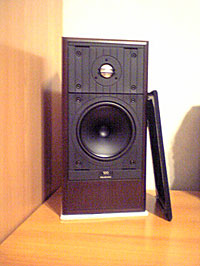
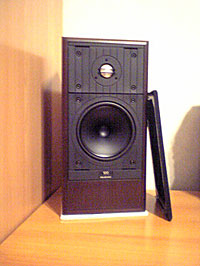 The subjects of this review conforms to Ken Kantor's specification. It is typical of a peculiarly English genre: the small two-way speaker that nevertheless tries to be a sonic overachiever. It comes from Celestion, the company that helped define the breed a decade ago.
Celestion 100: $1199/pair
The subjects of this review conforms to Ken Kantor's specification. It is typical of a peculiarly English genre: the small two-way speaker that nevertheless tries to be a sonic overachiever. It comes from Celestion, the company that helped define the breed a decade ago.
Celestion 100: $1199/pair
The 100 is the third-generation descendant of the SL6, the Celestion speaker that introduced the metal-dome tweeter to the world in 1982. The SL6 tweeter was developed with the diagnostic help of laser interferometry so that its first breakup mode was above the audio band, resulting in true pistonic motion in the unit's passband. The 100 continues that tradition by combining a similar tweeter—this time with an aluminum rather than a copper dome—with a very similar woofer. Like the original SL6 tweeter, however, the metal dome extends backward in a cylinder, around which the voice-coil is wound. This gives the effect of having a shorted turn in the magnetic field which electrically damps the drive-unit's low-frequency resonance as well as providing a degree of heatsinking. The woofer, constructed on a diecast chassis, is also a sophisticated design, based on that used in Celestion's second-generation SL6S. It uses a large magnet, and its 6.5" cone is formed from Cobex, a polyolefin polymer, with an integral inverted dustcap. Again, laser interferometry was used to diagnose the cone behavior, to arrange for its breakup problems to occur above its passband. The half-roll surround is fabricated from two different materials: an inner polymer ring to give good termination for waves traveling in the cone, and an outer ring formed from a soft, compliant synthetic rubber to give optimal bass performance.
The crossover features third-order, 18dB/octave slopes for both high- and low-pass functions, with high-quality components used: polypropylene capacitors, air-cored coils in the tweeter feed. Electrical connection is via two pairs of knurled, gold-plated binding posts on the rear, to allow bi-wiring. These are laid out horizontally—HF and LF ground, LF and HF hot—though the tiny legends are not printed but are formed in relief on the black plastic terminal panel. For those of us who need glasses to read, this is not the most legible way of doing things, rivaled only by JVC's penchant for printing in light gray on a dark gray background on their "1010" series products. Doesn't anyone at the Celestion or JVC factories ever use their own products under domestic conditions?
The completely sealed cabinet is made from 15mm MDF, veneered inside and out and filled with acoustic foam. Though taller than that of the SL6 or SL600, this cabinet has the same 12-liter volume, the extra space being taken up by extensive bracing. Two asymmetrically positioned internal figure-eight braces raise cabinet resonances above the midband to give, according to Celestion, "enormous rigidity." The back panel is inset by 1" to further increase rigidity, a technique pioneered by Celestion's Research Director Graham Bank when he was at Wharfedale.
Both drive-units are fitted flush with the front baffle, their diecast rectangular front plates grooved vertically to break up diffraction effects. The baffle edges are gently rounded, and the driver mounting bolts are recessed for the same reason, though the tweeter's three front-plate fixing bolts still stand proud. The grille is black cloth stretched over a polystyrene frame which friction-fits into slots above and below the drive-units. This is quite bulky, however, so I left it off for all my auditioning. The tweeter dome is still protected by two thin, horizontal bars, and, with the veneered front baffle, the naked Celestion 100 is a nice-looking piece of furniture. This was particularly true of the review samples, which were finished in a beautiful mahogany veneer (footnote 1) available for an additional $100/pair.
Listening
The 100s were broken in by wiring the two speakers in opposite polarity, placing them face-to-face, and driving them with high-level pink noise for several nights in a row. I also used them for a week or so's casual music duty before doing any serious listening. They sat on a pair of Celestion's excellent 24" Si stands, these filled with a mixture of lead shot and sand and spiked to the floor. Thin pads of Blu-Tak resistive damping mastic coupled the speakers to the stands' top plates. The Si stands put the tweeters 38" from the floor, just above my ear level. Further listening revealed the exact vertical axis to be not as critical as with the Monitor Audio Studio 15 I also review this month, though the listener still has to take care. On or just below the tweeter axis seemed about right, which makes 24" stands essential. Sit so that you can see the top of the cabinet and the sound becomes too hollow; sit level with the woofer and the speaker sounds a bit ragged in the upper mids. The overall balance of the 100 was not dissimilar to that of the Monitor Audio Studio 15: a little tilted-up in the treble (though not to the point where it detracted from the music), with a rather lean bass register. Again, the latter can be ameliorated by careful choice of amplifier. The lean quality also warmed up as the speaker broke in, leaving a tight, articulate, if not wonderfully extended bass register. Subjectively, there was good output down to about 50Hz, and though I heard some output in the 32Hz band, this was accompanied by doubling at high levels (though the overall quality still did not sound as "gruff" as the Studio 15 at the same high level). Nevertheless, the direct-injected Fender bass guitar on the second Stereophile Test CD was reproduced with good definition and weight as long as the playback level was kept within sensible bounds. And the kick drum on "Tinseltown in the Rain," from the first Blue Nile LP, had just the right ratio between the pat of the skin sound and the purr of the follow-through. The 100 even sounded quite convincing on organ pedals at moderate volumes. It was in the midrange and above where the 100 excelled, however. The high strings on John Tavener's Protecting Veil (CD, Virgin Classics VC7 91474-2) sounded superbly natural at normal levels, the speaker being free from formant-type midrange colorations ("eee," "aww," "oww," etc.), while voices had a good palpability. The treble, too, sounded clean, detailed, and delicate, the Chandos recording of Vaughan Williams's Tallis Fantasia (Musical Heritage Society MHS 512595H) offering excellent air around the instruments.
These positive comments only applied when I kept a careful hand on the playback level. Turn up the volume too high and the low treble got rather coarse and grainy. Yet at low levels, the 100 sounded a little too polite, somewhat lacking in "jump factor."
Footnote 1: Before you all leap to your feet to write letters about how politically incorrect it is for manufacturers to use endangered woods for such a trivial purpose as finishing loudspeakers, note that there are environmentally friendly, farmed sources for many of the veneers in current use. The real danger to the rain-forest, in my humble opinion, comes from those who either practice slash-and-burn "agriculture" or who destroy the forest to grow grass to feed beef cattle. Both practices further impoverish the already impoverished soil, the ultimate result being desert'n'dust in what used to be the most biologically diverse areas of Planet Earth.
The subjects of this review conforms to Ken Kantor's specification. It is typical of a peculiarly English genre: the small two-way speaker that nevertheless tries to be a sonic overachiever. It comes from Celestion, the company that helped define the breed a decade ago.
Celestion 100: $1199/pair
The 100 is the third-generation descendant of the SL6, the Celestion speaker that introduced the metal-dome tweeter to the world in 1982. The SL6 tweeter was developed with the diagnostic help of laser interferometry so that its first breakup mode was above the audio band, resulting in true pistonic motion in the unit's passband. The 100 continues that tradition by combining a similar tweeter—this time with an aluminum rather than a copper dome—with a very similar woofer. Like the original SL6 tweeter, however, the metal dome extends backward in a cylinder, around which the voice-coil is wound. This gives the effect of having a shorted turn in the magnetic field which electrically damps the drive-unit's low-frequency resonance as well as providing a degree of heatsinking. The woofer, constructed on a diecast chassis, is also a sophisticated design, based on that used in Celestion's second-generation SL6S. It uses a large magnet, and its 6.5" cone is formed from Cobex, a polyolefin polymer, with an integral inverted dustcap. Again, laser interferometry was used to diagnose the cone behavior, to arrange for its breakup problems to occur above its passband. The half-roll surround is fabricated from two different materials: an inner polymer ring to give good termination for waves traveling in the cone, and an outer ring formed from a soft, compliant synthetic rubber to give optimal bass performance.
The 100s were broken in by wiring the two speakers in opposite polarity, placing them face-to-face, and driving them with high-level pink noise for several nights in a row. I also used them for a week or so's casual music duty before doing any serious listening. They sat on a pair of Celestion's excellent 24" Si stands, these filled with a mixture of lead shot and sand and spiked to the floor. Thin pads of Blu-Tak resistive damping mastic coupled the speakers to the stands' top plates. The Si stands put the tweeters 38" from the floor, just above my ear level. Further listening revealed the exact vertical axis to be not as critical as with the Monitor Audio Studio 15 I also review this month, though the listener still has to take care. On or just below the tweeter axis seemed about right, which makes 24" stands essential. Sit so that you can see the top of the cabinet and the sound becomes too hollow; sit level with the woofer and the speaker sounds a bit ragged in the upper mids. The overall balance of the 100 was not dissimilar to that of the Monitor Audio Studio 15: a little tilted-up in the treble (though not to the point where it detracted from the music), with a rather lean bass register. Again, the latter can be ameliorated by careful choice of amplifier. The lean quality also warmed up as the speaker broke in, leaving a tight, articulate, if not wonderfully extended bass register. Subjectively, there was good output down to about 50Hz, and though I heard some output in the 32Hz band, this was accompanied by doubling at high levels (though the overall quality still did not sound as "gruff" as the Studio 15 at the same high level). Nevertheless, the direct-injected Fender bass guitar on the second Stereophile Test CD was reproduced with good definition and weight as long as the playback level was kept within sensible bounds. And the kick drum on "Tinseltown in the Rain," from the first Blue Nile LP, had just the right ratio between the pat of the skin sound and the purr of the follow-through. The 100 even sounded quite convincing on organ pedals at moderate volumes. It was in the midrange and above where the 100 excelled, however. The high strings on John Tavener's Protecting Veil (CD, Virgin Classics VC7 91474-2) sounded superbly natural at normal levels, the speaker being free from formant-type midrange colorations ("eee," "aww," "oww," etc.), while voices had a good palpability. The treble, too, sounded clean, detailed, and delicate, the Chandos recording of Vaughan Williams's Tallis Fantasia (Musical Heritage Society MHS 512595H) offering excellent air around the instruments.
Footnote 1: Before you all leap to your feet to write letters about how politically incorrect it is for manufacturers to use endangered woods for such a trivial purpose as finishing loudspeakers, note that there are environmentally friendly, farmed sources for many of the veneers in current use. The real danger to the rain-forest, in my humble opinion, comes from those who either practice slash-and-burn "agriculture" or who destroy the forest to grow grass to feed beef cattle. Both practices further impoverish the already impoverished soil, the ultimate result being desert'n'dust in what used to be the most biologically diverse areas of Planet Earth.