Let me take you back some 40 years to the mono days of the early 1950s. It's unlikely that the minimonitor genus of loudspeakers, of which this French JMlab is a prime example, would have survived back then. There was the practical problem of available amplifier power. The average amp could squeeze out no more than 10 to 15W into an 8 ohm load—far less power than the typically insensitive minimonitor demands for adequate dynamic headroom. But that in itself would not have sufficed to displace the minimonitor from the marketplace. After all, "high-power" amps (50-watters) could be had at a price. 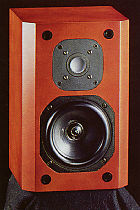 The most obvious reason for supposing that the minimonitor wouldn't have had a snowball's chance in hell of survival is that it was premature for its time. Imaging excellence is one of its primary reasons for being. With mono ruling the day, there would have been no opportunity for it to show off its imaging skills. Other than a few experimental stereo recordings, commercial program material was all in mono. To be sure, there was an intense interest in stereo because of a growing disaffection with mono's limitations. The late James Moir said it best in 1952: "...no competent critic would consider that the best possible monaural reproduction of anything but a soloist could be mistaken for the real thing, and until we can deceive most of the people for most of the time there is room for improvement." Moir went on to describe how a concert-hall orchestral stage of some 100' by 30' is compressed in size and strangled to emerge from a hole 8" or 10" in diameter. When a significant slice of hall reverb is captured, a mono recording is capable of reproducing a depth perspective, but all sound movement across the stage is reproduced as movement in depth. The soundstage is thus collapsed to a tunnel. Desperate audiophiles resorted to the next best thing to stereo, namely "fat mono." This consisted either of two spaced speakers reproducing the same mono channel or a single speaker reflecting its sound off of one or more walls. Some years ago, J. Gordon Holt related to me his first stereo listening experience. With tears in his eyes and presumably plenty of goosebumps, Gordon realized then the exciting horizon of stereo. There was no going back for him. But there's a less obvious third strike against the minimonitor that, in my opinion, would have counted for much more back then: the minimonitor's general inability to satisfactorily portray a large orchestra's tonal balance. Tonal-balance conviction meant a hell of a lot more to the old guard, probably because they were exposed to much more live unamplified music than today's audiophiles. Instead of the modern love affair with extreme treble and ultra-low bass, the emphasis was on the midrange, specifically the integration of the power range of the orchestra with the rest of the midrange. To these ears, orchestral conviction is compromised without a tonally accurate upper bass and lower midrange. The body of a cello, the "blat" of a tuba, and the warmth of a hall are all emaciated by a speaker that is tonally tilted toward the treble.
Again, I raise JGH as a shining example of the old guard. During the last decade he has grown increasingly irritated at what he perceives as infatuation on the part of the "audiophile" with imaging and detail. These attributes of reproduced music are not primary on JGH's list. He would often vent at me that he was a music lover, not an audiophile, and that he was losing touch with the typical audiophile. The ProAc Tablette, which received rave reviews elsewhere in the mid-'80s—and even a sympathetic nod from me (in Vol.7 No.4)—was completely lost on JGH. He was appalled that anyone could endorse such a tonally inaccurate speaker; clearly he thought that I had gone off the deep end. Live music simply does not sound bright and lean. Perhaps we have all overdosed on electronic music. Is this the root cause for the public's recent appetite for bright sound? Because that's exactly what the industry is dishing out. I find many recent speakers to be emphasized in the treble. Overly etched and zippy HF seems to be selling (footnote 1). Couple that with a lean lower midrange and you end up with a lean, mean speaker that, no matter how well it images, I would take pleasure in booting out of the listening room. The Micron
The most obvious reason for supposing that the minimonitor wouldn't have had a snowball's chance in hell of survival is that it was premature for its time. Imaging excellence is one of its primary reasons for being. With mono ruling the day, there would have been no opportunity for it to show off its imaging skills. Other than a few experimental stereo recordings, commercial program material was all in mono. To be sure, there was an intense interest in stereo because of a growing disaffection with mono's limitations. The late James Moir said it best in 1952: "...no competent critic would consider that the best possible monaural reproduction of anything but a soloist could be mistaken for the real thing, and until we can deceive most of the people for most of the time there is room for improvement." Moir went on to describe how a concert-hall orchestral stage of some 100' by 30' is compressed in size and strangled to emerge from a hole 8" or 10" in diameter. When a significant slice of hall reverb is captured, a mono recording is capable of reproducing a depth perspective, but all sound movement across the stage is reproduced as movement in depth. The soundstage is thus collapsed to a tunnel. Desperate audiophiles resorted to the next best thing to stereo, namely "fat mono." This consisted either of two spaced speakers reproducing the same mono channel or a single speaker reflecting its sound off of one or more walls. Some years ago, J. Gordon Holt related to me his first stereo listening experience. With tears in his eyes and presumably plenty of goosebumps, Gordon realized then the exciting horizon of stereo. There was no going back for him. But there's a less obvious third strike against the minimonitor that, in my opinion, would have counted for much more back then: the minimonitor's general inability to satisfactorily portray a large orchestra's tonal balance. Tonal-balance conviction meant a hell of a lot more to the old guard, probably because they were exposed to much more live unamplified music than today's audiophiles. Instead of the modern love affair with extreme treble and ultra-low bass, the emphasis was on the midrange, specifically the integration of the power range of the orchestra with the rest of the midrange. To these ears, orchestral conviction is compromised without a tonally accurate upper bass and lower midrange. The body of a cello, the "blat" of a tuba, and the warmth of a hall are all emaciated by a speaker that is tonally tilted toward the treble.
Again, I raise JGH as a shining example of the old guard. During the last decade he has grown increasingly irritated at what he perceives as infatuation on the part of the "audiophile" with imaging and detail. These attributes of reproduced music are not primary on JGH's list. He would often vent at me that he was a music lover, not an audiophile, and that he was losing touch with the typical audiophile. The ProAc Tablette, which received rave reviews elsewhere in the mid-'80s—and even a sympathetic nod from me (in Vol.7 No.4)—was completely lost on JGH. He was appalled that anyone could endorse such a tonally inaccurate speaker; clearly he thought that I had gone off the deep end. Live music simply does not sound bright and lean. Perhaps we have all overdosed on electronic music. Is this the root cause for the public's recent appetite for bright sound? Because that's exactly what the industry is dishing out. I find many recent speakers to be emphasized in the treble. Overly etched and zippy HF seems to be selling (footnote 1). Couple that with a lean lower midrange and you end up with a lean, mean speaker that, no matter how well it images, I would take pleasure in booting out of the listening room. The Micron
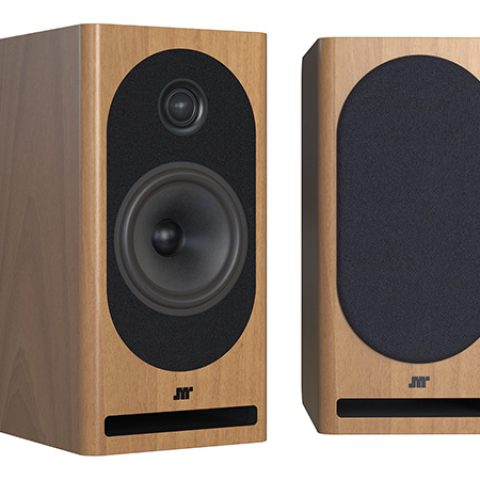
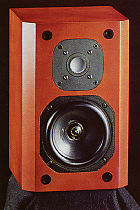
JMlab is quick to point out that "Micron" strictly refers to the speaker's "microbian size"—its internal volume is a mere 6.6 liters—and that in fact it is conspicuous by its "giant" musical reproduction. The edges of the front baffle are tapered, which helps break up the usual monotonous minibox look. My samples were finished in walnut veneer, which further enhanced the elegant look. There should be little spousal objection to such cute little things. The driver complement consists of a 5" dual-voice-coil Neoflex midrange-woofer and a Kevlar-diaphragm tweeter, the Focal T90K. (This is precisely the same tweeter that gave me so much grief during my Vol.13 No.10 review of the Focal Aria 5 loudspeaker.)
The most obvious reason for supposing that the minimonitor wouldn't have had a snowball's chance in hell of survival is that it was premature for its time. Imaging excellence is one of its primary reasons for being. With mono ruling the day, there would have been no opportunity for it to show off its imaging skills. Other than a few experimental stereo recordings, commercial program material was all in mono. To be sure, there was an intense interest in stereo because of a growing disaffection with mono's limitations. The late James Moir said it best in 1952: "...no competent critic would consider that the best possible monaural reproduction of anything but a soloist could be mistaken for the real thing, and until we can deceive most of the people for most of the time there is room for improvement." Moir went on to describe how a concert-hall orchestral stage of some 100' by 30' is compressed in size and strangled to emerge from a hole 8" or 10" in diameter. When a significant slice of hall reverb is captured, a mono recording is capable of reproducing a depth perspective, but all sound movement across the stage is reproduced as movement in depth. The soundstage is thus collapsed to a tunnel. Desperate audiophiles resorted to the next best thing to stereo, namely "fat mono." This consisted either of two spaced speakers reproducing the same mono channel or a single speaker reflecting its sound off of one or more walls. Some years ago, J. Gordon Holt related to me his first stereo listening experience. With tears in his eyes and presumably plenty of goosebumps, Gordon realized then the exciting horizon of stereo. There was no going back for him. But there's a less obvious third strike against the minimonitor that, in my opinion, would have counted for much more back then: the minimonitor's general inability to satisfactorily portray a large orchestra's tonal balance. Tonal-balance conviction meant a hell of a lot more to the old guard, probably because they were exposed to much more live unamplified music than today's audiophiles. Instead of the modern love affair with extreme treble and ultra-low bass, the emphasis was on the midrange, specifically the integration of the power range of the orchestra with the rest of the midrange. To these ears, orchestral conviction is compromised without a tonally accurate upper bass and lower midrange. The body of a cello, the "blat" of a tuba, and the warmth of a hall are all emaciated by a speaker that is tonally tilted toward the treble. JMlab is quick to point out that "Micron" strictly refers to the speaker's "microbian size"—its internal volume is a mere 6.6 liters—and that in fact it is conspicuous by its "giant" musical reproduction. The edges of the front baffle are tapered, which helps break up the usual monotonous minibox look. My samples were finished in walnut veneer, which further enhanced the elegant look. There should be little spousal objection to such cute little things. The driver complement consists of a 5" dual-voice-coil Neoflex midrange-woofer and a Kevlar-diaphragm tweeter, the Focal T90K. (This is precisely the same tweeter that gave me so much grief during my Vol.13 No.10 review of the Focal Aria 5 loudspeaker.)