Following my review of two high-performance minimonitors last November (footnote 1), I received a letter asking why I recommended a stand-mounted speaker at all when it was possible to buy a floorstanding design with more bass for the same amount of money. Furthermore, the correspondent went on, when you consider that the minimonitor sitting on its stand occupies as much floorspace as the floorstander, it's hard to see why a market for minimonitors exists at all.  Strong arguments, perhaps convincing to some. But floorstanding speakers have their drawbacks, too. It's much harder to control the vibrations of the large wooden panels involved, meaning that lower-midrange coloration can be a persistent problem. With its typically wide front baffle, a floorstander's imaging precision cannot be as good as that of a narrow-profile miniature. And while a floorstander can have extended bass compared with a stand-mounted speaker, this isn't always the case. In fact, the floorstanding vs stand-mounted debate is only really of concern to designers. What matters to audiophiles is performance. If the combination of a minimonitor and a good speaker stand floats your boat, then that's what's important. This month, to continue my quest for minimonitor perfection, I review two small stand-mounted speakers, the Joseph Audio RM7si and the Totem Mani-2. Both are reflex-loaded two-ways finished in rosewood veneer, but there the similarity ends. One is affordable; the other expensive. One uses a conventional crossover but a compound woofer; the other uses conventional drive-units but a unique crossover.
Let X = X
Strong arguments, perhaps convincing to some. But floorstanding speakers have their drawbacks, too. It's much harder to control the vibrations of the large wooden panels involved, meaning that lower-midrange coloration can be a persistent problem. With its typically wide front baffle, a floorstander's imaging precision cannot be as good as that of a narrow-profile miniature. And while a floorstander can have extended bass compared with a stand-mounted speaker, this isn't always the case. In fact, the floorstanding vs stand-mounted debate is only really of concern to designers. What matters to audiophiles is performance. If the combination of a minimonitor and a good speaker stand floats your boat, then that's what's important. This month, to continue my quest for minimonitor perfection, I review two small stand-mounted speakers, the Joseph Audio RM7si and the Totem Mani-2. Both are reflex-loaded two-ways finished in rosewood veneer, but there the similarity ends. One is affordable; the other expensive. One uses a conventional crossover but a compound woofer; the other uses conventional drive-units but a unique crossover.
Let X = X
Joseph Audio is a relatively new New York based company making loudspeakers designed by Richard Modaferri, who for a long time was one of the engineering lights at McIntosh. All the Joseph models feature Modaferri's patented "Infinite Slope" crossover topology, where a modest network (in terms of number of components used) produces high- and low-pass filter slopes in excess of 100dB/octave. The $1299/pair RM7si is the smallest model in the Joseph line; I first heard it at HI-FI '95, Stereophile's high-end show held last April in Los Angeles. In a tiny room, these minimonitors, driven by Audio Research electronics and an analog front-end, provided a consistently musical sound. Many Showgoers agreed with me, voting the Joseph room into the middle of the Best Sound at the Show list (see August '95, p.127). I subsequently heard the '7sis at the CES Specialty Audio and Home Theater in Chicago last June. Again the speakers pulled off the musicality trick, the Joseph room proving to be an island of musical tranquility to which I returned when I just needed to hear some tunes. Producing a good sound at hi-fi shows, as commendable as it may be, is not the real test of a component. What counts is whether it can provide long-term listening pleasure in the more critical environment of your own home.
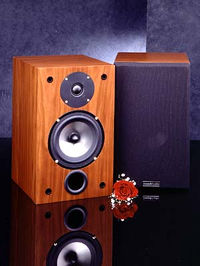
The first samples of the RM7si I received, a couple of months before HI-FI '95, combined a 1" soft-dome tweeter with a 6.5" plastic-cone woofer. Before I had a chance to do any serious listening to them, other than to note a somewhat bright balance, Joseph Audio's Jeff Joseph e-mailed me to say he was revising the RM7si, replacing the woofer with a unit with a fiberglass cone. It was this version of the speaker that was to impress me in Los Angeles and Chicago, and which would be representative of RM7si production. I subsequently received a second pair of review samples. The front-plate of the RM7si's Danish Vifa silk-dome tweeter has a slight horn flare; this increases sensitivity a little at the expense of narrowing the unit's dispersion at the top of its passband. Mounted beneath the tweeter is the Norwegian woofer, this constructed on a diecast chassis. The surround for the bright yellow cone is an inverted rubber half-roll, and rather than a conventional dustcap, this unit has a stationary, bullet-shaped "phase plug" mounted to the end of its magnet pole-piece. A flared port, 1.75" in internal diameter and 3" deep, reflex-loads the woofer and is mounted on the front baffle immediately beneath it.
Footnote 1: Platinum Solo and Acoustic Energy AE2 Signature, Vol.18 No.11, p.108.
Strong arguments, perhaps convincing to some. But floorstanding speakers have their drawbacks, too. It's much harder to control the vibrations of the large wooden panels involved, meaning that lower-midrange coloration can be a persistent problem. With its typically wide front baffle, a floorstander's imaging precision cannot be as good as that of a narrow-profile miniature. And while a floorstander can have extended bass compared with a stand-mounted speaker, this isn't always the case. In fact, the floorstanding vs stand-mounted debate is only really of concern to designers. What matters to audiophiles is performance. If the combination of a minimonitor and a good speaker stand floats your boat, then that's what's important. This month, to continue my quest for minimonitor perfection, I review two small stand-mounted speakers, the Joseph Audio RM7si and the Totem Mani-2. Both are reflex-loaded two-ways finished in rosewood veneer, but there the similarity ends. One is affordable; the other expensive. One uses a conventional crossover but a compound woofer; the other uses conventional drive-units but a unique crossover. Joseph Audio is a relatively new New York based company making loudspeakers designed by Richard Modaferri, who for a long time was one of the engineering lights at McIntosh. All the Joseph models feature Modaferri's patented "Infinite Slope" crossover topology, where a modest network (in terms of number of components used) produces high- and low-pass filter slopes in excess of 100dB/octave. The $1299/pair RM7si is the smallest model in the Joseph line; I first heard it at HI-FI '95, Stereophile's high-end show held last April in Los Angeles. In a tiny room, these minimonitors, driven by Audio Research electronics and an analog front-end, provided a consistently musical sound. Many Showgoers agreed with me, voting the Joseph room into the middle of the Best Sound at the Show list (see August '95, p.127). I subsequently heard the '7sis at the CES Specialty Audio and Home Theater in Chicago last June. Again the speakers pulled off the musicality trick, the Joseph room proving to be an island of musical tranquility to which I returned when I just needed to hear some tunes. Producing a good sound at hi-fi shows, as commendable as it may be, is not the real test of a component. What counts is whether it can provide long-term listening pleasure in the more critical environment of your own home.
Footnote 1: Platinum Solo and Acoustic Energy AE2 Signature, Vol.18 No.11, p.108.