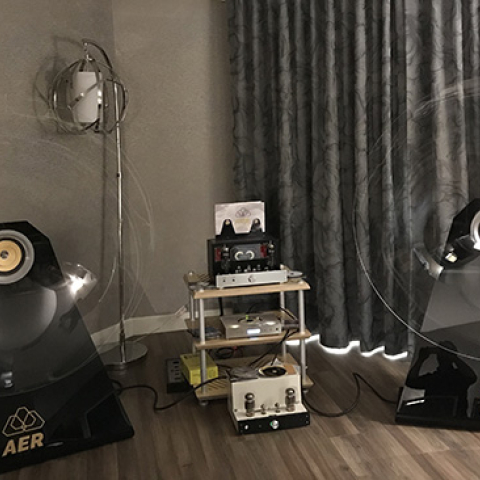
Back at the end of September 2005, I dropped by Jonathan and Kathleen Scull's Chelsea loft after work. I can't remember why; I think I was returning some gear. But we had also just finished shipping the 2006 Stereophile Buyer's Guide to the printer that day, and it was possible that I needed some high-quality musical R'n'R. Sitting in Jonathan's listening seat—the legendary Ribbon Chair"—and enjoying the sound of his system, I flashed on the days when he worked for Stereophile full-time and I occasionally used to pop round to his place, just two blocks away from what was then our office, on Manhattan's Fifth Avenue. Whatever components Jonathan was writing about, a consistent factor in the always superb sound of his system was the presence of the pair of JMlab Utopia loudspeakers that he had reviewed in the April 1998 issue of Stereophile. The Utopias delivered a seamless, full-range presentation that served Jonathan's eclectic taste in music while also allowing him to easily hear the effects, good or bad, of the various tweaks he was always trying.
 The next JMlab speakers I heard were the pair of Nova Utopia Bes that Paul Bolin reviewed in June 2004. I had flown out to Minnesota in March of that year to measure the speakers in Paul's listening room, and had spent a very pleasant evening going through his enormous music collection, including some Fairport Convention LPs I had not heard in 30 years. The Nova Utopias, which feature the company's new beryllium-diaphragm tweeter, had served the music well that chilly evening.
Perhaps it was because I could always hear the JMlab speakers at Jonathan's, but, since penning a short report on the Micron Carat in June 1996, I had never got off my backside to write about a pair of speakers from the French company myself.
So, when we published an enthusiastic Sam Tellig review of the floorstanding Electra 1027 Be last November, in which the beryllium-tweeter technology was being trickled down to more affordable designs, I decided it was high time I reviewed a model from Focal. (The company is in the midst of changing its brand name from JMlab to Focal, the name of the parent organization.) I asked Audio Plus Services, Focal's North American distributor, to send me a pair of Electra 1007 Bes for review.
The Electra 1007 Be...
The next JMlab speakers I heard were the pair of Nova Utopia Bes that Paul Bolin reviewed in June 2004. I had flown out to Minnesota in March of that year to measure the speakers in Paul's listening room, and had spent a very pleasant evening going through his enormous music collection, including some Fairport Convention LPs I had not heard in 30 years. The Nova Utopias, which feature the company's new beryllium-diaphragm tweeter, had served the music well that chilly evening.
Perhaps it was because I could always hear the JMlab speakers at Jonathan's, but, since penning a short report on the Micron Carat in June 1996, I had never got off my backside to write about a pair of speakers from the French company myself.
So, when we published an enthusiastic Sam Tellig review of the floorstanding Electra 1027 Be last November, in which the beryllium-tweeter technology was being trickled down to more affordable designs, I decided it was high time I reviewed a model from Focal. (The company is in the midst of changing its brand name from JMlab to Focal, the name of the parent organization.) I asked Audio Plus Services, Focal's North American distributor, to send me a pair of Electra 1007 Bes for review.
The Electra 1007 Be...
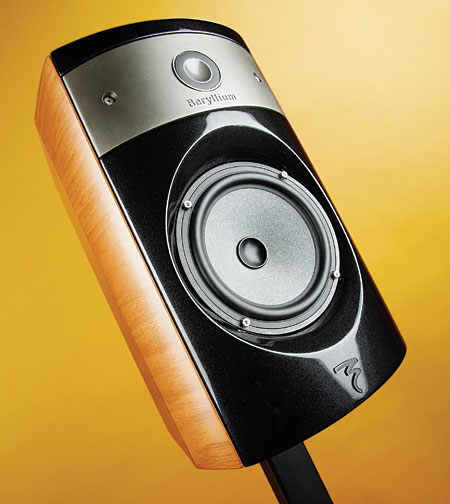
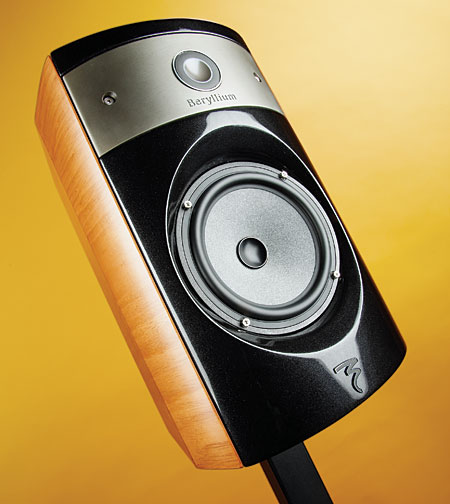
...is a stand-mounted, reflex-loaded two-way costing $3995/pair without stands. Within its elegant package is packed a wealth of high speaker technology, the heart of which is that rather special tweeter. Mounted in the center of a wide, curved, aluminum front plate, the rear of which provides the necessary acoustic loading, the tweeter uses an inverted dome pressed from pure beryllium foil. Beryllium is the fourth element in the periodic table—only hydrogen, helium, and lithium have lower atomic weights. But as well as being very light—its density is 1.5 times lower than aluminum's—beryllium is also very stiff: five times more rigid than aluminum. The speed of sound through beryllium is correspondingly 2.5 times faster than through aluminum. The combination of these properties makes it ideal for use as a tweeter diaphragm; its intrinsic vibrational modes are pushed up in frequency, well above the audioband, which allows it to act as a pure piston up to a specified 40kHz. The downside is that beryllium in dust form is poisonous. There is no danger to the speaker's owner with the beryllium used as a complete, unbroken diaphragm, but the Electra 1007 Be's manual does include a section on how to seal and return the speaker if the tweeter is damaged in any way. The speaker is shipped with a cover over the tweeter; a magnetically attached grille protects it in use once the shipping cover has been removed.
Mounted below the tweeter on the curved front baffle and inset a little is a 6.5" Focal woofer with a gray cone made of what Focal calls "W" material, a sandwich comprising tissues of woven glass fibers each side of a core of structural foam. The benefit is a low-mass cone material that is stiff and has high internal damping—normally mutually exclusive properties—which makes it ideal for use in a woofer. The woofer is reflex-loaded; the rectangular port at the base of the cabinet rear has radiused lips to minimize wind noise.
The cabinet construction is complex, the wooden side panels double-radiused to give a profile that tapers toward the rear. This and an internal filling of fiber reduce the effects of internal standing waves. The 1"-thick front baffle also has a curved profile, matching that of the tweeter's front plate, to optimize diffraction. There are no sharp edges at all in the vicinity of the tweeter other than the cabinet top, and even that is chamfered. The plastic space-frame woofer grille mounts flush with the front baffle via an ingenious arrangement in which plastic sleeves are pushed over the woofer mounting bolts. The vestigial tweeter grille is held in place magnetically.
The crossover is mounted on the inside of the rear panel and is high-order, to give acoustic rolloffs of 36dB/octave, according to Focal's white paper on the Electra 1007 Be. Electrical connection is via a single pair of high-quality binding posts mounted on an aluminum panel above the port on the rear of the cabinet. Although the posts can be tightened only with the fingers, the wide spacing and ergonomic profiling of their heads means that they give a positive connection with spades.
Overall, this speaker's fit'n'finish is superb. The Electra 1007 Be looks a lot more expensive than its price suggests.
Sound
I used both the S1007 stands Focal supplies with the Electra 1007 Bes and my faithful 24" Celestion Si stands, the latter with their central pillars filled with a mix of sand and lead shot. The Electras were initially placed a little farther away from the sidewalls than the Snell LCR7 XLs (also reviewed this month), but ended up in pretty much the same places. "Brilliant!" was the word that leapt to my lips when I played my first CD through the Electra 1007s, and that impression remained consistent throughout my auditioning—though as time went by and the speakers broke in, their top two octaves blended into the whole. The Focal's treble sounded extended, clean, and grain-free—the tweeter's beryllium diaphragm obviously contributes significantly to a superbly performing transducer—but I suspected that the tweeter was balanced slightly on the "hot" side of neutrality. Reticent this speaker was not. Not that it always called attention to itself—nothing so overt. String sound on an SACD of works by Ralph Vaughan Williams with James Judd conducting the New Zealand Symphony Orchestra (Naxos 6.110053), for example, while vibrant, never sounded steely, bright, or fatiguing—quite the opposite, in fact. I felt I could listen for hours, and often did so. Even Eric Clapton's rather aggressively miked vocals on Me and Mr. Johnson (CD, Reprise 48423-2) could be played back at high levels without strain.
At the other end of the frequency spectrum, the Electra's upper bass was rather ripe in absolute terms. The bass guitar and kick drum on Me and Mr. Johnson lacked some edge to their sounds, and my Fender bass on the channel-identification tracks of Editor's Choice (CD, Stereophile STPH016-2) was a little plummy. Listening to the one-third–octave warble tones on Editor's Choice revealed that the Focals were still putting out useful bass down to the 40Hz band, with audible output in the 32Hz band (helped by the room), though the 25Hz and 20Hz tones were inaudible. Even at high sound-pressure levels, no wind noise emanated from the port.
Pink noise sounded smooth, with a seamless integration of woofer and tweeter, as long as I was sitting on or just below the tweeter axis: 37" from the floor on the 24" stands. Above the tweeter axis, the pink noise took on a bit of a hollow coloration. When I listened to the cabinet walls through a stethoscope while playing the stepped toneburst track from Editor's Choice, all the surfaces were a bit lively between 256Hz and 400Hz, though I couldn't ascribe any audible coloration to this behavior with music.
The next JMlab speakers I heard were the pair of Nova Utopia Bes that Paul Bolin reviewed in June 2004. I had flown out to Minnesota in March of that year to measure the speakers in Paul's listening room, and had spent a very pleasant evening going through his enormous music collection, including some Fairport Convention LPs I had not heard in 30 years. The Nova Utopias, which feature the company's new beryllium-diaphragm tweeter, had served the music well that chilly evening.
Perhaps it was because I could always hear the JMlab speakers at Jonathan's, but, since penning a short report on the Micron Carat in June 1996, I had never got off my backside to write about a pair of speakers from the French company myself.
...is a stand-mounted, reflex-loaded two-way costing $3995/pair without stands. Within its elegant package is packed a wealth of high speaker technology, the heart of which is that rather special tweeter. Mounted in the center of a wide, curved, aluminum front plate, the rear of which provides the necessary acoustic loading, the tweeter uses an inverted dome pressed from pure beryllium foil. Beryllium is the fourth element in the periodic table—only hydrogen, helium, and lithium have lower atomic weights. But as well as being very light—its density is 1.5 times lower than aluminum's—beryllium is also very stiff: five times more rigid than aluminum. The speed of sound through beryllium is correspondingly 2.5 times faster than through aluminum. The combination of these properties makes it ideal for use as a tweeter diaphragm; its intrinsic vibrational modes are pushed up in frequency, well above the audioband, which allows it to act as a pure piston up to a specified 40kHz. The downside is that beryllium in dust form is poisonous. There is no danger to the speaker's owner with the beryllium used as a complete, unbroken diaphragm, but the Electra 1007 Be's manual does include a section on how to seal and return the speaker if the tweeter is damaged in any way. The speaker is shipped with a cover over the tweeter; a magnetically attached grille protects it in use once the shipping cover has been removed.
I used both the S1007 stands Focal supplies with the Electra 1007 Bes and my faithful 24" Celestion Si stands, the latter with their central pillars filled with a mix of sand and lead shot. The Electras were initially placed a little farther away from the sidewalls than the Snell LCR7 XLs (also reviewed this month), but ended up in pretty much the same places. "Brilliant!" was the word that leapt to my lips when I played my first CD through the Electra 1007s, and that impression remained consistent throughout my auditioning—though as time went by and the speakers broke in, their top two octaves blended into the whole. The Focal's treble sounded extended, clean, and grain-free—the tweeter's beryllium diaphragm obviously contributes significantly to a superbly performing transducer—but I suspected that the tweeter was balanced slightly on the "hot" side of neutrality. Reticent this speaker was not. Not that it always called attention to itself—nothing so overt. String sound on an SACD of works by Ralph Vaughan Williams with James Judd conducting the New Zealand Symphony Orchestra (Naxos 6.110053), for example, while vibrant, never sounded steely, bright, or fatiguing—quite the opposite, in fact. I felt I could listen for hours, and often did so. Even Eric Clapton's rather aggressively miked vocals on Me and Mr. Johnson (CD, Reprise 48423-2) could be played back at high levels without strain.