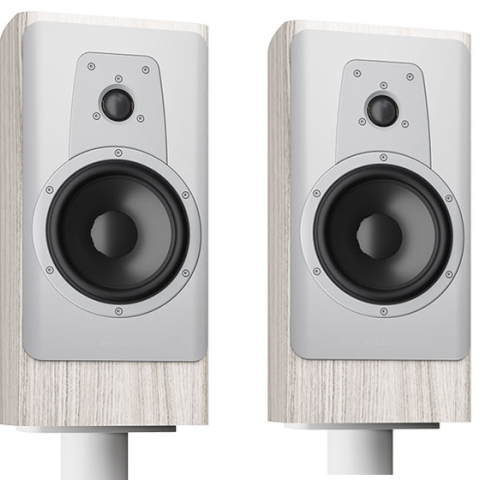
The least expensive model in Paradigm's Reference series, the Studio/20 loudspeaker is a rear-ported two-way dynamic bookshelf/satellite design, superficially identical to the powered Active/20 that JA reviewed last November. It features Paradigm's 25mm PAL pure-aluminum dome tweeter in a die-cast heatsink chassis, and a 170mm MLP mica-polymer cone in an AVS die-cast heatsink chassis with a 38mm voice coil. The crossover is third-order, quasi-Butterworth, said to be "phase-coherent." It features high-power ceramic resistors, film capacitors in all signal paths, and both air-core and steel-core inductors.  System & set-up
The Studio/20 is bi-wirable and bi-ampable; I tried it in both configurations. I tested the speakers in various locations ranging from 2' to 4' from the rear wall of my listening room, using Celestion Si stands filled with sand and lead shot. (Paradigm also makes their own proprietary stands for the '20.) Paradigm suggests not removing the speaker grilles, and I agree: the most neutral performance was obtained with the grilles on. Primary reference system used for this review included the California Icon Mk.II CD player with HDCD Power Boss upgrade, Thorens TD 160 turntable with SME 3009 Mk.III tonearm and Grado Signature 8MZ phono cartridge, Creek 4240SE integrated amplifier, MIT 330SG interconnects, and Acarian systems Black Orpheus speaker wire. I also tried the Paradigms in my new "vacation house outdoor remote system." Rather than carry around a portable boombox outdoors or install rock-shaped speakers in my garden, I picked up a 40' pair of MIT Terminator 3 interconnects and ran them from the preamp out/tape monitor of my Goldmund Studio/Syrinx PU-3/Koetsu Urushi/Vendetta Research SCP-2b/Audible Illusions Modulus L1 front-end, out the listening room, into the hallway, and into the amp input/line input of an NAD 3225PE integrated amp in the guest bedroom. The NAD drove the Paradigms, tucked in the window facing the backyard via a pair of MIT Terminator speaker cables. This system enabled me to get true high-end sound outdoors, but it was a five-minute walk to change records.
Impressive right out of the box
Even in my very early listening sessions, the Paradigm exhibited three obvious strengths I'd never before heard from a speaker this affordable: • Midrange timbral accuracy: From the upper bass through the upper midrange, the harmonic structures of sounds, their timbres, were as natural as I'd heard from any speaker. The reproduction of vocals, woodwinds, and brass instruments on well-engineered acoustic recordings was spooky in its realism; • Superb detail resolution and transparency: akin to what I'd expect from speakers costing $2000 or more; and
• Lifelike low-level dynamic performance at all volume levels. The Studio/20 may be the budget speaker for fans of well-recorded jazz chamber works. The immediacy and definition of John Coltrane's ballad "Naima" (from The Best of Coltrane, Impulse! AS-9200-2), and the lifelike reproduction of the delicate piano/horn interplay on Barry Altschul's You Can't Name Your Own Tune (Muse MR5124) and Miles in Berlin (Japanese CBS Sony 25AP 763), made it difficult to take notes during the performance. Electric instruments were not slighted by these speakers, however. The Studio/20's reproduction of the subtle inflections of the Fender Stratocaster and the Hammond organ on Joe Harley's XRCD version of Mighty Sam McClain's Give It Up to Love (JVCXR-0012-2) made it obvious how superior this remastering is to the original AudioQuest release. Sam's voice sounded gritty, growly, and full of passion—it sure made me itch to play a B3 again.
System & set-up The Studio/20 is bi-wirable and bi-ampable; I tried it in both configurations. I tested the speakers in various locations ranging from 2' to 4' from the rear wall of my listening room, using Celestion Si stands filled with sand and lead shot. (Paradigm also makes their own proprietary stands for the '20.) Paradigm suggests not removing the speaker grilles, and I agree: the most neutral performance was obtained with the grilles on. Primary reference system used for this review included the California Icon Mk.II CD player with HDCD Power Boss upgrade, Thorens TD 160 turntable with SME 3009 Mk.III tonearm and Grado Signature 8MZ phono cartridge, Creek 4240SE integrated amplifier, MIT 330SG interconnects, and Acarian systems Black Orpheus speaker wire. I also tried the Paradigms in my new "vacation house outdoor remote system." Rather than carry around a portable boombox outdoors or install rock-shaped speakers in my garden, I picked up a 40' pair of MIT Terminator 3 interconnects and ran them from the preamp out/tape monitor of my Goldmund Studio/Syrinx PU-3/Koetsu Urushi/Vendetta Research SCP-2b/Audible Illusions Modulus L1 front-end, out the listening room, into the hallway, and into the amp input/line input of an NAD 3225PE integrated amp in the guest bedroom. The NAD drove the Paradigms, tucked in the window facing the backyard via a pair of MIT Terminator speaker cables. This system enabled me to get true high-end sound outdoors, but it was a five-minute walk to change records.
Even in my very early listening sessions, the Paradigm exhibited three obvious strengths I'd never before heard from a speaker this affordable: • Midrange timbral accuracy: From the upper bass through the upper midrange, the harmonic structures of sounds, their timbres, were as natural as I'd heard from any speaker. The reproduction of vocals, woodwinds, and brass instruments on well-engineered acoustic recordings was spooky in its realism; • Superb detail resolution and transparency: akin to what I'd expect from speakers costing $2000 or more; and