When audiophiles speak of the "Golden Age" of audio components, they almost always are talking about amplifiers and preamplifiers, not loudspeakers. While a very few speaker models have stood the test of time—among them the BBC LS3/5a, the Vandersteen 2, the original Quad electrostatic and the Quad ESL-63, some of the Magnepans, and the Klipschorn—almost no one would disagree that, taken en masse, the speakers of today outperform not just those of the 1960s and 1970s but even those of the 1980s and 1990s. The advent of low-cost, computerized test equipment, high-quality, inexpensive measuring microphones, and persuasive research into what measured parameters matter most to listeners who are listening for a neutral-sounding, uncolored loudspeaker (footnote 1), has led to an almost across-the-board improvement in speaker sound quality (footnote 2).
 But perhaps even more significant, and aided by the trend toward the offshore manufacture of low-cost speakers, the level of excellence that used to be the preserve of high-priced designs is now available for very much less money than it used to be. $1000 buys the impecunious audiophile a pair of speakers that in some areas are almost beyond reproach. The $800/pair NHT Classic Three, which Bob Reina reviewed for Stereophile last November, and the $650/pair Epos M5, which he reviewed in April 2005, as well as the diminutive $600/pair Era Design 4, which I reviewed in January, set a standard for performance in the midrange and treble that you need to spend very much more to better.
But what do you lose if you spend less?
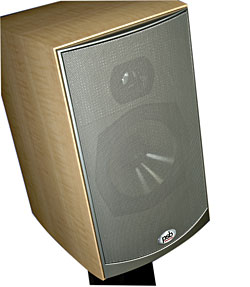
That question leads me to the subject of this review, the latest version of Canadian manufacturer PSB's best-selling Alpha speaker, the Alpha B1, which costs just $279/pair.
Alpha-betical
But perhaps even more significant, and aided by the trend toward the offshore manufacture of low-cost speakers, the level of excellence that used to be the preserve of high-priced designs is now available for very much less money than it used to be. $1000 buys the impecunious audiophile a pair of speakers that in some areas are almost beyond reproach. The $800/pair NHT Classic Three, which Bob Reina reviewed for Stereophile last November, and the $650/pair Epos M5, which he reviewed in April 2005, as well as the diminutive $600/pair Era Design 4, which I reviewed in January, set a standard for performance in the midrange and treble that you need to spend very much more to better.
But what do you lose if you spend less?
That question leads me to the subject of this review, the latest version of Canadian manufacturer PSB's best-selling Alpha speaker, the Alpha B1, which costs just $279/pair.
Alpha-betical
The original Alpha was a rather tawdry-looking two-way mini that had a 6.5" woofer with a vacuum-formed polypropylene cone and cost just $200/pair. But in his July 1992 review, Jack English concluded that it was "simply one of the best buys in audio, providing a musically satisfying sound...a sensational audio bargain." The Alpha went on to become one of the most popular audiophile speakers ever, with over 50,000 pairs sold by the end of the last century. PSB's Paul Barton revised the Alpha in 1998, replacing its 0.5" plastic-dome tweeter with a more refined unit, upgrading the crossover and terminals, magnetically shielding both drive-units for use in home-theater systems, and renaming it the Alpha A/V. The A/V cost $249/pair, and I enthusiastically reviewed it in April 2000.
The next revision was the Alpha B, which kept the $249/pair price but upgraded the woofer to a 5¼" polypropylene-cone unit very similar to that used in PSB's more expensive Image line. The tweeter was also upgraded, to an aluminum-dome unit recessed within a short flare and protected by a plastic "phase plate." In his May 2002 review, Bob Reina wrote that the PSB Alpha B was a classic example of the benefits of technology trickled down from a serious high-end speaker design. "Considering again the quality of construction and sound of these remarkable little boxes and checking the price yet again," he wrote, "I'm still shaking my head [at the fact that] this speaker doesn't cost $250 apiece but $250 per pair."
The Alpha B1
The latest version of the Alpha, the B1, has suffered a price rise, to $279/pair, but this is actually lower in real terms than the original Alpha's $200/pair price in 1992 dollars. Like the B, the B1 has molded plastic front and rear baffles, each with internal ribs to add rigidity, connected by an MDF "sleeve." It combines a 5¼", injection-molded, polypropylene-cone woofer with a ferrofluid-cooled, aluminum-dome tweeter. The latter is now a ¾" unit rather than a 1", for better top-octave dispersion, and the woofer cone has an attractive metalized finish. Both units are bolted to the baffle with wood screws and rabbeted into the front baffle. This, of course, is easy to arrange when the baffle is molded plastic rather than the necessary recesses having to be routed into a wooden baffle. The cabinet volume has been increased by, I believe, 10% compared with the Alpha B, and there is now a faint front-to-back convex "bow" to the top, bottom, and side panels. (Small stick-on pads add stability when the speaker is placed on a stand.) The rear-facing port at the top of the rear panel has a gently radiused exit at both ends, to reduce turbulence and wind noise. The crossover is specified as lying at 3kHz, with third-order slopes. The six-element crossover—two air-cored inductors, one ferrite-cored inductor, one resistor, and two electrolytic capacitors—is mounted on a small board attached to the inside of the rear panel just above the inset five-way binding posts. The cabinet—it must be a vinyl finish at this price, but it sure looks like veneer—is not internally braced, but there is a filling of acrylic fiber. In a departure from earlier Alphas, the B1's grille, a fine metal-mesh type with a thin layer of gauze on its inner surface, is removable, revealing some attractive-looking dimpling of the front baffle around the tweeter. Once it is removed, however, the grille is tricky to wrestle back into place.
Sound quality
I did all my auditioning with the Alpha B1's grilles in place, the sound getting a little too bright otherwise. The speakers sat on 24" Celestion SL stands, the central pillars of which were filled with dry sand and lead shot. In addition to the synthetic rubber pads front and back, I further damped the interface between the cabinet's base and the stand's top panel with thin strips of Blu-Tack. The stands put my ears level with the tweeters, and pink noise sounded smooth on that axis. When I stood up, however, the speaker's balance sounded a bit hollow. The B1s ended up in positions that had worked for the Harbeth and Stirling minimonitors that I wrote about last month, but tucked somewhat closer to the sidewalls to get a little more boundary reinforcement at low frequencies. Nevertheless, the Alpha is still a small speaker with a small woofer, and you can't expect thunderous bass from it. But it gave a usefully high output down to the 63Hz 1/3-octave band on my Editor's Choice CD (Stereophile STPH016-2), and there was still some audible output, aided by a room mode, in the 32Hz band. The organ pedals in the finale of Elgar's Enigma Variations, with George Hurst conducting the Bournemouth Symphony Orchestra (Naxos 8.553564), were still faintly audible, and the speakers made a brave attempt at reproducing the rolled bass drum at the very end of the work. Similarly, the combination of bass-trombone pedal tones and bass-drum punctuations in Elgar's In the South overture on the same CD was reproduced with bravado, as long as I kept a wary eye on the Ayre K-5xe preamp's volume control. Perhaps more important, while I had thought that the low frequencies of earlier Alphas were a bit lacking when it came to clearly defined leading edges, even when hung on the end of the mighty Mark Levinson No.33H monoblocks, the B1's bass was very clean and clear, other than at very high volumes.
Footnote 1: For example, the seminal series of technical papers produced by Floyd Toole with Sean Olive when they were at the NRC in Ottawa, Canada, and continued by them after they joined Harman International's research staff in the late 1990s. Their publications are voluminous: for references, surf the index of papers and preprints at www.aes.org. See also Jim Austin's "As We See It" on p.3. Footnote 2: I have to say "almost," as there are still a small number of one-man speaker companies that appear to believe that a limited-production "high-end" speaker is not under the same obligation to either sound neutral or measure well as one aimed at the wider market.
But perhaps even more significant, and aided by the trend toward the offshore manufacture of low-cost speakers, the level of excellence that used to be the preserve of high-priced designs is now available for very much less money than it used to be. $1000 buys the impecunious audiophile a pair of speakers that in some areas are almost beyond reproach. The $800/pair NHT Classic Three, which Bob Reina reviewed for Stereophile last November, and the $650/pair Epos M5, which he reviewed in April 2005, as well as the diminutive $600/pair Era Design 4, which I reviewed in January, set a standard for performance in the midrange and treble that you need to spend very much more to better.
But what do you lose if you spend less?
That question leads me to the subject of this review, the latest version of Canadian manufacturer PSB's best-selling Alpha speaker, the Alpha B1, which costs just $279/pair.
Alpha-betical
The original Alpha was a rather tawdry-looking two-way mini that had a 6.5" woofer with a vacuum-formed polypropylene cone and cost just $200/pair. But in his July 1992 review, Jack English concluded that it was "simply one of the best buys in audio, providing a musically satisfying sound...a sensational audio bargain." The Alpha went on to become one of the most popular audiophile speakers ever, with over 50,000 pairs sold by the end of the last century. PSB's Paul Barton revised the Alpha in 1998, replacing its 0.5" plastic-dome tweeter with a more refined unit, upgrading the crossover and terminals, magnetically shielding both drive-units for use in home-theater systems, and renaming it the Alpha A/V. The A/V cost $249/pair, and I enthusiastically reviewed it in April 2000.
The latest version of the Alpha, the B1, has suffered a price rise, to $279/pair, but this is actually lower in real terms than the original Alpha's $200/pair price in 1992 dollars. Like the B, the B1 has molded plastic front and rear baffles, each with internal ribs to add rigidity, connected by an MDF "sleeve." It combines a 5¼", injection-molded, polypropylene-cone woofer with a ferrofluid-cooled, aluminum-dome tweeter. The latter is now a ¾" unit rather than a 1", for better top-octave dispersion, and the woofer cone has an attractive metalized finish. Both units are bolted to the baffle with wood screws and rabbeted into the front baffle. This, of course, is easy to arrange when the baffle is molded plastic rather than the necessary recesses having to be routed into a wooden baffle. The cabinet volume has been increased by, I believe, 10% compared with the Alpha B, and there is now a faint front-to-back convex "bow" to the top, bottom, and side panels. (Small stick-on pads add stability when the speaker is placed on a stand.) The rear-facing port at the top of the rear panel has a gently radiused exit at both ends, to reduce turbulence and wind noise. The crossover is specified as lying at 3kHz, with third-order slopes. The six-element crossover—two air-cored inductors, one ferrite-cored inductor, one resistor, and two electrolytic capacitors—is mounted on a small board attached to the inside of the rear panel just above the inset five-way binding posts. The cabinet—it must be a vinyl finish at this price, but it sure looks like veneer—is not internally braced, but there is a filling of acrylic fiber. In a departure from earlier Alphas, the B1's grille, a fine metal-mesh type with a thin layer of gauze on its inner surface, is removable, revealing some attractive-looking dimpling of the front baffle around the tweeter. Once it is removed, however, the grille is tricky to wrestle back into place.
I did all my auditioning with the Alpha B1's grilles in place, the sound getting a little too bright otherwise. The speakers sat on 24" Celestion SL stands, the central pillars of which were filled with dry sand and lead shot. In addition to the synthetic rubber pads front and back, I further damped the interface between the cabinet's base and the stand's top panel with thin strips of Blu-Tack. The stands put my ears level with the tweeters, and pink noise sounded smooth on that axis. When I stood up, however, the speaker's balance sounded a bit hollow. The B1s ended up in positions that had worked for the Harbeth and Stirling minimonitors that I wrote about last month, but tucked somewhat closer to the sidewalls to get a little more boundary reinforcement at low frequencies. Nevertheless, the Alpha is still a small speaker with a small woofer, and you can't expect thunderous bass from it. But it gave a usefully high output down to the 63Hz 1/3-octave band on my Editor's Choice CD (Stereophile STPH016-2), and there was still some audible output, aided by a room mode, in the 32Hz band. The organ pedals in the finale of Elgar's Enigma Variations, with George Hurst conducting the Bournemouth Symphony Orchestra (Naxos 8.553564), were still faintly audible, and the speakers made a brave attempt at reproducing the rolled bass drum at the very end of the work. Similarly, the combination of bass-trombone pedal tones and bass-drum punctuations in Elgar's In the South overture on the same CD was reproduced with bravado, as long as I kept a wary eye on the Ayre K-5xe preamp's volume control. Perhaps more important, while I had thought that the low frequencies of earlier Alphas were a bit lacking when it came to clearly defined leading edges, even when hung on the end of the mighty Mark Levinson No.33H monoblocks, the B1's bass was very clean and clear, other than at very high volumes.
Footnote 1: For example, the seminal series of technical papers produced by Floyd Toole with Sean Olive when they were at the NRC in Ottawa, Canada, and continued by them after they joined Harman International's research staff in the late 1990s. Their publications are voluminous: for references, surf the index of papers and preprints at www.aes.org. See also Jim Austin's "As We See It" on p.3. Footnote 2: I have to say "almost," as there are still a small number of one-man speaker companies that appear to believe that a limited-production "high-end" speaker is not under the same obligation to either sound neutral or measure well as one aimed at the wider market.