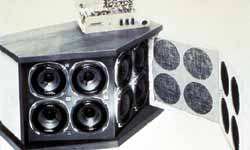
The Bose 901 has created more of a stir in audio circles than any other loudspeaker we can think of, with the possible exception of the original Acoustic Research system. Much of the 901's popularity is attributable to Julian Hirsch's rave report in Stereo Review, and there is no doubt but that Amar Bose's compellingly convincing ads had their effect, too. But these things alone could hardly account for the 901's popularity.  Perhaps the most important single factor in the 901's sales is its awesomely spacious sound, which makes other systems in a showroom sound a bit trivial, as if the Bose is the Truth and the Light, and the others are just playing around. The 901 sounds fantastically open and spacious, with a big, fat low end and a socko you-are-there presence that seems to put the performers right in the room, surrounded by the original auditorium. We were duly impressed by these qualities, too, and reported this in our preliminary report in the last issue. But we were less impressed by some other qualities of the 901, one of which was not altogether the fault of the system. We have observed in the past that some loudspeakers seem to be more critical than others of placement in the room, and while we have never definitely established what it is about a speaker that affects its room sensitivity, we do have some ideas on the subject.
Standing waves, which determine to a major extent a small (in comparison with a concert hail) room's acoustical coloration, are most effectively set into resonance by soundwaves originating from the room corners. The fact that, in a living room of typical size, the strongest standing-wave resonances usually occur at low frequencies, is the main reason why putting a speaker in a corner will produce the most bass-heavy sound. Once we get out of the corner, though, the efficiency with which each standing wave is stimulated will depend on the speaker's precise location relative to the room corner. Two feet out from the corner, and it may only "tickle" the major resonance in the room. That peak then will be less severe than with the speaker cornered. Three feet out, and that particular resonant mode may not be excited at all—the response may be perfectly smooth there but another resonance, which may have been completely suppressed two feet from the corner, may now be fully excited, producing a peak at another frequency. The larger the room, the less critical the speaker placement is likely to be, but in many typical listening rooms, a change in speaker placement of as little as a foot can make the difference between a sodden, suffocatingly heavy low end and a tight, well-defined one. The crucial factor seems to be the location in the room from which the woofer(s) are feeding energy into it. Thus, it is often (usually, in fact) possible to obtain flatter overall response with a single relatively small woofer, which radiates from a small area, than from a multi-woofer system whose low end radiates from a general area that may be several feet wide.
By the same token, loudspeakers which radiate their lows in one direction (they are nondirectional after they leave the speaker) seem less prone to excite all the room resonances than ones which radiate from front and rear or front and sides. True omnidirectional (360-degree) bass radiators make it harder still to control standing waves, and that appears to be one of the problems with the Bose 901. The 901 is neither an omnidirectional radiator nor a true doublet (front-and-rear) radiator. Most of its energy comes from a broad angle at the rear; a single driver in front delivers but a small fraction of the total radiated energy. The entire audio spectrum is radiated from both front and back, with back output predominating. The back wave is then supposed to be reflected from the wall behind the speakers, and these reflections "spray" the sound all over the listening room. The effect, as far as bass frequencies are concerned, is that the room is being stimulated, not by a pair of small surfaces, but by a pair of very broad areas. And the result is that, if there are any standing waves possible in that room, they will all be stimulated to the fullest. And although the 901 speakers are less critical of room placement insofar as stereo imaging is concerned than are most other systems, their approximate locations are nonetheless circumscribed by the requirements of a nearby rear wall and the usual dictates of symmetrical placement in the room, so their bass performance ends up being more dependent on the vagaries of the room than on the inherent capabilities of the speakers. Thus, some 901 installations will have deep, tight, and quite well-defined bass, while others (in the majority) will exhibit uncontrolled bass resonances at frequencies which are entirely a function of the room dimensions. This no doubt explains the very widely conflicting reactions of different listeners who auditioned the Bose 901 in stores or purchased them for use at home.
The 901 equalizer (which connects between preamp and power amp) does have a switch position that attenuates the range below about 50Hz (for reducing "turntable rumble and other low-frequency disturbances") and this can help to alleviate the situation in many cases, if used. But since bass attenuation is a dirty word to most audiophiles, fewer people use it than don't, which is hardly the fault of the speaker. The filter cannot, however, cope with resonances above 50Hz.
Perhaps the most important single factor in the 901's sales is its awesomely spacious sound, which makes other systems in a showroom sound a bit trivial, as if the Bose is the Truth and the Light, and the others are just playing around. The 901 sounds fantastically open and spacious, with a big, fat low end and a socko you-are-there presence that seems to put the performers right in the room, surrounded by the original auditorium. We were duly impressed by these qualities, too, and reported this in our preliminary report in the last issue. But we were less impressed by some other qualities of the 901, one of which was not altogether the fault of the system. We have observed in the past that some loudspeakers seem to be more critical than others of placement in the room, and while we have never definitely established what it is about a speaker that affects its room sensitivity, we do have some ideas on the subject.
Standing waves, which determine to a major extent a small (in comparison with a concert hail) room's acoustical coloration, are most effectively set into resonance by soundwaves originating from the room corners. The fact that, in a living room of typical size, the strongest standing-wave resonances usually occur at low frequencies, is the main reason why putting a speaker in a corner will produce the most bass-heavy sound. Once we get out of the corner, though, the efficiency with which each standing wave is stimulated will depend on the speaker's precise location relative to the room corner. Two feet out from the corner, and it may only "tickle" the major resonance in the room. That peak then will be less severe than with the speaker cornered. Three feet out, and that particular resonant mode may not be excited at all—the response may be perfectly smooth there but another resonance, which may have been completely suppressed two feet from the corner, may now be fully excited, producing a peak at another frequency. The larger the room, the less critical the speaker placement is likely to be, but in many typical listening rooms, a change in speaker placement of as little as a foot can make the difference between a sodden, suffocatingly heavy low end and a tight, well-defined one. The crucial factor seems to be the location in the room from which the woofer(s) are feeding energy into it. Thus, it is often (usually, in fact) possible to obtain flatter overall response with a single relatively small woofer, which radiates from a small area, than from a multi-woofer system whose low end radiates from a general area that may be several feet wide.
By the same token, loudspeakers which radiate their lows in one direction (they are nondirectional after they leave the speaker) seem less prone to excite all the room resonances than ones which radiate from front and rear or front and sides. True omnidirectional (360-degree) bass radiators make it harder still to control standing waves, and that appears to be one of the problems with the Bose 901. The 901 is neither an omnidirectional radiator nor a true doublet (front-and-rear) radiator. Most of its energy comes from a broad angle at the rear; a single driver in front delivers but a small fraction of the total radiated energy. The entire audio spectrum is radiated from both front and back, with back output predominating. The back wave is then supposed to be reflected from the wall behind the speakers, and these reflections "spray" the sound all over the listening room. The effect, as far as bass frequencies are concerned, is that the room is being stimulated, not by a pair of small surfaces, but by a pair of very broad areas. And the result is that, if there are any standing waves possible in that room, they will all be stimulated to the fullest. And although the 901 speakers are less critical of room placement insofar as stereo imaging is concerned than are most other systems, their approximate locations are nonetheless circumscribed by the requirements of a nearby rear wall and the usual dictates of symmetrical placement in the room, so their bass performance ends up being more dependent on the vagaries of the room than on the inherent capabilities of the speakers. Thus, some 901 installations will have deep, tight, and quite well-defined bass, while others (in the majority) will exhibit uncontrolled bass resonances at frequencies which are entirely a function of the room dimensions. This no doubt explains the very widely conflicting reactions of different listeners who auditioned the Bose 901 in stores or purchased them for use at home.
The 901 equalizer (which connects between preamp and power amp) does have a switch position that attenuates the range below about 50Hz (for reducing "turntable rumble and other low-frequency disturbances") and this can help to alleviate the situation in many cases, if used. But since bass attenuation is a dirty word to most audiophiles, fewer people use it than don't, which is hardly the fault of the speaker. The filter cannot, however, cope with resonances above 50Hz.
Perhaps the most important single factor in the 901's sales is its awesomely spacious sound, which makes other systems in a showroom sound a bit trivial, as if the Bose is the Truth and the Light, and the others are just playing around. The 901 sounds fantastically open and spacious, with a big, fat low end and a socko you-are-there presence that seems to put the performers right in the room, surrounded by the original auditorium. We were duly impressed by these qualities, too, and reported this in our preliminary report in the last issue. But we were less impressed by some other qualities of the 901, one of which was not altogether the fault of the system. We have observed in the past that some loudspeakers seem to be more critical than others of placement in the room, and while we have never definitely established what it is about a speaker that affects its room sensitivity, we do have some ideas on the subject.