Unless you've recently returned from a five-year tour of Tibetan monasteries, the odds are pretty good you've heard about the Nautilus revision of B&W's classic three-way floorstanding monitor, the 801. Having sold 30,000 of the earlier 801, the Matrix, B&W recently revised this classic to incorporate some design features of its $40,000, four-way concept speaker, the Nautilus. Wes Phillips reviewed the new Nautilus 801 in the January 1999 Stereophile (p.107) and found it "incredibly dynamic, images and soundstages like crazy, and has that special magic that marks it as one of the great loudspeakers."  I had to agree. During a brief audition of the Nautilus 801 at HI-FI '98 in Los Angeles—where it played tracks from the Titanic soundtrack at full volume in a room packed with 30 people—I was bowled over by its bass slam, impressive low-end extension, wide dynamic range, and freedom from compression. But the Nautilus 801 weighs 230 lbs, and for optimal performance, two of them require four channels of topnotch amplification. I wondered if its sonic characteristics could be distilled into a two-way loudspeaker using the same design principles. When B&W's Chris Browder made it possible for me to review the "bookshelf" model, the Nautilus 805, I jumped at the chance. Technology
All Nautilus 800 loudspeakers, including the 805, have common acoustical goals: a stable center image, good depth of soundstage (even off-axis), no coloration, excellent bass-transient performance ("slam"), and no compression. To meet these goals, the Nautilus 805 joins its brethren in having curved cabinet surfaces, a Matrix enclosure, a Nautilus tweeter, a woven Kevlar cone in the mid/bass driver, a "Flowport" venting system with computer-designed flare and anti-turbulence dimpling, separated crossover boards, and shrouded WBT speaker terminals.
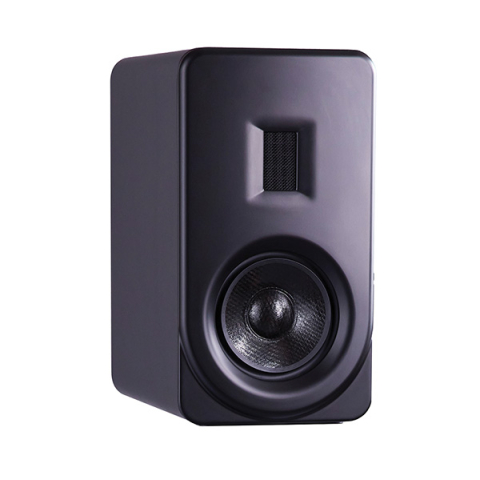
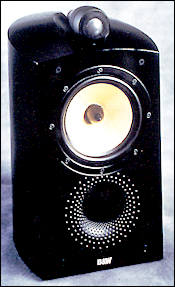
The B&W Nautilus 805 is quite different from its predecessor, the good-sounding Matrix 805, in size, shape, drivers, crossover, and price (it costs 25% more). The Matrix 805 (Vol.16 No.4, p.225), was a rectangular box topped with a bullet-shaped "eyeball" tweeter housing. The new model is a scaled-down version of the Nautilus 801's round-backed Matrix woofer cabinet. Its rounded, narrower cabinet profile is almost elliptical in cross section when viewed from above. The transmission-line tweeter housing—described as a "racy-looking, streamlined, tear-drop-shaped nacelle" by Wes Phillips—is nestled in a groove in the top of the Nautilus 805's mid/bass cabinet.
I had to agree. During a brief audition of the Nautilus 801 at HI-FI '98 in Los Angeles—where it played tracks from the Titanic soundtrack at full volume in a room packed with 30 people—I was bowled over by its bass slam, impressive low-end extension, wide dynamic range, and freedom from compression. But the Nautilus 801 weighs 230 lbs, and for optimal performance, two of them require four channels of topnotch amplification. I wondered if its sonic characteristics could be distilled into a two-way loudspeaker using the same design principles. When B&W's Chris Browder made it possible for me to review the "bookshelf" model, the Nautilus 805, I jumped at the chance. Technology All Nautilus 800 loudspeakers, including the 805, have common acoustical goals: a stable center image, good depth of soundstage (even off-axis), no coloration, excellent bass-transient performance ("slam"), and no compression. To meet these goals, the Nautilus 805 joins its brethren in having curved cabinet surfaces, a Matrix enclosure, a Nautilus tweeter, a woven Kevlar cone in the mid/bass driver, a "Flowport" venting system with computer-designed flare and anti-turbulence dimpling, separated crossover boards, and shrouded WBT speaker terminals.