I've spent six-odd years in a sort of hi-fi counterculture, playing with things like mono cartridges, one-box CD players, and cheap, homemade cables—and, of course, owning and listening to single-ended triode (SET) amplifiers and horn loudspeakers. But before all that, I owned components that, while more mainstream, did the job just as well in certain ways. That category included solid-state electronics (Naim, BEL, Spectral), dynamic loudspeakers of middling efficiency (ProAc, Epos, Magneplanar), electrostatic loudspeakers of very low efficiency (Stax), and even "high-end" accessories like Tiptoes and Shun Mook Mpingo discs (which I still have, although my five-year-old daughter has more or less permanently co-opted the latter for playtime use).  If you SET enthusiasts have the feeling that I'm setting you up for a bit of distressing news, like the veterinarian who calls to tell you how happy Skippy looked just before he slipped his leash, you're right. As I write this, I haven't listened to my horn-loaded Lowthers in a month, because I've been having too much fun listening to the Quad ESL-989 loudspeakers I wrote about in the May issue (Follow-Up, p.109), driven by a high-power, high-tech solid-state amplification system from Linn. I feel a little guilty, but not because I've been enjoying things I can't afford to buy for myself. Rather, with my kit speakers and my kit amplifier and my DIY cables, I had been inching toward a completely homemade hi-fi, however slowly. But neither I nor any other DIY enthusiast I know could put together something like these Linns at home, any more than we could whip up a replacement for Skippy with some golden-retriever DNA that just happened to be lying around.
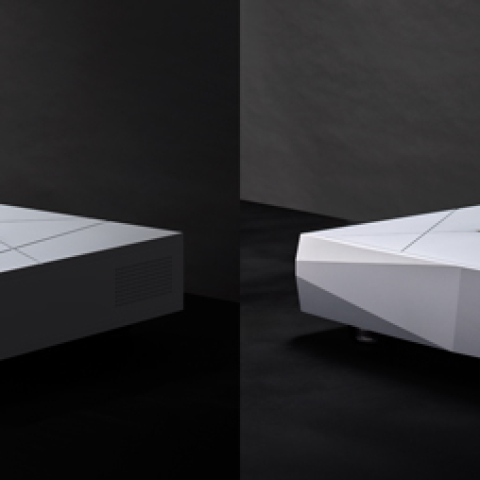
The first evidence of this is the casework of the Linn Klimax Twin power amplifier ($8995) and Klimax Kontrol preamplifier ($9895), each of which is—like a good fly reel—precision-machined from great, heaping chunks of high-purity aluminum alloy. Linn uses the word clamshell to describe these, conjuring images of elegant and very expensive wristwatches—and I suppose that's appropriate. More to the point is the way these surprisingly heavy two-piece enclosures caress the parts inside, drawing away heat and preventing them from vibrating. As with the Klimaxes' companion CD player, Linn's top-of-the-line CD12, the precision with which the two enclosure halves fit together is astonishing. The Klimax design team says the casework even has a significant musical and sonic influence. The low-slung Klimaxes are squarish when viewed from above, being just a little larger than an LP sleeve. The amp looks positively serene: a clean sweep of metal disturbed only by a neat row of 14 curvy slits on the top for cooling, and a small, crescent-shaped recess for an indicator light on the front. The preamp has a solid top and sports only six tiny, shiny buttons on its front panel (all of whose functions are duplicated, and then some, on the standard remote-control handset), plus a larger, crescent-shaped recess in the form of a dark Plexiglas display screen. As with the CD12, the size and location of the display was chosen to mimic and complement the styling of Linn's companion turntable, the LP12: The dark curve is meant to remind one of the LP12's platter and mat, seen from a three-quarters view. I have one of those, too, and can confirm that Linn's old and new products do look very smart sitting next to one another. The preamp's display has a sharp blue readout to tell you about loudness, balance, source selection, standby status, and other such things; the sophisticated logic circuitry behind it lets you adjust individually such things as relative gain and balance settings for each source. Say, for example, you have a phono cartridge whose output is a little lower in one channel than the other, or a CD player with a slightly higher output than average, and you want to be able to switch between these and other sources without having to readjust balance and loudness every time. No problem: It takes just a few moments to program the Klimax Kontrol accordingly, using various keys on the remote.
You can further customize each source selection by using the handset to enter a name of up to eight characters. I've set up my sample to read "SONY 777" on input 1 and "LINNLP12" on input 2; the name on input 3 has alternated so far between two rude and immature suggestions, neither of which has yet ceased to amuse me. Parents: Take note. The Klimax Kontrol has balanced ins and outs, and needs to be programmed by its user to determine which of the rear-mounted input jacks a given source is connected to, choosing from among one pair of balanced inputs (XLRs) and three pairs of unbalanced inputs (gold-plated RCAs). I had no true balanced sources to hand, but I did use the Klimax Kontrol's balanced outputs with the similarly balanced-design Klimax Twin amplifier.
If you SET enthusiasts have the feeling that I'm setting you up for a bit of distressing news, like the veterinarian who calls to tell you how happy Skippy looked just before he slipped his leash, you're right. As I write this, I haven't listened to my horn-loaded Lowthers in a month, because I've been having too much fun listening to the Quad ESL-989 loudspeakers I wrote about in the May issue (Follow-Up, p.109), driven by a high-power, high-tech solid-state amplification system from Linn. I feel a little guilty, but not because I've been enjoying things I can't afford to buy for myself. Rather, with my kit speakers and my kit amplifier and my DIY cables, I had been inching toward a completely homemade hi-fi, however slowly. But neither I nor any other DIY enthusiast I know could put together something like these Linns at home, any more than we could whip up a replacement for Skippy with some golden-retriever DNA that just happened to be lying around.
The first evidence of this is the casework of the Linn Klimax Twin power amplifier ($8995) and Klimax Kontrol preamplifier ($9895), each of which is—like a good fly reel—precision-machined from great, heaping chunks of high-purity aluminum alloy. Linn uses the word clamshell to describe these, conjuring images of elegant and very expensive wristwatches—and I suppose that's appropriate. More to the point is the way these surprisingly heavy two-piece enclosures caress the parts inside, drawing away heat and preventing them from vibrating. As with the Klimaxes' companion CD player, Linn's top-of-the-line CD12, the precision with which the two enclosure halves fit together is astonishing. The Klimax design team says the casework even has a significant musical and sonic influence. The low-slung Klimaxes are squarish when viewed from above, being just a little larger than an LP sleeve. The amp looks positively serene: a clean sweep of metal disturbed only by a neat row of 14 curvy slits on the top for cooling, and a small, crescent-shaped recess for an indicator light on the front. The preamp has a solid top and sports only six tiny, shiny buttons on its front panel (all of whose functions are duplicated, and then some, on the standard remote-control handset), plus a larger, crescent-shaped recess in the form of a dark Plexiglas display screen. As with the CD12, the size and location of the display was chosen to mimic and complement the styling of Linn's companion turntable, the LP12: The dark curve is meant to remind one of the LP12's platter and mat, seen from a three-quarters view. I have one of those, too, and can confirm that Linn's old and new products do look very smart sitting next to one another. The preamp's display has a sharp blue readout to tell you about loudness, balance, source selection, standby status, and other such things; the sophisticated logic circuitry behind it lets you adjust individually such things as relative gain and balance settings for each source. Say, for example, you have a phono cartridge whose output is a little lower in one channel than the other, or a CD player with a slightly higher output than average, and you want to be able to switch between these and other sources without having to readjust balance and loudness every time. No problem: It takes just a few moments to program the Klimax Kontrol accordingly, using various keys on the remote.
You can further customize each source selection by using the handset to enter a name of up to eight characters. I've set up my sample to read "SONY 777" on input 1 and "LINNLP12" on input 2; the name on input 3 has alternated so far between two rude and immature suggestions, neither of which has yet ceased to amuse me. Parents: Take note. The Klimax Kontrol has balanced ins and outs, and needs to be programmed by its user to determine which of the rear-mounted input jacks a given source is connected to, choosing from among one pair of balanced inputs (XLRs) and three pairs of unbalanced inputs (gold-plated RCAs). I had no true balanced sources to hand, but I did use the Klimax Kontrol's balanced outputs with the similarly balanced-design Klimax Twin amplifier.
If you SET enthusiasts have the feeling that I'm setting you up for a bit of distressing news, like the veterinarian who calls to tell you how happy Skippy looked just before he slipped his leash, you're right. As I write this, I haven't listened to my horn-loaded Lowthers in a month, because I've been having too much fun listening to the Quad ESL-989 loudspeakers I wrote about in the May issue (Follow-Up, p.109), driven by a high-power, high-tech solid-state amplification system from Linn. I feel a little guilty, but not because I've been enjoying things I can't afford to buy for myself. Rather, with my kit speakers and my kit amplifier and my DIY cables, I had been inching toward a completely homemade hi-fi, however slowly. But neither I nor any other DIY enthusiast I know could put together something like these Linns at home, any more than we could whip up a replacement for Skippy with some golden-retriever DNA that just happened to be lying around.