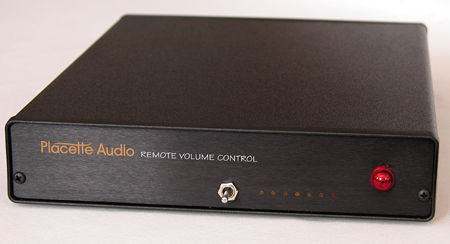
The Placette Audio Remote Volume Control is simplicity itself: a paperback-sized black box with one set of unbalanced inputs and outputs, a toggle switch (and a remote) to change the level, and a row of LEDs that light up to indicate the relative volume level. The signal path, too, is simple, with only a stepped attenuator between input and output. But this is not just any attenuator—it's a 125-step model built entirely with super-premium Vishay S-102 foil resistors.
 The idea behind the Placette is also simple. Most source components have enough output voltage to drive a power amplifier—they just need a way to control volume. Why not eliminate the active components of a traditional preamp or line stage altogether, along with all of their distortions? But Placette also believes that most volume controls have their own problems: step attenuators have too few steps, even the best potentiometers can cause distortion and channel-to-channel imbalances, and all of them present variable capacitive and inductive loads that might degrade frequency response. The only solution to these problems, Placette believes, is their "platinum sledgehammer" approach of switched discrete Vishay foil resistors.
However, when I replaced my preamp with the Placette, what it did for my audio system was anything but simple. I started with it in a minimalist system, between the Primare D30.2 CD player I review elsewhere in this issue and my VTL Ichiban amplifiers, wired with 0.5m Nirvana SX Ltd. and Kimber KCAG interconnects. The result was stunning—one of those audio epiphanies that make me completely rethink my assumptions and listening priorities. I went on to try the Placette in several other systems, in some replacing a preamp, in others a CD player's onboard volume control. The results varied: the difference was much more dramatic if the Placette replaced an active stage, and there were minor tradeoffs in dynamics in some cases, but three things always occurred.
The first, which I suspect was due to the Placette's superior channel-to-channel balance and tracking, was that the image became centered and locked into place in a way that made other setups sound distorted and uncertain. By "centered," I mean primarily that the sonic picture became centered with respect to my speakers, but also that the performers were more centered and suspended within the original recording space. When I listened to John Rutter's Requiem (CD, Reference RR-57CD) with the Placette in the system, the choirs were more clearly centered within the Meyerson Symphony Center, well in from the walls. The Meyerson itself—the entire sonic picture—seemed straighter and better aligned with respect to the speakers.
The idea behind the Placette is also simple. Most source components have enough output voltage to drive a power amplifier—they just need a way to control volume. Why not eliminate the active components of a traditional preamp or line stage altogether, along with all of their distortions? But Placette also believes that most volume controls have their own problems: step attenuators have too few steps, even the best potentiometers can cause distortion and channel-to-channel imbalances, and all of them present variable capacitive and inductive loads that might degrade frequency response. The only solution to these problems, Placette believes, is their "platinum sledgehammer" approach of switched discrete Vishay foil resistors.
However, when I replaced my preamp with the Placette, what it did for my audio system was anything but simple. I started with it in a minimalist system, between the Primare D30.2 CD player I review elsewhere in this issue and my VTL Ichiban amplifiers, wired with 0.5m Nirvana SX Ltd. and Kimber KCAG interconnects. The result was stunning—one of those audio epiphanies that make me completely rethink my assumptions and listening priorities. I went on to try the Placette in several other systems, in some replacing a preamp, in others a CD player's onboard volume control. The results varied: the difference was much more dramatic if the Placette replaced an active stage, and there were minor tradeoffs in dynamics in some cases, but three things always occurred.
The first, which I suspect was due to the Placette's superior channel-to-channel balance and tracking, was that the image became centered and locked into place in a way that made other setups sound distorted and uncertain. By "centered," I mean primarily that the sonic picture became centered with respect to my speakers, but also that the performers were more centered and suspended within the original recording space. When I listened to John Rutter's Requiem (CD, Reference RR-57CD) with the Placette in the system, the choirs were more clearly centered within the Meyerson Symphony Center, well in from the walls. The Meyerson itself—the entire sonic picture—seemed straighter and better aligned with respect to the speakers.
 Second, installing the Placette improved the system's transparency by removing a layer of grunge that—in most cases—I hadn't even realized was there. The spaces around images became clean and open, and notes emerged from and flowed through the recording venue's ambience. Tonal purity was improved as well, with instruments and voices sounding more relaxed and natural. The Placette pointed out that the other volume controls, especially the line stages, were weaving a subtle patchwork of distortions into the sound, textures so inherent to the components' performance that I'd been listening around them.
The third thing that happened when I replaced other line stages or volume controls with the Placette was that the sonic picture snapped into focus. The choirs on Requiem were obviously rows of singers through the Placette, and those rows were clearly lines of distinct individuals, each with his or her own unique voice located at a specific point in three-dimensional space.
The Remote Volume Control retails for $1000 and is available directly from Placette Audio. They offer a 30-day, money-back guarantee; should the buyer opt to keep his unit, he also gets a lifetime warranty and full trade-in credit toward one of Placette's more expensive models: a three-input passive line stage ($1400); or a seven-input, two-output, zero-gain active line stage ($4000) that maintains a constant 10 ohm output impedance, which allows it to drive long cables.
Summing up
Second, installing the Placette improved the system's transparency by removing a layer of grunge that—in most cases—I hadn't even realized was there. The spaces around images became clean and open, and notes emerged from and flowed through the recording venue's ambience. Tonal purity was improved as well, with instruments and voices sounding more relaxed and natural. The Placette pointed out that the other volume controls, especially the line stages, were weaving a subtle patchwork of distortions into the sound, textures so inherent to the components' performance that I'd been listening around them.
The third thing that happened when I replaced other line stages or volume controls with the Placette was that the sonic picture snapped into focus. The choirs on Requiem were obviously rows of singers through the Placette, and those rows were clearly lines of distinct individuals, each with his or her own unique voice located at a specific point in three-dimensional space.
The Remote Volume Control retails for $1000 and is available directly from Placette Audio. They offer a 30-day, money-back guarantee; should the buyer opt to keep his unit, he also gets a lifetime warranty and full trade-in credit toward one of Placette's more expensive models: a three-input passive line stage ($1400); or a seven-input, two-output, zero-gain active line stage ($4000) that maintains a constant 10 ohm output impedance, which allows it to drive long cables.
Summing up
I heartily recommend giving the Placette Audio Remote Volume Control a listen. I guarantee that the results will be at least interesting, and with Placette's risk-free trial, the only danger is that it will change your perspective on audio systems—as it did mine. Its practical limitations—having only a single input and requiring very short cable runs—prevent it from being a product that I could conveniently live with. Its sonic performance, however, is something that I don't want to live without. I plan to check out one or both of Placette's larger units in the very near future.
The idea behind the Placette is also simple. Most source components have enough output voltage to drive a power amplifier—they just need a way to control volume. Why not eliminate the active components of a traditional preamp or line stage altogether, along with all of their distortions? But Placette also believes that most volume controls have their own problems: step attenuators have too few steps, even the best potentiometers can cause distortion and channel-to-channel imbalances, and all of them present variable capacitive and inductive loads that might degrade frequency response. The only solution to these problems, Placette believes, is their "platinum sledgehammer" approach of switched discrete Vishay foil resistors.
However, when I replaced my preamp with the Placette, what it did for my audio system was anything but simple. I started with it in a minimalist system, between the Primare D30.2 CD player I review elsewhere in this issue and my VTL Ichiban amplifiers, wired with 0.5m Nirvana SX Ltd. and Kimber KCAG interconnects. The result was stunning—one of those audio epiphanies that make me completely rethink my assumptions and listening priorities. I went on to try the Placette in several other systems, in some replacing a preamp, in others a CD player's onboard volume control. The results varied: the difference was much more dramatic if the Placette replaced an active stage, and there were minor tradeoffs in dynamics in some cases, but three things always occurred.
Second, installing the Placette improved the system's transparency by removing a layer of grunge that—in most cases—I hadn't even realized was there. The spaces around images became clean and open, and notes emerged from and flowed through the recording venue's ambience. Tonal purity was improved as well, with instruments and voices sounding more relaxed and natural. The Placette pointed out that the other volume controls, especially the line stages, were weaving a subtle patchwork of distortions into the sound, textures so inherent to the components' performance that I'd been listening around them.
The third thing that happened when I replaced other line stages or volume controls with the Placette was that the sonic picture snapped into focus. The choirs on Requiem were obviously rows of singers through the Placette, and those rows were clearly lines of distinct individuals, each with his or her own unique voice located at a specific point in three-dimensional space.
I heartily recommend giving the Placette Audio Remote Volume Control a listen. I guarantee that the results will be at least interesting, and with Placette's risk-free trial, the only danger is that it will change your perspective on audio systems—as it did mine. Its practical limitations—having only a single input and requiring very short cable runs—prevent it from being a product that I could conveniently live with. Its sonic performance, however, is something that I don't want to live without. I plan to check out one or both of Placette's larger units in the very near future.