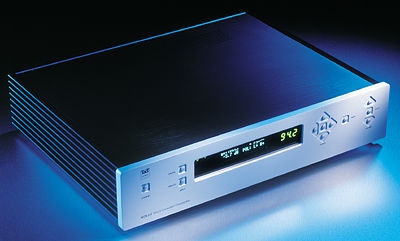
I anticipated the installation of the TacT Audio RCS 2.0 room-correction processor with mixed emotions—I already liked my system and room, and such a device threatened to make all my studied efforts trivial. What if one might use any decent amps and speakers, cables that were merely conductive, and no room treatment at all? And what if, on top of that, you could just put them wherever your significant other thought they looked right? What if all the magic you needed was contained in this box? Scary.  The TacT RCS (Room Correction System) 2.0 is an up-to-date manifestation of a long history of such devices, and derives from an earlier design developed under the Snell trademark. The RCS itself is the outcome of wave-propagation research by Dr. Radomir Bozovic. It works by 1) measuring how the system and room together reproduce test signals, 2) determining the differences, in both the frequency and time domains, between the original test signals and the measured ones, and 3) developing and applying a corrective algorithm to the test and music signals that compensates for the changes wrought by hardware and acoustics. While the concept has existed for years, it is only with the coming of fast, affordable DSP devices that it can be realized in a consumer product like the RCS 2.0. The basic RCS 2.0 is a two-channel digital device with four optional analog inputs (up to 24-bit/96kHz A/D) and two optional analog outputs (24/96 D/A), in addition to the standard digital I/O. (The unit reviewed, the 2.0AA, had both options.) Because the RCS also has the ability to control gain (or, more properly, attenuation), signal polarity (for each channel individually!), and to select among its digital and analog inputs, it can also, with its tiny, lightweight remote control, function as the preamp/control center for a full system.
Arrival and Setup
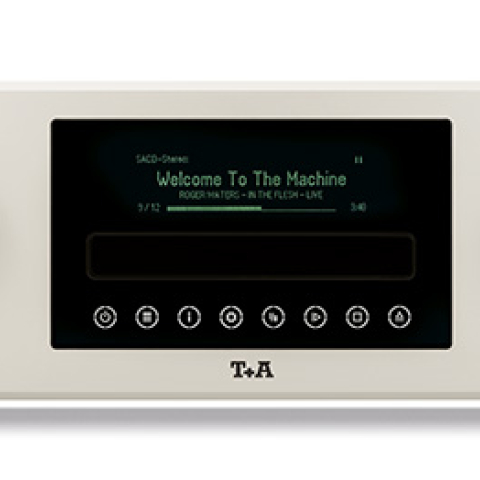
The TacT RCS (Room Correction System) 2.0 is an up-to-date manifestation of a long history of such devices, and derives from an earlier design developed under the Snell trademark. The RCS itself is the outcome of wave-propagation research by Dr. Radomir Bozovic. It works by 1) measuring how the system and room together reproduce test signals, 2) determining the differences, in both the frequency and time domains, between the original test signals and the measured ones, and 3) developing and applying a corrective algorithm to the test and music signals that compensates for the changes wrought by hardware and acoustics. While the concept has existed for years, it is only with the coming of fast, affordable DSP devices that it can be realized in a consumer product like the RCS 2.0. The basic RCS 2.0 is a two-channel digital device with four optional analog inputs (up to 24-bit/96kHz A/D) and two optional analog outputs (24/96 D/A), in addition to the standard digital I/O. (The unit reviewed, the 2.0AA, had both options.) Because the RCS also has the ability to control gain (or, more properly, attenuation), signal polarity (for each channel individually!), and to select among its digital and analog inputs, it can also, with its tiny, lightweight remote control, function as the preamp/control center for a full system.
Arrival and Setup
Peter Lyngdorf and Karsten Petersen of TacT installed the RCS between the AES/EBU digital output of my Meridian 800 DVD/CD transport and the balanced analog inputs of my McCormack DNA-1 Rev.A power amplifier, and connected a long RS-232 cord to Lyngdorf's laptop, on which the TacT software was installed. (A PC with Windows 95/98/NT is required only for setup, measurement, customization, and installation of the programs for the DSP engines in the RCS; it is not needed for daily operation.) Petersen then plugged the calibrated microphone into the back of the RCS and rigged a support, with duct tape and a yardstick, to position the mike at my normal listening position. Lyngdorf said that the improvements wrought by the RCS would be more difficult to discern in a reviewer's system, which typically is already very good. He suggested that we push my speakers into the corners and remove all acoustic devices from the room—then I'd hear how important a change the RCS can make. I declined. We hovered over Lyngdorf's shoulder as he commanded the RCS to pump a series of double pulses—one short to cover the range from 2kHz to 20kHz; the other long to cover the region below 2kHz—through the system and record the output on the laptop for analysis. This took about two minutes; results improve with longer test periods, which reduce to obscurity the influence of random acoustic events. Subsequently, I found that the central air-conditioning noise substantially interfered with the measuring process—the TacT actually tried to cancel it!
From the measurements, the software displays the impulse responses of the two channels and, via FFT processing, it also displays response curves for the two speakers as well as a hyper-accurate measurement of the speaker-to-microphone (or listener) distance. If you expect a smooth, flat curve, you'll be disappointed. The next step was to choose a target response curve so that the RCS could calculate a real-time correction for the speakers. To answer the obvious question of "Why not automatically target a flat response?": First, a flat integrated response implies a tipped-up on-axis response, because room responses are rolled off in the HF (see sidebar). Second, many speakers and some amps simply cannot handle the power needed for a fully equalized flat response down to the extreme bass. Third, almost all commercial recordings are balanced for typical domestic systems, which, whatever their provenance, are almost never flat. And fourth (this might be controversial), a completely flat response would almost certainly sap your system of some of the very characteristics that make you prefer it to other systems. But don't take my word for it—the RCS 2.0 has nine program memories; you should include a flat compensation for your own evaluation. Lyngdorf selected a target curve from the library supplied on the program CD-ROM and edited it a bit with the mouse while viewing the measured curve. The calculation and download of the correction filter to the RCS 2.0 took another minute. A short listening session ensued, and then the TacT guys were allowed to leave.
That initial quickie compensation resulted in a too-tight, constipated bass and a soundstage so sparse that I wondered if there shouldn't be more instruments to populate it. I considered packing the RCS up for return but I'm glad I didn't. The real work—critical listening and fine-tuning the RCS until the correction was just right—still lay ahead.
The TacT RCS (Room Correction System) 2.0 is an up-to-date manifestation of a long history of such devices, and derives from an earlier design developed under the Snell trademark. The RCS itself is the outcome of wave-propagation research by Dr. Radomir Bozovic. It works by 1) measuring how the system and room together reproduce test signals, 2) determining the differences, in both the frequency and time domains, between the original test signals and the measured ones, and 3) developing and applying a corrective algorithm to the test and music signals that compensates for the changes wrought by hardware and acoustics. While the concept has existed for years, it is only with the coming of fast, affordable DSP devices that it can be realized in a consumer product like the RCS 2.0. The basic RCS 2.0 is a two-channel digital device with four optional analog inputs (up to 24-bit/96kHz A/D) and two optional analog outputs (24/96 D/A), in addition to the standard digital I/O. (The unit reviewed, the 2.0AA, had both options.) Because the RCS also has the ability to control gain (or, more properly, attenuation), signal polarity (for each channel individually!), and to select among its digital and analog inputs, it can also, with its tiny, lightweight remote control, function as the preamp/control center for a full system. Peter Lyngdorf and Karsten Petersen of TacT installed the RCS between the AES/EBU digital output of my Meridian 800 DVD/CD transport and the balanced analog inputs of my McCormack DNA-1 Rev.A power amplifier, and connected a long RS-232 cord to Lyngdorf's laptop, on which the TacT software was installed. (A PC with Windows 95/98/NT is required only for setup, measurement, customization, and installation of the programs for the DSP engines in the RCS; it is not needed for daily operation.) Petersen then plugged the calibrated microphone into the back of the RCS and rigged a support, with duct tape and a yardstick, to position the mike at my normal listening position. Lyngdorf said that the improvements wrought by the RCS would be more difficult to discern in a reviewer's system, which typically is already very good. He suggested that we push my speakers into the corners and remove all acoustic devices from the room—then I'd hear how important a change the RCS can make. I declined. We hovered over Lyngdorf's shoulder as he commanded the RCS to pump a series of double pulses—one short to cover the range from 2kHz to 20kHz; the other long to cover the region below 2kHz—through the system and record the output on the laptop for analysis. This took about two minutes; results improve with longer test periods, which reduce to obscurity the influence of random acoustic events. Subsequently, I found that the central air-conditioning noise substantially interfered with the measuring process—the TacT actually tried to cancel it!