By contrast, a class-D amplifier can, in theory, be 100% efficient, and practical circuits are at least 90% efficient. Watt for watt, all of the expensive parts of an amplifier design—the power transformer, output-stage heatsinking, and chassis—can be smaller and thus less expensive: a high-power class-D amplifier can be small in size, light in weight, and cheap. Class-D amplifiers appear, therefore, to have had every competitive advantage. So why do audiophiles still mostly buy and use amplifiers with class-AB output stages?
The answer is the ultimate sound quality—so far, class-D amplifiers have found widespread domestic acceptance only as subwoofer amplifiers. There are exceptions: Bruno Putzeys's Hypex modules, as used in the Channel Islands amplifiers, have their followers; PS Audio's GCC-100 is a favorite of Stereophile reviewer Robert Deutsch; and the latest generation of Bel Canto's e.One Reference 1000 monoblocks are to be found in "Music in the Round" columnist Kalman Rubinson's system.
Still, when I encountered NAD's Masters Series M2 class-D integrated amplifier, which sells for a respectable $5999, I was torn between respect for the technology its design demonstrated and skepticism about its ultimate sound quality. How good could a class-D amplifier sound? The only way to find out was to review it.
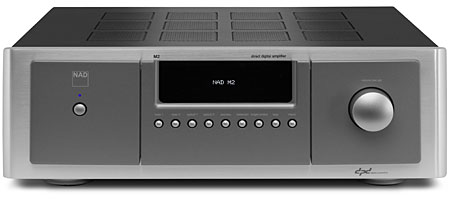
The Masters Series M2
Although it's convenient to refer to the NAD M2 as an integrated amplifier, it's actually something rather different: the M2 is a multiple-input D/A converter with an output stage that can drive a loudspeaker. Although it has two pairs of analog inputs—one pair single-ended on RCAs, the other pair balanced on XLRs—these are immediately converted to 24-bit digital, with a user-selectable sample rate of 48, 96, or 192kHz. Sources are selected with the buttons below the front panel's blue fluorescent display or with the remote.
Both digital input signals and the converted analog input signals are fed to a digital signal-processing section, this specified as having an internal data path 35 bits wide. The DSP section includes the volume control; as the maximum bit depth handled by the control is 24, the 35-bit data path, in theory, allows there to be up to 11 bits' worth (ie, 66dB) of attenuation with no degradation of signal resolution. Level adjustments are made either with a front-panel rotary encoder or with the usual Up/Down buttons on the remote control, in 0.5dB steps. The DSP section also allows the user to choose from seven impedance-compensation filters, to allow the amplifier's top octave to be tuned to match the chosen speaker impedance in that region.
The rightmost front-panel button is labeled Menu; in conjunction with the rotary encoder, it allows the user to select the sample rate of the analog inputs' A/D converters, the speaker impedance-matching filter, a gain offset for each of the analog inputs (from 0dB to –9dB in 3dB steps), the amplifier's absolute polarity, and the alphanumeric name of each input. The volume control can be bypassed if the owner wishes to use the M2 with a separate preamplifier, while digital data can be routed via an external processing loop if desired.

The M2's rear panel offers two pairs of plastic-shrouded binding posts for each channel, to either side of the IEC AC inlet and main power switch. (A front-panel button switches the M2 in and out of Standby mode.) The balanced and unbalanced analog input jacks are on the far left of the rear panel, with the digital inputs and loop sockets vertically arrayed next to them.
Footnote 1: The D in class-D does not stand for digital, as some commentators have suggested. Rather, D was just the next available letter in the alphabet when amplifier circuit topologies were being classified. A class-D amplifier can be either digital or analog in operating principle.