"A high-quality amplifier must be capable of passing rigid laboratory measurements, meet all listening requirements, and be simple and straightforward in design in the interest of minimizing performance degradation..."—Cdr. Charles W. Harrison Jr., Audio, January 1956 (footnote 1)
"It don't mean a thing if it ain't got that swing."—Duke Ellington
 My mother was visiting. "What exactly is a preamplifier?" she asked. I explained, in some detail with helpful use of analogy (though the fact that we were in one of Santa Fe's many excellent restaurants meant that I had to eschew the use of slides and an overhead projector). "Why then do I need a power amplifier?" was her next question. Obviously I had left something out of my expert explanation. Dessert interrupted the fine flow of my discourse, and she had returned to the UK by the time I had remembered what it was I was going to say. Which was:
Your source components, be they phono cartridges, CD players, FM tuners, or tape recorders, output an electrical signal that by convention represents the music's original acoustic pressure waves as a varying voltage. This voltage is passed along the reproduction chain, raised in level, its shape modified in a mid-fi system by tone and other controls, in a high-end system preserved with its shape as intact as possible, until it comes time for the loudspeakers to use it to generate acoustic pressure waves that correspond exactly—if you've paid enough for the speakers, of course—to those impinging on the mike in the recording studio.
But—and it's a large "but"—a loudspeaker is driven by a varying current, not voltage. Which is where the power amplifier comes in. Its output voltage ideally is a magnified facsimile of the voltage applied to its input; when that voltage is applied to the loudspeaker terminals, the speaker draws current from the amplifier, the exact amount dependent on both the voltage and the manner in which the speaker's impedance magnitude and phase change with frequency. All that the amplifier has to be able to do is source that appropriate amount of current; no more, no less.
If you multiply the maximum RMS voltage the amplifier can deliver by the current that is equivalent to that voltage into a specified load, you have the amplifier's power rating: "100 watts," for example. You can get a "100W" amplifier from an Asian manufacturer for as little as $300. You can also pay $6000 or more for a "high-end" "100W" stereo amplifier. How can it be possible for apparently identically rated power amplifiers to cover a price ratio of 20 times? Is the manufacturer of the expensive amplifier guilty of consumer fraud? Or has the manufacturer of the cheap amplifier omitted something?
The answer to both questions is "not necessarily." Look again at my specification of an ideal amplifier. The amplifier delivers to the loudspeaker a magnified voltage; the loudspeaker then sucks current proportional to that voltage. Many amplifiers cannot deliver that current if the loudspeaker has an impedance much below 8 ohms; or if the speaker's phase angle—a measure of how far apart in time the voltage and equivalent current become—is too great; or they cannot deliver that current in the low bass or high treble, the amplifiers' specifications only being valid in the midrange; or if they can deliver the current, the shape of the voltage waveform is affected, becoming distorted in one or more of a number of ways; or the amplifiers become less and less stable the more their output current increases; or they can only deliver that current for a very limited time; or their ability to deliver that current is dependent on either the kind of music being reproduced or the recent history of the music signal (which affects the temperature of their heatsinks)—or even both.
All amplifiers suffer to a lesser or greater extent from some or all of these ills, but as a general rule, the more money you pay for an amplifier, the more likely it will—or should—resemble that perfect amplifier. It's even probable that the more an amplifier resembles the ideal, the more likely its owner will enjoy his records. Which brings me to this review. In this and the next two issues, I will be reporting on the behavior of a small number of "high-end" amplifiers. Does their behavior more closely approach the paradigm than that of less expensive models? Can there be an amplifier which sounds superb despite being an exception to that ideal? I kick off with the Mark Levinson No.23.5, which offers high specified power—at a price!
Mark Levinson No.23.5: $5900
My mother was visiting. "What exactly is a preamplifier?" she asked. I explained, in some detail with helpful use of analogy (though the fact that we were in one of Santa Fe's many excellent restaurants meant that I had to eschew the use of slides and an overhead projector). "Why then do I need a power amplifier?" was her next question. Obviously I had left something out of my expert explanation. Dessert interrupted the fine flow of my discourse, and she had returned to the UK by the time I had remembered what it was I was going to say. Which was:
Your source components, be they phono cartridges, CD players, FM tuners, or tape recorders, output an electrical signal that by convention represents the music's original acoustic pressure waves as a varying voltage. This voltage is passed along the reproduction chain, raised in level, its shape modified in a mid-fi system by tone and other controls, in a high-end system preserved with its shape as intact as possible, until it comes time for the loudspeakers to use it to generate acoustic pressure waves that correspond exactly—if you've paid enough for the speakers, of course—to those impinging on the mike in the recording studio.
But—and it's a large "but"—a loudspeaker is driven by a varying current, not voltage. Which is where the power amplifier comes in. Its output voltage ideally is a magnified facsimile of the voltage applied to its input; when that voltage is applied to the loudspeaker terminals, the speaker draws current from the amplifier, the exact amount dependent on both the voltage and the manner in which the speaker's impedance magnitude and phase change with frequency. All that the amplifier has to be able to do is source that appropriate amount of current; no more, no less.
If you multiply the maximum RMS voltage the amplifier can deliver by the current that is equivalent to that voltage into a specified load, you have the amplifier's power rating: "100 watts," for example. You can get a "100W" amplifier from an Asian manufacturer for as little as $300. You can also pay $6000 or more for a "high-end" "100W" stereo amplifier. How can it be possible for apparently identically rated power amplifiers to cover a price ratio of 20 times? Is the manufacturer of the expensive amplifier guilty of consumer fraud? Or has the manufacturer of the cheap amplifier omitted something?
The answer to both questions is "not necessarily." Look again at my specification of an ideal amplifier. The amplifier delivers to the loudspeaker a magnified voltage; the loudspeaker then sucks current proportional to that voltage. Many amplifiers cannot deliver that current if the loudspeaker has an impedance much below 8 ohms; or if the speaker's phase angle—a measure of how far apart in time the voltage and equivalent current become—is too great; or they cannot deliver that current in the low bass or high treble, the amplifiers' specifications only being valid in the midrange; or if they can deliver the current, the shape of the voltage waveform is affected, becoming distorted in one or more of a number of ways; or the amplifiers become less and less stable the more their output current increases; or they can only deliver that current for a very limited time; or their ability to deliver that current is dependent on either the kind of music being reproduced or the recent history of the music signal (which affects the temperature of their heatsinks)—or even both.
All amplifiers suffer to a lesser or greater extent from some or all of these ills, but as a general rule, the more money you pay for an amplifier, the more likely it will—or should—resemble that perfect amplifier. It's even probable that the more an amplifier resembles the ideal, the more likely its owner will enjoy his records. Which brings me to this review. In this and the next two issues, I will be reporting on the behavior of a small number of "high-end" amplifiers. Does their behavior more closely approach the paradigm than that of less expensive models? Can there be an amplifier which sounds superb despite being an exception to that ideal? I kick off with the Mark Levinson No.23.5, which offers high specified power—at a price!
Mark Levinson No.23.5: $5900
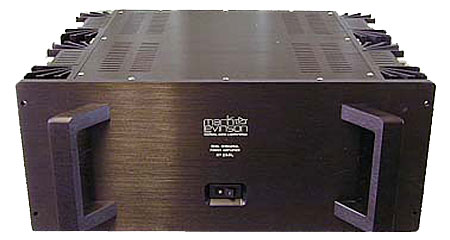
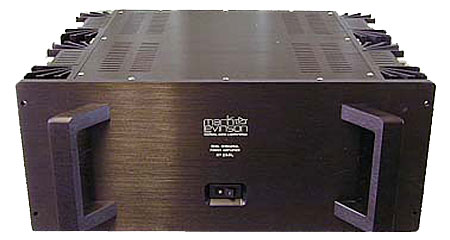
The No.23.5 is an evolutionary development from the Mark Levinson No.23 that Lewis Lipnick raved about in 1988 (Vol.11 No.9), featuring revised input circuitry, among other things. (The changes are comprehensive—it costs $3500 to upgrade from 23 to 23.5 status.) Styled in the traditional Mark Levinson fashion, with side-mounted heatsinks and an all-black finish broken by white engraved legends, the 23.5 offers two sets of inputs on the chassis rear, single-ended or unbalanced via Camac sockets and balanced via XLRs. Speaker connection is via a single pair per channel of 5-way binding posts. The No.23.5 belies its modest size when you try to lift it, its 100-lb weight giving rise to muttered curses as you try to maneuver it into position into the listening room. Removing the top cover reveals a full chassis: two shielded 1258VA toroidal transformers, one for each channel, occupy the full depth of the central space, with two large, vertically mounted 36,000µF electrolytic capacitors on either side serving as the output stage reservoirs for each channel's ±83.7V voltage rails. The caps' ground connection is a solid proprietary-alloy bar of high-purity copper plated with a number of materials, including silver; more solid bars join the voltage rails to the output devices. There is just enough space between these caps and the side to squeeze in the driver and output circuitry, the 12 complementary push-pull output transistors and their heatsinks then forming the chassis sides.
Though there's enough standing bias to ensure that these output devices run warm, the 23.5 operates its output in class-A/B. Also mounted to the heatsinks are the driver transistors, these operated in class-A and arranged as a complementary emitter-follower driving two further complementary emitter-followers connected in parallel to get sufficient current gain. The input and driver stages for each channel are powered by a separate regulated power supply derived from separate transformer windings, preventing the output stage from modulating the voltage rails for the preceding circuitry.
The balanced inputs feed a cascoded differential amplifier, which then feeds a second cascoded differential amplifier with a current mirror. (When the No.23.5 is operated as a single-ended amplifier, a shorting strap links pins 1 and 3 of the XLR, tying the inverting input of the differential input to ground.) These differential amplifiers use discrete constant-current sources throughout. Though the No.23.5 has a push-pull output stage, it is not differential throughout, the current mirror converting the balanced signal to unbalanced. The input circuitry incorporates a soft-clipping circuit to prevent high-order overload harmonics from reaching the output stage.
Protection circuitry prevents turn-on/turn-off transients from reaching the output, and also monitors AC mains current, heatsink temperature, DC offset, phase-angle–dependent output-stage power dissipation, and whether or not the output has been short-circuited.
Footnote 1: From "High Quality Dual-Channel Amplifier," reprinted in Audio Anthology: When Audio Was Young, Vol.4, published by Audio Amateur Publications, Inc., available for $16.95 plus $1.75 S&H from Old Colony Sound Lab, P.O. Box 243, Peterborough, NH 03458-0243. Tel: (603) 924-6371. Fax: (603) 924-9467. Web: .
My mother was visiting. "What exactly is a preamplifier?" she asked. I explained, in some detail with helpful use of analogy (though the fact that we were in one of Santa Fe's many excellent restaurants meant that I had to eschew the use of slides and an overhead projector). "Why then do I need a power amplifier?" was her next question. Obviously I had left something out of my expert explanation. Dessert interrupted the fine flow of my discourse, and she had returned to the UK by the time I had remembered what it was I was going to say. Which was:
Your source components, be they phono cartridges, CD players, FM tuners, or tape recorders, output an electrical signal that by convention represents the music's original acoustic pressure waves as a varying voltage. This voltage is passed along the reproduction chain, raised in level, its shape modified in a mid-fi system by tone and other controls, in a high-end system preserved with its shape as intact as possible, until it comes time for the loudspeakers to use it to generate acoustic pressure waves that correspond exactly—if you've paid enough for the speakers, of course—to those impinging on the mike in the recording studio.
The No.23.5 is an evolutionary development from the Mark Levinson No.23 that Lewis Lipnick raved about in 1988 (Vol.11 No.9), featuring revised input circuitry, among other things. (The changes are comprehensive—it costs $3500 to upgrade from 23 to 23.5 status.) Styled in the traditional Mark Levinson fashion, with side-mounted heatsinks and an all-black finish broken by white engraved legends, the 23.5 offers two sets of inputs on the chassis rear, single-ended or unbalanced via Camac sockets and balanced via XLRs. Speaker connection is via a single pair per channel of 5-way binding posts. The No.23.5 belies its modest size when you try to lift it, its 100-lb weight giving rise to muttered curses as you try to maneuver it into position into the listening room. Removing the top cover reveals a full chassis: two shielded 1258VA toroidal transformers, one for each channel, occupy the full depth of the central space, with two large, vertically mounted 36,000µF electrolytic capacitors on either side serving as the output stage reservoirs for each channel's ±83.7V voltage rails. The caps' ground connection is a solid proprietary-alloy bar of high-purity copper plated with a number of materials, including silver; more solid bars join the voltage rails to the output devices. There is just enough space between these caps and the side to squeeze in the driver and output circuitry, the 12 complementary push-pull output transistors and their heatsinks then forming the chassis sides.
Footnote 1: From "High Quality Dual-Channel Amplifier," reprinted in Audio Anthology: When Audio Was Young, Vol.4, published by Audio Amateur Publications, Inc., available for $16.95 plus $1.75 S&H from Old Colony Sound Lab, P.O. Box 243, Peterborough, NH 03458-0243. Tel: (603) 924-6371. Fax: (603) 924-9467. Web: .