How much amplifier power do you need? Most audiophiles figure a maximum of a few hundred watts per channel—beyond that, you're wasting your money or showing off. Others think that anything more than a few watts will mess up an amplifier's musical coherence or "purity," so they stop there and find uncommonly sensitive speakers, usually compression horns with cone woofers.
 Of course, how much power you need depends on how much realism you seek. If you want only background music, or a pleasant but subdued version of the real thing, perhaps you don't need that much power. However, if you want a high degree of fidelity to the original event and the ability to reproduce the full dynamic majesty of a symphony orchestra, the concert SPLs of your favorite rock band, or even the visceral drive of as expressive a solo pianist as Keith Jarrett, you may need more power than you think, even in a room of small to medium size.
That's the contention of Musical Fidelity's founder-designer, Antony Michaelson, and he's got the numbers to back it up—along with a novel new product, the 550K Supercharger, which he claims can dynamically, um, supercharge your audio system without your having to replace any of it, and without changing its tonal character.
The transient peaks in live music can reach high sound pressure levels. For example, John Atkinson, sitting in a mid-hall seat in London's Royal Festival Hall, measured timpani thwacks at +106dB peak back in the early 1980s; reproducing those peaks without clipping and thus generating "slam factor" is what can make the difference between a system sounding "blah" or "wow," between "canned" or "real."
So if you're interested in reproducing musical realism at home, how much power do you really need? More than you might think, says Musical Fidelity's Antony Michaelson, who offers his reasoning in a white paper. Michaelson's bottom line is that with loudspeakers having normal sensitivity, you are going to need at least 500W to reproduce music's transient peaks in your listening room at a realistic level.
But that is not going to be possible with your favorite low-powered amplifier. A 100Wpc amplifier with 87dB-sensitive speakers will produce a maximum spl of just 100dB, which doesn't reach live levels (footnote 1).
Enter the Musical Fidelity 550K Supercharger.
What is a Supercharger?
Of course, how much power you need depends on how much realism you seek. If you want only background music, or a pleasant but subdued version of the real thing, perhaps you don't need that much power. However, if you want a high degree of fidelity to the original event and the ability to reproduce the full dynamic majesty of a symphony orchestra, the concert SPLs of your favorite rock band, or even the visceral drive of as expressive a solo pianist as Keith Jarrett, you may need more power than you think, even in a room of small to medium size.
That's the contention of Musical Fidelity's founder-designer, Antony Michaelson, and he's got the numbers to back it up—along with a novel new product, the 550K Supercharger, which he claims can dynamically, um, supercharge your audio system without your having to replace any of it, and without changing its tonal character.
The transient peaks in live music can reach high sound pressure levels. For example, John Atkinson, sitting in a mid-hall seat in London's Royal Festival Hall, measured timpani thwacks at +106dB peak back in the early 1980s; reproducing those peaks without clipping and thus generating "slam factor" is what can make the difference between a system sounding "blah" or "wow," between "canned" or "real."
So if you're interested in reproducing musical realism at home, how much power do you really need? More than you might think, says Musical Fidelity's Antony Michaelson, who offers his reasoning in a white paper. Michaelson's bottom line is that with loudspeakers having normal sensitivity, you are going to need at least 500W to reproduce music's transient peaks in your listening room at a realistic level.
But that is not going to be possible with your favorite low-powered amplifier. A 100Wpc amplifier with 87dB-sensitive speakers will produce a maximum spl of just 100dB, which doesn't reach live levels (footnote 1).
Enter the Musical Fidelity 550K Supercharger.
What is a Supercharger?
Built in Taiwan, it's the same 550W monoblock amplifier circuit used in Musical Fidelity's kW550 integrated amplifier—which, MF claims, is quiet, linear, tonally superb, and produces high powers—550W into 8 ohms or 750W into 4 ohms—with ultra-low levels of distortion. MF claims the 550K delivers about 250 amps of current peak–peak, with a massive voltage swing. In the 550K, however, this circuit is used in a low-gain configuration: you connect your existing amplifier's output from its speaker terminals to the 550K's input terminals. Then, using a short jumper cable (supplied), you connect the 550K's output terminals to your speakers. Thus, instead of your regular amplifier seeing a typical reactive, low-impedance loudspeaker load and being asked to produce volts, amps, and high peak current beyond its capabilities as it attempts to follow the music's dynamic range, it instead sees the constant resistive load of a high-impedance input circuit. MF claims that an amplifier driving the 550K is called on to deliver only about 7% of the current required to drive a typical loudspeaker. Essentially, your existing amplifier is now acting as a preamplifier for the 550K. Musical Fidelity also claims that if you already like the sound of your amplifier—especially if it's a tube amp with a typically high output impedance that will interact with a loudspeaker's varying impedance to produce frequency-response aberrations—you'll like it even more when you hear it driving a pair of 550Ks.
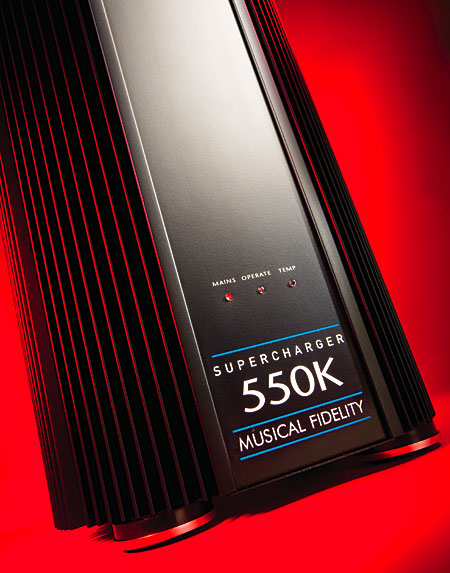
Instead of a conventional rectangular chassis, the 550K comes packed in a cylindrical heatsink. It looks neat enough to leave out in the open, but it's just as easy to tuck it behind your speakers and forget about it, thanks to its signal-sensing turn-on circuit, which turns the output on when music plays, and shuts it down after there's been none for 10 minutes or so. The 550K also has a line-level RCA jack input, but I didn't use it. I think the real story here is using the 550K as a power booster, not as a standalone power amp.
What's not to like?
With a pair of 550Ks sitting like mini R2D2s next to or even behind your speakers, you get at least 550W (or 27dBW) for at least a 10dB gain in output. And, Musical Fidelity claims, you keep or actually improve the sound of your favorite low-power amplifier, tube or solid-state. What's not to like? Theoretically, nothing. Judging by online posts, many audiophiles who've heard about the 550K Supercharger remain skeptical about Musical Fidelity's claim that it "doesn't change the sound of your amp (except for the better)."
Of course, how much power you need depends on how much realism you seek. If you want only background music, or a pleasant but subdued version of the real thing, perhaps you don't need that much power. However, if you want a high degree of fidelity to the original event and the ability to reproduce the full dynamic majesty of a symphony orchestra, the concert SPLs of your favorite rock band, or even the visceral drive of as expressive a solo pianist as Keith Jarrett, you may need more power than you think, even in a room of small to medium size.
That's the contention of Musical Fidelity's founder-designer, Antony Michaelson, and he's got the numbers to back it up—along with a novel new product, the 550K Supercharger, which he claims can dynamically, um, supercharge your audio system without your having to replace any of it, and without changing its tonal character.
Built in Taiwan, it's the same 550W monoblock amplifier circuit used in Musical Fidelity's kW550 integrated amplifier—which, MF claims, is quiet, linear, tonally superb, and produces high powers—550W into 8 ohms or 750W into 4 ohms—with ultra-low levels of distortion. MF claims the 550K delivers about 250 amps of current peak–peak, with a massive voltage swing. In the 550K, however, this circuit is used in a low-gain configuration: you connect your existing amplifier's output from its speaker terminals to the 550K's input terminals. Then, using a short jumper cable (supplied), you connect the 550K's output terminals to your speakers. Thus, instead of your regular amplifier seeing a typical reactive, low-impedance loudspeaker load and being asked to produce volts, amps, and high peak current beyond its capabilities as it attempts to follow the music's dynamic range, it instead sees the constant resistive load of a high-impedance input circuit. MF claims that an amplifier driving the 550K is called on to deliver only about 7% of the current required to drive a typical loudspeaker. Essentially, your existing amplifier is now acting as a preamplifier for the 550K. Musical Fidelity also claims that if you already like the sound of your amplifier—especially if it's a tube amp with a typically high output impedance that will interact with a loudspeaker's varying impedance to produce frequency-response aberrations—you'll like it even more when you hear it driving a pair of 550Ks.
With a pair of 550Ks sitting like mini R2D2s next to or even behind your speakers, you get at least 550W (or 27dBW) for at least a 10dB gain in output. And, Musical Fidelity claims, you keep or actually improve the sound of your favorite low-power amplifier, tube or solid-state. What's not to like? Theoretically, nothing. Judging by online posts, many audiophiles who've heard about the 550K Supercharger remain skeptical about Musical Fidelity's claim that it "doesn't change the sound of your amp (except for the better)."