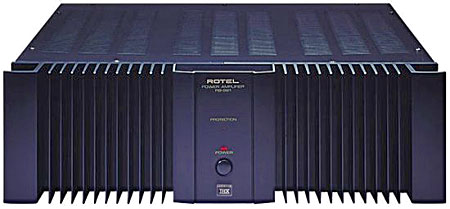
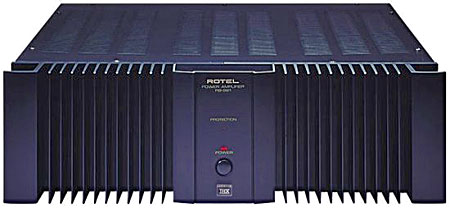
Rotel's philosophy of audio design is consistent with my own taste as a reviewer. As explained in Rotel's US dealer training manual (143 pages, with multiple-choice review questions at the conclusion of each chapter), the company's focus is on "balanced design." Rotel eschews "price-no-object" designs (narrows the market unnecessarily) and "mass appeal," feature-laden products (which have no impact on sound quality or reliability). All of Rotel's "balanced designs" feature:
1) high-quality parts sourced from specialty manufacturers, to ensure reliability and sonic advantage;
2) circuit topology designed to minimize signal paths and to keep each channel's signal path identical to preserve soundstaging; and
3) critical evaluation—listening panels determine the subtle sonic attributes of different parts or circuit layouts.
Serious design
How is this design philosophy implemented in the execution of the $999, 200Wpc RB-991? The power supply is based on a multiple-secondary toroidal transformer rated at 1.2kVA. From the transformer on, each channel's power supply is separate, with individual rectifier arrays and banks of BHC slit-foil capacitors. According to Rotel, 20 output devices (10 per channel) are employed to maximize stability and reliability under extended high-output conditions. The dual-differential input with constant-current source feeds a class-A voltage-amplifier stage, which leads in turn leading to the triple Darlington output section. The circuit employs Black Gate and Wima capacitors and Roederstein metal-film and Vishay military-grade resistors. The amp features switchable balanced and unbalanced inputs. Costs are kept to a minimum by manufacturing this British/Japanese-designed amplifier in China.
Serious sound
The RB-991's strengths were apparent in the first hour of listening, and their combination presented a level of sonic realism I did not think possible in a high-powered amplifier at this price:
• Extraordinary Resolution of Detail—After 15 years of owning expensive high-resolution audiophile gear while reviewing affordable components, I've gotten used to a two-tiered performance regime of detail resolution: the schools of "cost no object" and "good resolution for the price." The Rotel RB-991 is the first high-powered (ie, 100Wpc or greater) basic amplifier I've heard that resolves detail at a level I've come to expect from amplifiers in the $3000–$5000 range.
On Kohjiba's Transmigration of the Soul, from Stereophile's Festival CD (Stereophile STPH007-2), the inner detail and decay of the flute and percussion were easy to discern, as was a sense of the sound of the hall. The bowing techniques of the violinists and cellist were easy to discern. And the pitch definition of the drums and the low-level dynamic articulation of the percussionists on John Cage's Third Construction, from Pulse (New World/Classic NW 319) resulted in a lifelike, involving presentation of this stunning work.
• Highly Defined and Extended High Frequencies—The Rotel's high frequencies were pure, clean, and extended throughout the top three octaves, without sounding harsh or metallic. Janis Ian's voice on Breaking Silence (Analogue Productions APP 027) had unusually intelligible sibilant articulation, and the subtle percussion textures were clearly defined and palpable.
• Midrange Neutrality—The RB-991's midrange was neither rich and tubelike nor thin and restrained. On vocals, jazz, rock, or orchestral music, all instruments and vocals were reproduced without a hint of coloration. Mighty Sam McClain's voice on Give It Up to Love (LP, AudioQuest Music AWLP 1015) was in its natural burly, growly state, with all subtle inflections reproduced by the Rotel's excellent articulation of low-level dynamics. Furthermore, one could hear the exact point where the Hammond B-3's tube Leslie speaker just trips into distortion—a point I know too well from the many nights I've shared onstage with the wooden keyboard beast.
On "Round Midnight," from Clap Hands, Here Comes Charlie! (LP, Verve/Classic V6-4053), Ella Fitzgerald's emotive and seductively delicate voice melted me into a puddle.
King Crimson's "Easy Money," from Larks' Tongues in Aspic (LP, Island ILPS 9230, UK pressing) is a good test for midrange timbre and detail reproduction. Vocals are unprocessed and unenhanced on this recording; with the Rotel, they were tactile and natural. The minimalist drum kit, as well as percussion "and allsorts" (ie, shakers, crunchers, and the shimmering deacon chimes), were perfectly suspended in space with a long, resonant decay, and shone in all their nonresonant, uncolored glory.
In other areas, the Rotel continued to impress. Bass was tight, extended, and tuneful, and the amplifier delivered realistic low- and high-level dynamic swings on all program material. Soundstage width, depth, and image specificity were beyond reproach.
So is the Rotel the perfect budget amplifier? Well, not quite—the detailed and pristine high-frequency presentation were double-edged swords. Sure, the highs were uncolored, detailed, and extended, without a trace of bite or harshness, but they were also a bit prominent and forward and not in the least relaxed, in the way a more expensive tube or solid-state amp can be without losing extension.
For example, on Sibelius' Violin Concerto (RCA[/Classic?] LSC-2435), Jascha Heifetz' violin was searing yet sweet, but overly forceful, with the upper harmonics of his violin a bit overly prominent. Similarly, "Take the A Train," from Bill Berry's For Duke (M&K Realtime RT 101), sounded natural and detailed throughout the melody and solos, but when the trumpet tuttis come in near the end, they seemed a bit forward and in your face.
The bottom line is that the balance of the high frequencies' strengths and weaknesses will be a personal decision based on listening biases, equipment matching, and selection of listening material. The purity and detail of the Rotel RB-991's high frequencies are, indeed, two of its greatest strengths, but...during long listening sessions on a revealing system with source material that was not of uniformly high quality, the amp's overall sonic presentation did, at times, grow fatiguing.
Competition?
I compared the Rotel with the similarly priced and powered NAD 218 THX amplifier that I review elsewhere in this issue, as well as with my considerably more expensive Audio Research VT100 Mk.II. The Rotel and the NAD were exemplary performers representing excellent value, but gave quite different sonic presentations. The Rotel's overall neutrality and exceptional detail resolution hinted at a performance level that one would expect at higher price ranges, but its ruthlessly revealing high frequencies resulted in a less than musical experience with recordings of lesser quality. The NAD, on the other hand, was quite soft and forgiving overall (except for its scarily powerful bottom octave), with a rich, tubelike dimensionality offset by a thick midbass and limited high-frequency resolution.
Both amplifiers are recommended, but again, the choice will be dictated by listening biases, equipment matching, and, perhaps, musical taste. Neither amp, however, could hold a candle to the ARC, which offered a level of refinement, delicacy, neutrality, and freedom from mechanical artifacts that neither of the affordable amps could approach—as it should, at $5000.
Summing up
The Rotel RB-991 is an exceptional performer, especially considering its modest price and generous power rating. Its resolution of detail and overall neutrality hint at a performance level that one would expect from an amp costing two or three times as much. Although one might obtain a higher level of refinement and resolution by spending up to $2000 on an amplifier in the 100–200Wpc range, I'm not sure that would necessarily be a cost-effective investment. This may be the ideal amp for those shopping for a $2000 amp, but who really wish they could find an extra thousand to invest in the front-end or speakers. The RB-991 may be just the solution.