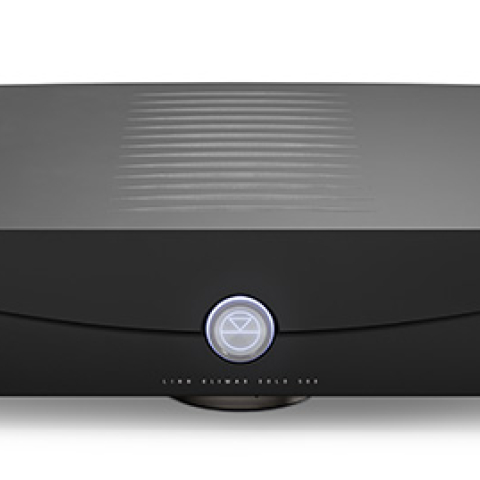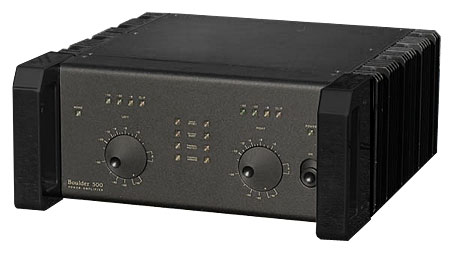
Yet another amp from Colorado! This is the third amp to come my way from that state (the others being the Spectrascan and the Rowland Research), and at this point, after living with it for a couple of months, I'm quite comfortable in declaring the Boulder 500 to be one helluvan amp.
 Jeff Nelson and Randy Gill, the two principals at Silver Lake Research, have recently crossed over from the professional market into the audiophile arena. That's why the Boulder looks the way it does, featuring a host of such "pro" touches as balanced/unbalanced inputs, conductive plastic input level pots, and extensive protection circuitry. And, not surprisingly, most Boulder sales to date have been to recording studios.
The professional touch carries through to the chunky, solid feel of the chassis and the quality of the construction. Inside, there's a remarkable number of parts stuffed onto five fiberglass epoxy PC boards. The main printed circuit board houses the two input-stage 990 discrete operational amplifiers (op-amps), the regulated power supplies and logic circuitry for metering, thermal protection, DC-input offset detection, and shorted output recognition. The rest of the chassis space is occupied by a 1200VA toroidal power transformer, four big filter capacitors totalling 148,000µF, and no less than 28 metal-can output transistors, each capable of dissipating 250 watts.
The Technology
Jeff Nelson and Randy Gill, the two principals at Silver Lake Research, have recently crossed over from the professional market into the audiophile arena. That's why the Boulder looks the way it does, featuring a host of such "pro" touches as balanced/unbalanced inputs, conductive plastic input level pots, and extensive protection circuitry. And, not surprisingly, most Boulder sales to date have been to recording studios.
The professional touch carries through to the chunky, solid feel of the chassis and the quality of the construction. Inside, there's a remarkable number of parts stuffed onto five fiberglass epoxy PC boards. The main printed circuit board houses the two input-stage 990 discrete operational amplifiers (op-amps), the regulated power supplies and logic circuitry for metering, thermal protection, DC-input offset detection, and shorted output recognition. The rest of the chassis space is occupied by a 1200VA toroidal power transformer, four big filter capacitors totalling 148,000µF, and no less than 28 metal-can output transistors, each capable of dissipating 250 watts.
The Technology
The heart of the design is Deane Jensen's discrete 990 op-amp—not an integrated circuit!—adapted for the high voltage and current needs of a power amp. The 990 was designed originally as a gain stage for use in studio mixing consoles, and is in widespread studio use. Its circuit topology gives excellent stability, with lower distortion and noise and higher slew rate, output power, and bandwidth than integrated circuit op-amps. Two sequential 990 gain stages are used in the Boulder 500 to give the required high power gain: the first stage is a true 990, and provides high input impedance and most of the voltage gain; the second stage incorporates the output transistors and handles the current amplification. A fairly large amount of negative feedback is used. The designers claim, however, that transient intermodulation distortion—the traditional problem of high feedback amps—has been eliminated by careful selection of gain parameters, and by compensation for the delay in the feedback loop of the output transistors. The squarewave response of the Boulder 500 into reactive loads is extremely well behaved, with no ringing or overshoot, and provides ample proof of the theoretical validity of the design. Incidentally, a squarewave is made up of a fundamental sinewave combined with its odd-order harmonics in a particular phase/amplitude relationship. A squarewave, therefore, is very sensitive to HF phase aberrations, which manifest themselves as visible overshoot at the corners. The Boulder is DC-coupled from input to output, but this does not mean that the frequency response is flat to DC—a servo is used to prevent DC voltages from reaching the amp's outputs, which results in a low-frequency –3dB point of 0.015Hz! Compared with AC-coupled designs, DC-coupling eliminates group delay in the passband due to inadequate coupling capacitors, and extends bass response. The general result is improved bass transients and pitch definition. The servo can correct up to 100mV DC present at the inputs, after which the "Input Offset" indicators on the front panel illuminate and the amp mutes.
And that's not all, folks! There's more protective circuitry: if an output is shorted, the amp will turn off that channel for three seconds, then very briefly test for a short. In the meantime, the "Output Short" indicator on the front panel will light. For those of you in search of a sound system fit for a sauna, please take note of the Boulder's elaborate thermal protection. The temperatures of the transistor cases and the chassis are monitored. Thermal warning and thermal cutout indicators illuminate when the transistor cases reach about 194°F and 238°F, respectively, at which point the amp mutes. The amplifier also mutes when the internal chassis temperature reaches 185°F.
The Sound
It only took me several seconds of listening to lock in on the Boulder's remarkable clarity and top-to-bottom transparency. There's far less overlying mud and fuzz compared with the average $1000 solid-state amplifier. In fact, one would have to look at cost-no-object designs before finding an amp that equaled or slightly bettered the Boulder 500 in these respects. Music emerges through the Boulder with very little electronic hash and grundge. Another way of stating this would be to say that intertransient silence is exemplary; there's more silence between musical notes. In any event, the end result is that the music-to-garbage ratio is significantly enhanced with this amp. These are qualities I value very much in reproduced music; they dramatically enhance the illusion of "live," and reduce long-term listening fatigue. The Boulder improves sonically after warming up for a rather modest 30 minutes. (Additional warmup didn't seem to yield further improvement.) Cold, the sound is a bit grainy, and midrange focus is somewhat diminished. Of course, all my observations are based on the sound of the amp properly warmed up.
Tonally, the Boulder is neutral, with no subjective emphasis of any frequency range. Rather chameleon-like, the amplifier takes on the character of the associated equipment; there's no place to hide sins of omissions or commission in the front end. Transparency, detail resolution, and clarity are so good that any uglies you may have are exposed along with the music. The treble is very extended, but without the sweetness that characterizes the Rowland Research amps, for example. The entire region from, say, 4 to 8kHz is just ever-so-slightly hard, but happily without the gratuitous brightness displayed by so many solid-state amps. The mids are very clean and detailed, with excellent focus and resolution. Soundstage depth and extension are also excellent, but lack the holographic localization of tube gear.
In fact, what's missing is the magic of good tube gear. I refer to the palpable realism, the "reach out and touch someone" illusion, that such classic tube gear projects. There's also the question of musical textures: tube mids may be described as either soft or liquid, while solid-state mids in general sound grainier and somewhat "electronic" in nature. Some of you might argue that all of this is nothing more than tube euphonics, and that solid-state speaks the truth. That may be true. But for me, tube gear heightens the illusion of the original soundstage in my listening room; it's addictive! Once you experience this sonic high, it is nearly impossible to do without.
The Boulder is firmly in the solid-state camp, with an overall texture that errs just slightly on the hard side of the proper softness-to-hardness mix of live music. The Boulder is nevertheless always very listenable, never irritating. It is one of only a handful of power amplifiers that I can listen to all day without reaching for the aspirin bottle.
I've left the best news for last: the bass octaves are simply superb. Bass transients are handled effortlessly—even into highly reactive loads—without a trace of instability, and with precise woofer control. Pitch definition is outstanding. It is just this combination of precision and accuracy that lends the bass register a powerful sense of authority and solidity, in stark contrast to the bloated and mushy bass of the average tube amp.
Summing Up
The $2650 Boulder 500 has many strengths and no major weaknesses. I clearly prefer it to the Spectrascan amps (which I enthusiastically reviewed in Vol.8 No.5) because of the latter's treble problems. It even beats the mono Rowland Research Model 7 ($3250 each) in terms of midrange clarity and resolution. Only the Threshold SA-1 mono amps ($3600 each) come to mind as solid-state amplifiers that I would rather live with, principally because of their sweet, open, and suave high end. I would also consider the Boulder 500 more rugged than the average audiophile product, which translates into long-term reliability. Excellent sonics and reliability, what more could you ask for, at a price that's about half that of the so-called state-of-the-art amplifiers? Highly recommended.
Jeff Nelson and Randy Gill, the two principals at Silver Lake Research, have recently crossed over from the professional market into the audiophile arena. That's why the Boulder looks the way it does, featuring a host of such "pro" touches as balanced/unbalanced inputs, conductive plastic input level pots, and extensive protection circuitry. And, not surprisingly, most Boulder sales to date have been to recording studios.
The professional touch carries through to the chunky, solid feel of the chassis and the quality of the construction. Inside, there's a remarkable number of parts stuffed onto five fiberglass epoxy PC boards. The main printed circuit board houses the two input-stage 990 discrete operational amplifiers (op-amps), the regulated power supplies and logic circuitry for metering, thermal protection, DC-input offset detection, and shorted output recognition. The rest of the chassis space is occupied by a 1200VA toroidal power transformer, four big filter capacitors totalling 148,000µF, and no less than 28 metal-can output transistors, each capable of dissipating 250 watts.
The heart of the design is Deane Jensen's discrete 990 op-amp—not an integrated circuit!—adapted for the high voltage and current needs of a power amp. The 990 was designed originally as a gain stage for use in studio mixing consoles, and is in widespread studio use. Its circuit topology gives excellent stability, with lower distortion and noise and higher slew rate, output power, and bandwidth than integrated circuit op-amps. Two sequential 990 gain stages are used in the Boulder 500 to give the required high power gain: the first stage is a true 990, and provides high input impedance and most of the voltage gain; the second stage incorporates the output transistors and handles the current amplification. A fairly large amount of negative feedback is used. The designers claim, however, that transient intermodulation distortion—the traditional problem of high feedback amps—has been eliminated by careful selection of gain parameters, and by compensation for the delay in the feedback loop of the output transistors. The squarewave response of the Boulder 500 into reactive loads is extremely well behaved, with no ringing or overshoot, and provides ample proof of the theoretical validity of the design. Incidentally, a squarewave is made up of a fundamental sinewave combined with its odd-order harmonics in a particular phase/amplitude relationship. A squarewave, therefore, is very sensitive to HF phase aberrations, which manifest themselves as visible overshoot at the corners. The Boulder is DC-coupled from input to output, but this does not mean that the frequency response is flat to DC—a servo is used to prevent DC voltages from reaching the amp's outputs, which results in a low-frequency –3dB point of 0.015Hz! Compared with AC-coupled designs, DC-coupling eliminates group delay in the passband due to inadequate coupling capacitors, and extends bass response. The general result is improved bass transients and pitch definition. The servo can correct up to 100mV DC present at the inputs, after which the "Input Offset" indicators on the front panel illuminate and the amp mutes.
It only took me several seconds of listening to lock in on the Boulder's remarkable clarity and top-to-bottom transparency. There's far less overlying mud and fuzz compared with the average $1000 solid-state amplifier. In fact, one would have to look at cost-no-object designs before finding an amp that equaled or slightly bettered the Boulder 500 in these respects. Music emerges through the Boulder with very little electronic hash and grundge. Another way of stating this would be to say that intertransient silence is exemplary; there's more silence between musical notes. In any event, the end result is that the music-to-garbage ratio is significantly enhanced with this amp. These are qualities I value very much in reproduced music; they dramatically enhance the illusion of "live," and reduce long-term listening fatigue. The Boulder improves sonically after warming up for a rather modest 30 minutes. (Additional warmup didn't seem to yield further improvement.) Cold, the sound is a bit grainy, and midrange focus is somewhat diminished. Of course, all my observations are based on the sound of the amp properly warmed up.
The $2650 Boulder 500 has many strengths and no major weaknesses. I clearly prefer it to the Spectrascan amps (which I enthusiastically reviewed in Vol.8 No.5) because of the latter's treble problems. It even beats the mono Rowland Research Model 7 ($3250 each) in terms of midrange clarity and resolution. Only the Threshold SA-1 mono amps ($3600 each) come to mind as solid-state amplifiers that I would rather live with, principally because of their sweet, open, and suave high end. I would also consider the Boulder 500 more rugged than the average audiophile product, which translates into long-term reliability. Excellent sonics and reliability, what more could you ask for, at a price that's about half that of the so-called state-of-the-art amplifiers? Highly recommended.