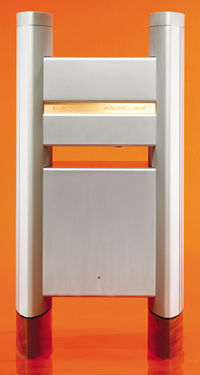
 A few years ago, a then-unknown amplifier manufacturer from Australia began placing ads in the audio press claiming that it was producing a truly revolutionary product, a monoblock power amplifier with distortion specifications bordering on the unbelievable: a signal 99.9996% pure. The company was Halcro, the amplifier in question the dm58 monoblock.
There was some snickering in the audio community when these ads appeared. As impressive as the dm58's specifications seemed, audiophiles are not easily swayed by claims of superiority based solely on measurements. The 1970s THD wars among the major Japanese receiver manufacturers of the day conclusively proved that great specs alone were no guarantee of even good, much less great, sound.
Nonetheless, the sheer audacity of Halcro's claims generated much curiosity and interest. Added to this were the company's stunning demonstrations at hi-fi shows around the world, which paired Halcro amps with some of the industry's most well-regarded speakers. Needless to say, I jumped at John Atkinson's offer of a pair of dm58s for review. I was anxious to hear whether the revolution promised by Halcro was actually at hand.
Spock, what is this thing?
Getting a clear picture of exactly what goes on inside a Halcro dm58 is about as easy as finding out what the CIA is up to. Designer and chief engineer Bruce Candy is loath to make public any more than the bare minimum about how his amps work, and much of the circuitry and its applications are proprietary and/or patented. The amplifiers are impossible for any but trained personnel to open, and if an owner were to prize one apart, he would promptly find his warranty voided. As a result, one must take Halcro's descriptions of the hows and whys on faith (footnote 1).
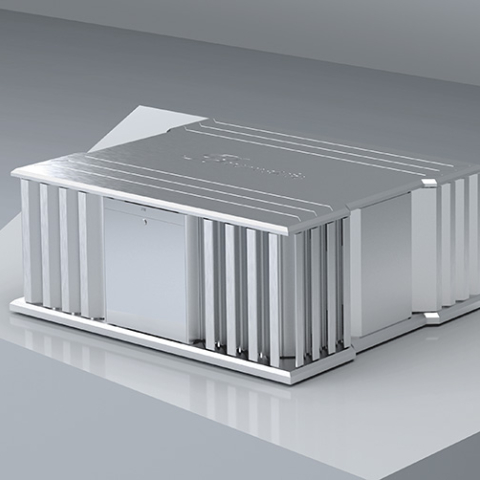
A few things can be said with certainty. The arrestingly handsome, vertically oriented dm58 is visually and electrically divided into three parts: a two-compartment upper box bisected by a polished-copper nameplate, and a large lower box. The uppermost module contains an input/output section; a much smaller section beneath it holds the MOSFET final amplification stage. Extensive, heavy shielding and Faraday cages separate these sections physically and electrically, and prevent magnetic or electromagnetic induction between the sections and the intrusion of RFI and other airborne pollution. Around back, the top section allows selection of XLR or RCA input jacks, while underneath is the dashpot-style standby switch. The speaker terminals are the best I've seen—well-spaced, and equipped with grippy rubber covers that preclude the need for wrenches. There is also a separate ground terminal.
The lower section, containing the power supply, is where (Bruce Candy admits) much of the amplifier's magic lives. The dm58 can be plugged into any outlet that provides at least 85V (but no more than 270V) at 45-65Hz, and can be fired up to provide full rated power with no further adjustments. Incoming AC is massively filtered to eliminate all manner of RFI and other forms of noise and interference that can ride in from the wall socket. Then, prior to rectification and distribution to the amp's circuitry, the AC is completely regenerated. But an extra twist is added: The power supply ensures that the incoming current and voltage waveforms are identical and in-phase by way of a power-factor correction unit. Seven separate protection circuits safeguard the amplifier, which is essentially immune to anything that might damage it (footnote 2).
Footnote 1: To describe all of the technological innovations in the dm58 would require much more space than is available here. Translations of articles from the Japanese and Chinese audio magazines that have delved deeply into Halcro's design philosophy and circuitry are available from Halcro's US distributor.—Paul Bolin
Footnote 2: The protection circuitry is all proprietary; Candy will not disclose exactly how it works. Work it does, though. One hot and muggy night, I lifted an LP from the turntable and unexpectedly sent a massive static discharge through my system, frying a number of parts in the power supply of the Manley Steelhead phono preamp. The Halcros calmly clicked and went into standby, awaiting further orders, and worked perfectly thereafter.—Paul Bolin