I think every audio reviewer hopes for a surprise—when a good, but not outstanding, product is refined by the manufacturer into something special. The review then becomes an exciting discovery, reaffirming the pleasure one takes in good audio, and in listening to music being reproduced as it should be. It makes the listening exciting and the writing easier. The Classé Fifteen solid-state stereo amplifier is just such a surprise.
 I first heard the Fifteen in an earlier version, the DR-15, when Classé's president Glen Grue shipped me an all-black pair of them while I was reviewing the Classé Six Mk.II preamplifier (Vol.17 No.2, p.107). The DR-15 had been produced when David Reich was a member of the design team. I found the amplifier to be highly accurate sonically, but overly polite-sounding. Shortly after I received the DR-15s, Glen replaced them with a single silver Classé Fifteen.
Description
I first heard the Fifteen in an earlier version, the DR-15, when Classé's president Glen Grue shipped me an all-black pair of them while I was reviewing the Classé Six Mk.II preamplifier (Vol.17 No.2, p.107). The DR-15 had been produced when David Reich was a member of the design team. I found the amplifier to be highly accurate sonically, but overly polite-sounding. Shortly after I received the DR-15s, Glen replaced them with a single silver Classé Fifteen.
Description
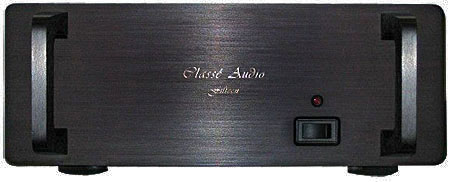
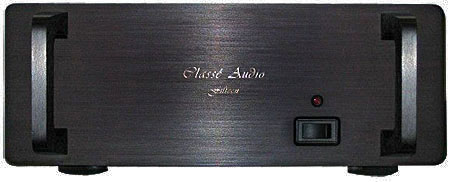
The Classé Fifteen is a conventional, single-chassis, 60-lb solid-state stereo amplifier with rounded heatsinks, rear external switching for regular or balanced inputs, and a toggle switch for stereo or bridged-mono operation. Its thick, curved faceplate has sculpted, one-piece handles, and is finished in either satin black or soft-shadow silver. Speaker connections are made via the heavy, silver-plated bolts that have been a feature of Classé Audio amplifiers since their first model, the DR-3. The company-supplied nut driver allows the owner to tighten these bolts down onto speaker-wire spade lugs, making for an extremely tight electrical connection.
Other nice features are a detachable line cord and a supplied Allen key for the top-plate bolts. Each Fifteen is protected by a 120V, 8A fast-blow fuse, as well as the electronic protection circuits. When the rear-panel Stereo/Mono switch is set to mono, the left input serves as the Mono input. The Mono positive speaker input is the left positive, the Mono negative the right positive. As with other bridged amplifiers, the Fifteen in Mono mode cannot be used with crossovers or servo modules that feature a common ground.
Technical details
How does the design of the current Fifteen differ from that of the model I first heard? Using listening and bench tests, the Classé design team made circuit adjustments to the earlier design. First, the current delivery to the front end was improved with better impedance matching between supply and signal-bearing circuitry; second, the amount of input-stage regulation was reduced; and third, the output-stage emitter resistor values were changed. The result, according to Glen Grue, was an "improved squarewave response and a more natural, more dynamic, more savage sound from the amplifier." The Fifteen uses 1% custom metal-film resistors, polystyrene and polypropylene capacitors, printed circuit boards with special transfer characteristics, and switches and controls that feature silver and gold contacts. The amplifier's power supply employs a large, high-current toroidal transformer, 80,000µF of filter capacitance, extra capacitor filtering of both the main output or current gain stage, and a local supply to the input differential amplifier. The Fifteen employs the same ultrasonic bypassing techniques used in the company's Model Six Mk.II preamp. Both signal circuitry and power supply are bypassed, with special attention paid to emitter resistors and output devices.
The Model Fifteen's build techniques help ensure its reliability—it comes with a lifetime warranty (available to the original owner only). Before a Fifteen is assembled, its output transistors are mounted on a large grid and burned-in for months. When they're matched at build time, all drift has been theoretically eliminated, so the sound of the amplifier will change minimally over time. Low-level devices are also matched carefully at build time.
 Chassis construction and system-board assembly are first-rate. The case is standard sheet metal, but the screw holes are pre-drilled, with nuts fixed to the metal on the opposite side to allow firm tightening. The main circuit board, which consists of a high-quality epoxy pcb with solder mask and designator, has no point-to-point wiring. Each channel sports several 4700µF blue capacitors and large, yellow polypropylene capacitors. Leads from the main board to the gold RCA jacks are neatly dressed, and good solder joints, apparently of high-quality silver, are evident everywhere. This type of construction ensures high reliability and long component life.
Sound
Chassis construction and system-board assembly are first-rate. The case is standard sheet metal, but the screw holes are pre-drilled, with nuts fixed to the metal on the opposite side to allow firm tightening. The main circuit board, which consists of a high-quality epoxy pcb with solder mask and designator, has no point-to-point wiring. Each channel sports several 4700µF blue capacitors and large, yellow polypropylene capacitors. Leads from the main board to the gold RCA jacks are neatly dressed, and good solder joints, apparently of high-quality silver, are evident everywhere. This type of construction ensures high reliability and long component life.
Sound
As mentioned above, I was unimpressed with the sound of the early version of this amplifier—it could be politely described as "lifeless." When the current production model arrived, I placed it in my system with tempered enthusiasm, so the resulting sound was even more shocking. What a difference! Driving the Snell B minors, the new Fifteen was a real ear-popper: dynamic, muscular, and powerful, while maintaining detail and appropriate orchestral warmth. Surely there must be some mistake, I thought. Amplifiers aren't supposed to sound this good right out of the box. But the Fifteen really delivered where it counts: pace, realism, soundstaging, and dynamics.
Deep-bass organ-pedal notes growled during César Franck's Chorale No.1 for pipe organ (Marcel Dupré, Mercury Living Presence 434 311-2), without muddying the clarity of the upper registers. This was the tight, solid bass that pipe-organ fans crave! Rock music had ample bass slam, strong dynamic contrasts, and a warm midrange. On James Horner's "The Hit" (from the Patriot Games soundtrack, RCA 07863-66051-2), the Fifteen delivered the same subterranean bass that I've heard with the more expensive solid-state amplifiers. The bass was solid, full, and fast, as demonstrated by the Fifteen's ability to reproduce the stungun-like synthesizer note at the opening of Terry Dorsey's "Ascent," from Time Warp (Telarc CD-80106). The bass of the Classé had plenty of definition—I could easily hear the progressive descent of organ notes in the 30–40Hz region in Saint-Saࡗens's Symphony 3 (Mercury Living Presence 432 719-2).
I was bowled over by how much power my Chario Academy 1s needed to sing in my large living room. Woodside tube monoblocks clipped readily, making Dan Baird's voice screech on "Julie and Lucky," from his Love Songs for the Hearing Impaired CD (Def American 26999-2). Switching to the 175Wpc Classé Fifteen greatly increased listenability. Both the Charios and Snell B minors benefited from the power of the Classé Fifteen.
While the Fifteen's bass response was just as good as that of the Mark Levinson No.27.5, its midrange wasn't as aggressive. It achieved just the right sense of presence without becoming overly hard or chalky, maintaining the adrenaline-pumping pace of David Bowie's voice on "Putting Out the Fire" (Cat People soundtrack, MCA MCAD-1498).
The Fifteen also imaged well, particularly when driving the Snell B minors. The spoken "Well done!" at the end of Anna Maria Stanczyk's performance of Chopin's Scherzo in b-flat, Op.31 (track 10 of Stereophile's first Test CD) appeared at the extreme left of the stage, thus showing the Fifteen's ability to re-create the proper soundstage perspective. Similarly, the Classé placed the sonic image of the guitar on Richard Thompson's "Why Must I Plead" (Rumor and Sigh, Capitol C21S 95713) just to the right of the right speaker. While the Fifteen and the Krell KSA-250 were equal in soundstage width and instrumental placement, the latter did generate an image of greater depth.
The Classé's treble response was extended and smooth. The violins on the Stanislaw Skrowaczewski/Minneapolis Symphony performance of Prokofiev's Romeo and Juliet, Suites 1 and 2 (Mercury Living Presence CD 432 004-2) were rich, resonant, and smooth. Even so, it captured the thrash-like guitar chords in and the pace of White Zombie's "Thunder Kiss '65" (La Sexorcisto: Devil Music, Vol.1, Geffen GEFD-24460) without sprays of shrill distortion. The vibes on Joe Beck's "Unspoken Words" (The Journey, DMP CD-481) were detailed, clear, and open.
The Fifteen had no problem delivering a dynamic, fast response with good, full-range dynamic systems; but how would it sound with electrostatics? I have found only a few solid-state amplifiers (the Mark Levinson No.27.5, for example) that do well with dynamic systems, and that don't sound hard or overly bright on electrostatics. When driving the Quad ESL-63 USA Monitors, the Classé Fifteen remained clean, extended, and pellucid. Elmer Bernstein's wide–dynamic-range film score for The Magnificent Seven (Koch C-7222) was reproduced with no signs of hash, glare, or excessive midrange presence.
Conclusion
No other power amplifier in my current arsenal, including two more expensive solid-state units, each of which received a Class A rating in Stereophile's "Recommended Components" in its time, could better the Classé Fifteen when it was driven by the Classé Six Mk.II preamplifier in Bypass mode. The Fifteen was these amplifiers' equal in bass response, dynamic range, clarity, transient speed, overall coherency, and freedom from midrange grain, whether driving dynamic or electrostatic loudspeakers. Only the more expensive and more powerful Krell KSA-250 could top it in soundstage depth. The Fifteen's $3000 price tag distinguishes it from nearly all other Class A–rated amplifiers, showing that you don't have to spend high-end money to get high-end sound. Be sure you listen to this amplifier—you'll be as surprised as I was!—Larry Greenhill
I first heard the Fifteen in an earlier version, the DR-15, when Classé's president Glen Grue shipped me an all-black pair of them while I was reviewing the Classé Six Mk.II preamplifier (Vol.17 No.2, p.107). The DR-15 had been produced when David Reich was a member of the design team. I found the amplifier to be highly accurate sonically, but overly polite-sounding. Shortly after I received the DR-15s, Glen replaced them with a single silver Classé Fifteen.
Description
The Classé Fifteen is a conventional, single-chassis, 60-lb solid-state stereo amplifier with rounded heatsinks, rear external switching for regular or balanced inputs, and a toggle switch for stereo or bridged-mono operation. Its thick, curved faceplate has sculpted, one-piece handles, and is finished in either satin black or soft-shadow silver. Speaker connections are made via the heavy, silver-plated bolts that have been a feature of Classé Audio amplifiers since their first model, the DR-3. The company-supplied nut driver allows the owner to tighten these bolts down onto speaker-wire spade lugs, making for an extremely tight electrical connection.
How does the design of the current Fifteen differ from that of the model I first heard? Using listening and bench tests, the Classé design team made circuit adjustments to the earlier design. First, the current delivery to the front end was improved with better impedance matching between supply and signal-bearing circuitry; second, the amount of input-stage regulation was reduced; and third, the output-stage emitter resistor values were changed. The result, according to Glen Grue, was an "improved squarewave response and a more natural, more dynamic, more savage sound from the amplifier." The Fifteen uses 1% custom metal-film resistors, polystyrene and polypropylene capacitors, printed circuit boards with special transfer characteristics, and switches and controls that feature silver and gold contacts. The amplifier's power supply employs a large, high-current toroidal transformer, 80,000µF of filter capacitance, extra capacitor filtering of both the main output or current gain stage, and a local supply to the input differential amplifier. The Fifteen employs the same ultrasonic bypassing techniques used in the company's Model Six Mk.II preamp. Both signal circuitry and power supply are bypassed, with special attention paid to emitter resistors and output devices.
Chassis construction and system-board assembly are first-rate. The case is standard sheet metal, but the screw holes are pre-drilled, with nuts fixed to the metal on the opposite side to allow firm tightening. The main circuit board, which consists of a high-quality epoxy pcb with solder mask and designator, has no point-to-point wiring. Each channel sports several 4700µF blue capacitors and large, yellow polypropylene capacitors. Leads from the main board to the gold RCA jacks are neatly dressed, and good solder joints, apparently of high-quality silver, are evident everywhere. This type of construction ensures high reliability and long component life.
Sound
As mentioned above, I was unimpressed with the sound of the early version of this amplifier—it could be politely described as "lifeless." When the current production model arrived, I placed it in my system with tempered enthusiasm, so the resulting sound was even more shocking. What a difference! Driving the Snell B minors, the new Fifteen was a real ear-popper: dynamic, muscular, and powerful, while maintaining detail and appropriate orchestral warmth. Surely there must be some mistake, I thought. Amplifiers aren't supposed to sound this good right out of the box. But the Fifteen really delivered where it counts: pace, realism, soundstaging, and dynamics.
No other power amplifier in my current arsenal, including two more expensive solid-state units, each of which received a Class A rating in Stereophile's "Recommended Components" in its time, could better the Classé Fifteen when it was driven by the Classé Six Mk.II preamplifier in Bypass mode. The Fifteen was these amplifiers' equal in bass response, dynamic range, clarity, transient speed, overall coherency, and freedom from midrange grain, whether driving dynamic or electrostatic loudspeakers. Only the more expensive and more powerful Krell KSA-250 could top it in soundstage depth. The Fifteen's $3000 price tag distinguishes it from nearly all other Class A–rated amplifiers, showing that you don't have to spend high-end money to get high-end sound. Be sure you listen to this amplifier—you'll be as surprised as I was!—Larry Greenhill