It was a hot, humid, New York City evening in early August, and I was thankful to be sitting in the air-conditioned dark of Avery Fisher Hall, up in the Second Tier, for a Mostly Mozart concert. Listening to cello soloist Alisa Weilerstein in Osvaldo Golijov's hypnotic Azul, I was suddenly jolted by an explosive mix of primitive cello sonorities, accordion, and staccato riffs on ethnic percussion instruments. My thoughts turned to the importance in music of both power and delicacy, and of how Bryston Ltd.'s 28B-SST, a 1000W monoblock power amplifier, was designed to address both.
 Design
Why is Bryston selling a 1kW monoblock? The company's CEO, Chris Russell, explained that customers had requested more power than was available from Bryston's 600W monoblock, the 7B-SST (reviewed in the April 2003 Stereophile, Vol.26 No.4), for reasons cited by Michael Fremer in his review of the Musical Fidelity 550K Supercharger monoblock in September 2007 (Vol.30 No.9): more involvement with the music at more realistic volume levels. In addition, monoblocks let you use very short lengths of speaker cable: an amp can be placed right next to each speaker. As in Bryston's other monoblock designs, the 28B-SST's output stage combines two amplifiers permanently bridged in series and operated out of phase with one another. This allows the amplifier to swing high voltages into the load. (If the owner insists on using speakers of very low impedance, such as the Apogee Scintilla, the 28B-SST's output stage must be rewired in parallel at the Bryston factory.) The bridged output stage proved successful in the 7B-SST, which excelled in what I called in my 2003 follow-up, its "neutrality," "incredible deep-bass abilities," and "terrific soundstage depth and midbass punch"; and the two-channel 14B-SST (November 2002, Vol.25 No.11), which produced what I described as "solid, massive deep bass that was rich and expansive," despite its "unflappable neutrality."
So, other than its 1kW power rating, what's new and different in the 28B-SST? Well, wires have been virtually eliminated—circuit boards are connected with gas-tight, gold-to-gold contacts. As a result, Bryston needs to do much less hand tweaking during manufacture. Other new features in the 28B-SST include its discrete input-buffer circuit, which uses a symmetrical design to reduce distortion. Bryston is so pleased with this circuit's performance that they'll be using it from now on in all SST-series amplifiers. The power supply includes a huge toroidal transformer made by Plitron and rated at 2000VA continuous power. (Plitron also makes the Torus Power Isolation Units, also reviewed this month.)
The 28B-SST has been given a new, highly reliable On/Off pushbutton, and heatsinks that maximize heat dissipation for long-term operation without a fan having to be used. Because the 28B-SST's components and circuits are rugged, the protection-circuit parameters are not as restrictive as are found in other amplifiers. Even so, the protection circuit is designed to handle most fault conditions, including shorts and DC offset.
Borrowed from earlier Bryston designs are the control circuit boards for power up, fault detection and logic, and LED display. As in other Bryston amps, all AC mains circuits are shielded from the audio circuits. The inrush current on power-up needed to charge the sixteen 10,000µF electrolytic capacitors is slowed from 18ms to 1.5 seconds by a microprocessor-controlled turn-on phase circuit. The 28B-SST's output stage uses 32 bipolar output transistors: eight PNP/NPN pairs on each side of the chassis, each set of eight controlled by a single pair of driver transistors. These power transistors—the large, fast types used in the 14B-SST—are said to be highly reliable. The output devices are hand-selected to ensure that their gains are matched.
Bryston publishes only the 28B-SST's maximum power output into 8 ohms; no ratings are offered for loads of 4 or 2 ohms. However, run into 4 ohm loads, with the rear-panel circuit breaker bypassed, the amplifier won't clip until it's continuously delivering 1800W. The resulting current flow will trip the 15-amp breakers in most homes after 10–20 seconds of continuous power. Chris Russell explained that, because regulatory agencies test an amplifier at its rated power under home conditions, for the 28B-SST Bryston chose a power rating into 8 ohms that would not trip the average home's circuit breaker.
Rugged construction
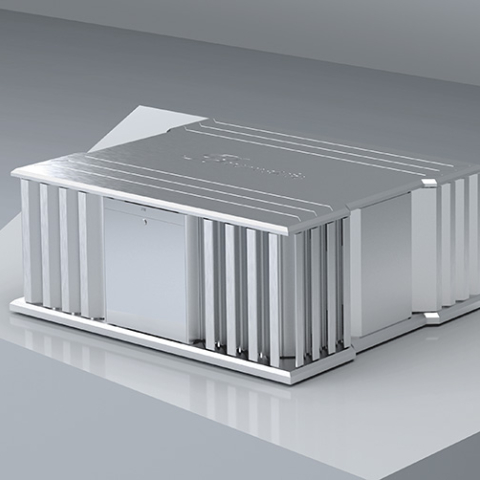
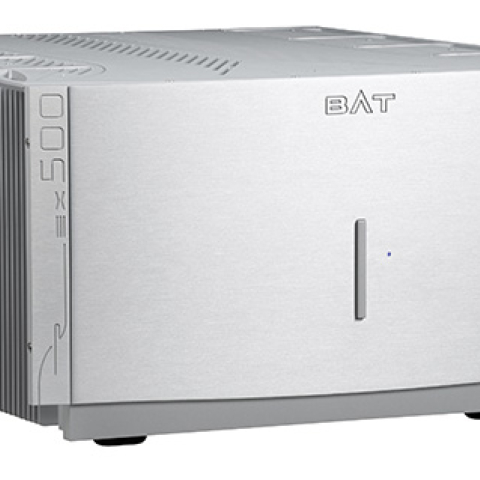
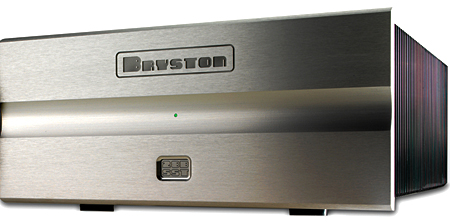
The 28B-SST's chassis continues Bryston's "thermal monolith" design, with 38 heat-radiating fins per side. The front panel is simple, with only an On/Off switch in its lower half, and a tricolor LED: it glows green when the 28B-SST is on, red when it's overloaded or distorting (detected by the 28B-SST's clip-sensing comparator circuit), or yellow-orange during thermal shutdown. All set-and-forget switches and controls are on the rear panel. These include an On/Off circuit-breaker switch at bottom left, accompanied by a small pilot light that can be seen when looking down on the amplifier from above. There are switches for power-up mode, external-trigger voltage turn-on options, and one that toggles between 0dB or +6dB gain. When the external trigger switch is set to Local, the 28B-SST ignores any external 4–12V turn-on signal, powering up only when the switch on the front panel is pressed. The rear panel also has single-ended and balanced input connectors, and a switch to select between them. From the top down, there are: a Neutrik balanced input that can take either a balanced XLR plug (pin 2 hot) or a balanced, ¼" tip-ring-sleeve (TRS) phone plug (tip positive). Just below that are two red-and-blue five-way speaker-binding posts rated at 60A and designed to meet CE standards. Below them is an IEC mains socket for the detachable AC cord. Instructions clearly printed on the rear panel make it possible to set up the 28B-SST without having to refer to the supplied sheet.
The 28B-SST receives a torturous four-day burn-in at the factory consisting of a squarewave input signal driving the amplifier at full power into a capacitor. The driving signal is gated one hour on, one hour off, this cycle repeated many times. This heats, cools, then reheats the amp again and again; the resulting expansion and contraction are expected to reveal any loose connections, and to fatally stress any device prone to early failure. After burn-in, each 28B-SST is again tested; those results are shipped with the unit.
Setup
The 28B-SST is the first Bryston product I've reviewed that has both front and rear handles, which made its 92 lbs relatively easy to move around. I placed the monoblocks one atop the other against the front wall, near my full-range loudspeakers. I plugged their detachable power cords into the rear-panel jacks of a Torus Power RM20 Power Isolation Unit (PIU). Bryston's James Tanner thought this would be an opportunity to demonstrate how a Torus PIU could provide the best current platform for the Bryston's sound. Bryston's speaker binding posts are so well configured that it was a breeze to attach my Pure Silver Cable speaker cables, which are fitted with spade lugs. While being the requisite 19–25mm apart to meet European CE regulations, the posts are shrouded in plastic to prevent fingers from touching the metal contacts when the amplifier is playing.
I placed each of my three loudspeaker systems—Quad ESL-989s, original Revel Ultima Salons, and Escalante Design Fremonts—46" from the front wall, 6' 10" apart, and 32" from each sidewall, toed-in to face my overstuffed listening chair 8' away, which places my ears 37" above the floor. My lightly damped room is rectangular, 26' long by 13' wide by 12' high, with a semi-cathedral ceiling. Behind my chair, the room opens into a 25' by 15' kitchen through an 8' by 4' doorway.
Sound
The Revel Ultima Salon1's relatively low voltage-input sensitivity (86dB/W/m) demands a lot of power to fill my listening room. Whatever the Revels demanded the 28B-SSTs delivered, without clipping or compressing. After driving the Revels at lease-breaking volumes for two or three hours, the Brystons' heatsinks were warm to the touch, but never got as hot as had Bryston's B100-DA 100Wpc integrated amplifier. In the past, other Bryston amplifiers—the 4B-SST (Vol.22 No.10, Vol.24 No.10), the B100-DA (Vol.30 No.4), the 7B-SST (Vol.26 No.4), and the 14B-SST (Vol.25 No.11)—have been reported to be distortionless, clear, and neutral. But the 28B-SST also sounded sweet, delicate, and smooth—not at all what I expected from a 1kW solid-state monoblock. This is probably why Bryston's Chris Russell calls the 28B-SST the "best tweeter amplifier I've ever heard!"
That treble sweetness was first apparent to me when I used the 28B-SSTs to drive my Quad ESL-989s in a biamped setup with a pair of JL Audio Fathom f113 powered subwoofers (reviewed in September 2007). I heard some delicate midrange and treble notes for the first time, such as from the acoustic guitars on Emmylou Harris' Spyboy (CD, Eminent EM 25001-2), and the upper range of Patricia Barber's voice on her Café Blue (CD, Premonition 21810 2).
Design
Why is Bryston selling a 1kW monoblock? The company's CEO, Chris Russell, explained that customers had requested more power than was available from Bryston's 600W monoblock, the 7B-SST (reviewed in the April 2003 Stereophile, Vol.26 No.4), for reasons cited by Michael Fremer in his review of the Musical Fidelity 550K Supercharger monoblock in September 2007 (Vol.30 No.9): more involvement with the music at more realistic volume levels. In addition, monoblocks let you use very short lengths of speaker cable: an amp can be placed right next to each speaker. As in Bryston's other monoblock designs, the 28B-SST's output stage combines two amplifiers permanently bridged in series and operated out of phase with one another. This allows the amplifier to swing high voltages into the load. (If the owner insists on using speakers of very low impedance, such as the Apogee Scintilla, the 28B-SST's output stage must be rewired in parallel at the Bryston factory.) The bridged output stage proved successful in the 7B-SST, which excelled in what I called in my 2003 follow-up, its "neutrality," "incredible deep-bass abilities," and "terrific soundstage depth and midbass punch"; and the two-channel 14B-SST (November 2002, Vol.25 No.11), which produced what I described as "solid, massive deep bass that was rich and expansive," despite its "unflappable neutrality."
The 28B-SST's chassis continues Bryston's "thermal monolith" design, with 38 heat-radiating fins per side. The front panel is simple, with only an On/Off switch in its lower half, and a tricolor LED: it glows green when the 28B-SST is on, red when it's overloaded or distorting (detected by the 28B-SST's clip-sensing comparator circuit), or yellow-orange during thermal shutdown. All set-and-forget switches and controls are on the rear panel. These include an On/Off circuit-breaker switch at bottom left, accompanied by a small pilot light that can be seen when looking down on the amplifier from above. There are switches for power-up mode, external-trigger voltage turn-on options, and one that toggles between 0dB or +6dB gain. When the external trigger switch is set to Local, the 28B-SST ignores any external 4–12V turn-on signal, powering up only when the switch on the front panel is pressed. The rear panel also has single-ended and balanced input connectors, and a switch to select between them. From the top down, there are: a Neutrik balanced input that can take either a balanced XLR plug (pin 2 hot) or a balanced, ¼" tip-ring-sleeve (TRS) phone plug (tip positive). Just below that are two red-and-blue five-way speaker-binding posts rated at 60A and designed to meet CE standards. Below them is an IEC mains socket for the detachable AC cord. Instructions clearly printed on the rear panel make it possible to set up the 28B-SST without having to refer to the supplied sheet.
The 28B-SST is the first Bryston product I've reviewed that has both front and rear handles, which made its 92 lbs relatively easy to move around. I placed the monoblocks one atop the other against the front wall, near my full-range loudspeakers. I plugged their detachable power cords into the rear-panel jacks of a Torus Power RM20 Power Isolation Unit (PIU). Bryston's James Tanner thought this would be an opportunity to demonstrate how a Torus PIU could provide the best current platform for the Bryston's sound. Bryston's speaker binding posts are so well configured that it was a breeze to attach my Pure Silver Cable speaker cables, which are fitted with spade lugs. While being the requisite 19–25mm apart to meet European CE regulations, the posts are shrouded in plastic to prevent fingers from touching the metal contacts when the amplifier is playing.
The Revel Ultima Salon1's relatively low voltage-input sensitivity (86dB/W/m) demands a lot of power to fill my listening room. Whatever the Revels demanded the 28B-SSTs delivered, without clipping or compressing. After driving the Revels at lease-breaking volumes for two or three hours, the Brystons' heatsinks were warm to the touch, but never got as hot as had Bryston's B100-DA 100Wpc integrated amplifier. In the past, other Bryston amplifiers—the 4B-SST (Vol.22 No.10, Vol.24 No.10), the B100-DA (Vol.30 No.4), the 7B-SST (Vol.26 No.4), and the 14B-SST (Vol.25 No.11)—have been reported to be distortionless, clear, and neutral. But the 28B-SST also sounded sweet, delicate, and smooth—not at all what I expected from a 1kW solid-state monoblock. This is probably why Bryston's Chris Russell calls the 28B-SST the "best tweeter amplifier I've ever heard!"