Martin Colloms (footnote 1) suggests that the traditional ways of assessing hi-fi component problems overlook the obvious: does the component dilute the recording's musical meaning? For all its quantifiable technical faults, easily identified in the laboratory when compared with the measured near-perfection of CD, the vinyl LP disc possesses a powerful and effortlessly musical content, with an easy, fundamental rhythmic stability and solidity. Interestingly, this innate character seems to be quite robust, more so than digital. Subjectively rewarding results may be obtained from analog sources without much trouble. Many well-established but not necessarily high-priced components may be assembled to produce musically satisfying results. With analog, one can listen through the blemishes and be aware of a strong musical message, one in which the music's flow, pace, and tempo are well conveyed, and into which the listener is drawn. By contrast, digital audio is a fragile medium. Sonic greatness remains elusive, digital replay often seeming to get bogged down at an earlier stage, one in which the listener's lack of involvement leads to a substitute activity. The mind remains busy, but is now cataloguing perceptual features and comparing them with previous experiences. This is an interesting abstraction, comparable in the realm of visual art with the analysis of the brush techniques of old masters. But, as Robert Harley points out in this month's "As We See It," an obsession with technical minutiae can blind one to an appreciation of the whole. That easy, rhythmic grace inherent in competent analog replay points to one of the greatest paradoxes of digital replay.
Digital's technical advantages at low frequencies include low group delay due to a highly extended bass response, in theory even continuing down to DC. Technical appearances can be misleading, however. From my experience of more than 250 digital products, coherent, expressive, naturally explosive dynamics and the ability to present good musical pace and a confident, upbeat rhythm are areas in which digital is surprisingly weak. If digital bass is agreed to be tighter-sounding, less colored and less "phasey," then how on Earth can analog still be in the running when it comes down to subjectively satisfying bass rhythm? Nevertheless, digital bass generally sounds laid-back and downbeat, even if it is highly neutral when viewed purely in technical terms. A listener well-trained in the analysis of sound quality may understandably be fooled into thinking that good bass automatically implies good rhythm. It does not. While good rhythm is a key aspect of both live and reproduced music-making, it is not easy to analyze. It's as if the act of focusing on the details of a performance blinds one to the parameter in question. The subjective awareness of rhythm is a continuous event, registered at the whole-body level and recognized in a state of conscious but relaxed awareness. Once you've learned that reproduced sound can impart that vital sense of music-making as an event, that the impression of an upbeat, involving drive can be reproduced again and again, you can't help but pursue this quality throughout your listening experience.
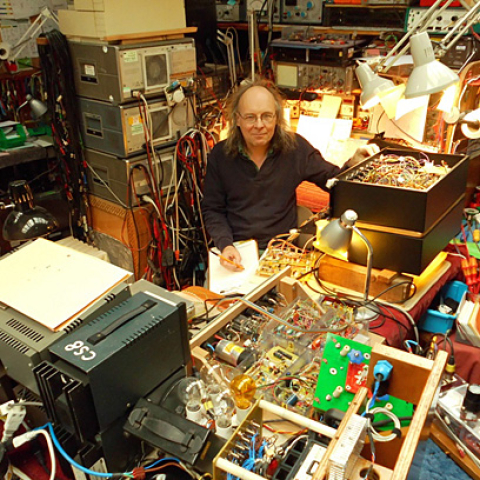
Scientifically trained, I failed to develop a proper awareness of this aspect of reproduction for many years, so committed was I to the analytical methods of sound-quality assessment. My engineering background had taught me to reduce problems of sound quality to a series of quantifiable variables, each of which could then be rated in a fairly predictable manner. My objective was the production of more accurate, more consistent reviews. This analytic framework was largely based on my experiences during the development of a long line of superior monitoring loudspeakers for the BBC, where I learned much about live vs reproduced comparisons and developed a vocabulary to quantify perceived errors. Those obvious and easily described loudspeaker flaws allowed a quick entry into the field of sound-quality analysis. What has emerged from my more recent work is the understanding that while a neutral, perceivably accurate sonic character is helpful to high-quality reproduced sound, it is not a prerequisite. This is similar to saying that though low distortion is a generally worthwhile goal for an amplifier, this parameter is not well correlated with subjective quality unless present to unusual excess.
Footnote 1: As well as being a Stereophile Contributing Editor and the primary component reviewer for the English magazine Hi-Fi News & Record Review, Martin Colloms is the author of one of the standard textbooks on loudspeaker design, High Performance Loudspeakers, the fourth edition of which appeared in 1991. Published by Pentech Press, Plymouth, Devon, England, HPL is available in the US for $38.95 from Old Colony Book Service, P.O. Box 243, Peterborough, NH 03458-0243. Tel: (603) 924-6371/6526. Fax: (603) 924-9467.---JA
Footnote 1: As well as being a Stereophile Contributing Editor and the primary component reviewer for the English magazine Hi-Fi News & Record Review, Martin Colloms is the author of one of the standard textbooks on loudspeaker design, High Performance Loudspeakers, the fourth edition of which appeared in 1991. Published by Pentech Press, Plymouth, Devon, England, HPL is available in the US for $38.95 from Old Colony Book Service, P.O. Box 243, Peterborough, NH 03458-0243. Tel: (603) 924-6371/6526. Fax: (603) 924-9467.---JA