Recently, I assessed four disparate room-correction systems based on digital signal processing (DSP): Copland DRC205, Lyngdorf Audio RoomPerfect, Velodyne SMS-1, and Meridian DRC. I concluded that Meridian's approach—which applies IIR (Infinite Impulse Response) "anti-resonance" filters to suppress room resonant modes, if only partially—was, in many respects, the best. What I particularly like about Meridian DRC is that, unlike the Copland and Lyngdorf processors, its approach to system tonal balance is largely hands-off. Yes, it lightens up the extreme bass a little, as you'd expect, but it doesn't recast the system balance in any way that might prove undesirable. If you like your system's tonal character as it is, Meridian DRC behaves just as you'd want a room-correction system to behave: it quells room resonance effects while leaving the system's essential sound well alone.
 Nevertheless, I was left questioning whether this approach to electronic room acoustic correction—of using the main speakers to provide the correction as well as reproduce the music—is the optimal one. As the Meridian system's developers themselves acknowledged in an AES paper describing its operation (footnote 1), there is a limit to how much correction can be applied this way without imposing undesirable effects on the speakers' sound. Whether this limitation permits or prevents the optimal correction being applied is unclear, but any such restriction is obviously a concern. Plus, there are limits to what can be achieved when, as with the Meridian system, the microphone is placed only at the listening position during the setup process.
It's a golden rule of DSP room correction that no attempt be made to fill in notches in the in-room response, because to attempt this would hog amplifier power and generate unacceptably large excursions of drive-unit diaphragms. Thus, digital room-correction systems usually leave response notches well alone and concentrate their efforts on suppressing peaks. The received wisdom is that notches are much less audible than peaks, so this is not the obvious weakness it may appear. Nonetheless, I wonder whether it isn't a disadvantage. Something I learned from my room-correction experiments—although it should have been obvious—is that one room mode in particular tends to be a problem in this regard, and current room-correction approaches do nothing about it. This set me wondering how its influence might be lessened and what subjective benefits might accrue.
Figs. 1 and 2 show before and after spectra for the Copland DRC205 and Lyngdorf RoomPerfect room-correction systems, respectively, measured on one channel from the seat position in my listening room. In each case, the blue curve represents the in-room response without correction, the red curve the response with correction. (Ignore the rolloffs above 800Hz, which are due to the measurement system.) In all the traces, one notable feature is a large notch in the bass response between 40 and 50Hz—a notch that neither DSP system does anything to counteract, even though RoomPerfect takes multiple measurements from different mike positions within the room before contriving its correction filter.
Nevertheless, I was left questioning whether this approach to electronic room acoustic correction—of using the main speakers to provide the correction as well as reproduce the music—is the optimal one. As the Meridian system's developers themselves acknowledged in an AES paper describing its operation (footnote 1), there is a limit to how much correction can be applied this way without imposing undesirable effects on the speakers' sound. Whether this limitation permits or prevents the optimal correction being applied is unclear, but any such restriction is obviously a concern. Plus, there are limits to what can be achieved when, as with the Meridian system, the microphone is placed only at the listening position during the setup process.
It's a golden rule of DSP room correction that no attempt be made to fill in notches in the in-room response, because to attempt this would hog amplifier power and generate unacceptably large excursions of drive-unit diaphragms. Thus, digital room-correction systems usually leave response notches well alone and concentrate their efforts on suppressing peaks. The received wisdom is that notches are much less audible than peaks, so this is not the obvious weakness it may appear. Nonetheless, I wonder whether it isn't a disadvantage. Something I learned from my room-correction experiments—although it should have been obvious—is that one room mode in particular tends to be a problem in this regard, and current room-correction approaches do nothing about it. This set me wondering how its influence might be lessened and what subjective benefits might accrue.
Figs. 1 and 2 show before and after spectra for the Copland DRC205 and Lyngdorf RoomPerfect room-correction systems, respectively, measured on one channel from the seat position in my listening room. In each case, the blue curve represents the in-room response without correction, the red curve the response with correction. (Ignore the rolloffs above 800Hz, which are due to the measurement system.) In all the traces, one notable feature is a large notch in the bass response between 40 and 50Hz—a notch that neither DSP system does anything to counteract, even though RoomPerfect takes multiple measurements from different mike positions within the room before contriving its correction filter.
 Fig.1 Result of applying room correction in KH's listening room using Copland DRC205: in-room response, uncorrected (blue trace), corrected (red).
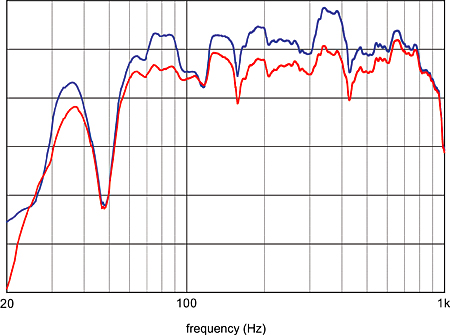 Fig.2 As in fig.1, but using Lyngdorf Audio's RoomPerfect (implemented in the TDA 2200 amplifier).
This notch occurs principally because my rectangular-plus-bay-window listening room is 13.8' (4.2m) wide, which corresponds to a fundamental width mode of 41Hz. As I have the speakers firing down the room's long dimension and my listening position is on the room's centerline to ensure symmetrical acoustical conditions for the left and right channels, I am always seated at the pressure node of this resonance, where it has a null. By moving the listening position forward or back and the listening height up or down, I can move the notch a little and vary the response either side of it as a result of interaction with other modes. But it remains a consistent feature, as it must do in any rectangular room with a centerline seating position—there is no getting away from it.
Immediately below the notch is a peak at around 35Hz, which roughly corresponds to the room's 31Hz length mode. We can expect to see a similar switchback response in any rectangular room laid out as mine is; or, if the speakers are fired across the short room dimension, the positions of the peak and trough will be reversed so that, instead of a switchback, there will be a premature curtailment of bass response. Attempting to fill in the trough with electronic equalization of the main speakers is inadvisable for the reasons already stated, and effective passive absorption of the guilty room mode is difficult to achieve without the use of purpose-designed absorbers that only the most ardent audiophile would consider domestically acceptable. So what else might we do to eliminate a problem that's endemic to many listening rooms?
Meridian's system of applying an anti-resonance could do it but doesn't, for two reasons. First, the Meridian system searches for and corrects only room modes associated with response peaks, not response notches. Second, it couldn't, in any case, "see" the room-width mode when the setup mike is placed at the listening position's pressure node.
A superior solution might require a different approach to electronic room correction. Instead of asking the main speakers to apply room correction as well as reproduce the music, we could instead add a third speaker, perhaps more, whose only task is that of applying modal correction. In effect, such a speaker or speakers would provide active modal absorption and offer two principal benefits. First, there is no question of the room-correction signals having an undesirable effect on the main speakers' direct sound. Second, these active absorber(s) can be positioned in one or more room corners, where they can most effectively couple to and so control room modes. If we then also change the setup routine, so that it is able to detect every room mode, we might arrange to kill the room's fundamental width (or length) mode entirely, thereby eliminating the problem of the room's centerline notch.
Shadow
Fig.2 As in fig.1, but using Lyngdorf Audio's RoomPerfect (implemented in the TDA 2200 amplifier).
This notch occurs principally because my rectangular-plus-bay-window listening room is 13.8' (4.2m) wide, which corresponds to a fundamental width mode of 41Hz. As I have the speakers firing down the room's long dimension and my listening position is on the room's centerline to ensure symmetrical acoustical conditions for the left and right channels, I am always seated at the pressure node of this resonance, where it has a null. By moving the listening position forward or back and the listening height up or down, I can move the notch a little and vary the response either side of it as a result of interaction with other modes. But it remains a consistent feature, as it must do in any rectangular room with a centerline seating position—there is no getting away from it.
Immediately below the notch is a peak at around 35Hz, which roughly corresponds to the room's 31Hz length mode. We can expect to see a similar switchback response in any rectangular room laid out as mine is; or, if the speakers are fired across the short room dimension, the positions of the peak and trough will be reversed so that, instead of a switchback, there will be a premature curtailment of bass response. Attempting to fill in the trough with electronic equalization of the main speakers is inadvisable for the reasons already stated, and effective passive absorption of the guilty room mode is difficult to achieve without the use of purpose-designed absorbers that only the most ardent audiophile would consider domestically acceptable. So what else might we do to eliminate a problem that's endemic to many listening rooms?
Meridian's system of applying an anti-resonance could do it but doesn't, for two reasons. First, the Meridian system searches for and corrects only room modes associated with response peaks, not response notches. Second, it couldn't, in any case, "see" the room-width mode when the setup mike is placed at the listening position's pressure node.
A superior solution might require a different approach to electronic room correction. Instead of asking the main speakers to apply room correction as well as reproduce the music, we could instead add a third speaker, perhaps more, whose only task is that of applying modal correction. In effect, such a speaker or speakers would provide active modal absorption and offer two principal benefits. First, there is no question of the room-correction signals having an undesirable effect on the main speakers' direct sound. Second, these active absorber(s) can be positioned in one or more room corners, where they can most effectively couple to and so control room modes. If we then also change the setup routine, so that it is able to detect every room mode, we might arrange to kill the room's fundamental width (or length) mode entirely, thereby eliminating the problem of the room's centerline notch.
Shadow
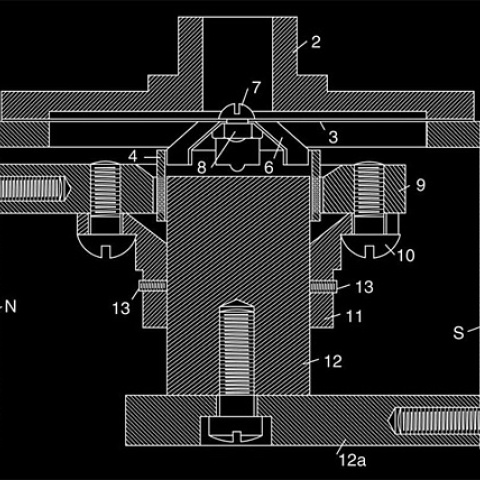
As Stereophile readers of long standing and good memory will realize, I'm far from the first to think that active absorbers might ultimately prove the best way to tackle room modes. Back in 1989, Phantom Acoustics launched its Shadow Active Low-Frequency Acoustic Control, based on US Patent 4,899,387. The patent lists the device's inventor as Nelson Pass—whom we know much better as an amplifier designer—and the patent assignee as the Threshold Corporation of Auburn, California. What the specification describes is a tall cylinder, intended for placement in a room corner (fig.3), with upward- and downward-firing moving-coil drive-units located toward each end. These provide modal absorption by generating antiphase signals at the modal frequencies, which are generated simply by phase-inverting and amplifying the output of an integral microphone. Fig.3 Patent drawing of what became the Phantom Acoustics Shadow.
Footnote 1: Rhonda J. Wilson, Michael D. Capp, and J. Robert Stuart, "The Loudspeaker-Room Interface: Controlling Excitation of Room Modes," AES 23rd International Conference, May 2003; www.aes.org.
Nevertheless, I was left questioning whether this approach to electronic room acoustic correction—of using the main speakers to provide the correction as well as reproduce the music—is the optimal one. As the Meridian system's developers themselves acknowledged in an AES paper describing its operation (footnote 1), there is a limit to how much correction can be applied this way without imposing undesirable effects on the speakers' sound. Whether this limitation permits or prevents the optimal correction being applied is unclear, but any such restriction is obviously a concern. Plus, there are limits to what can be achieved when, as with the Meridian system, the microphone is placed only at the listening position during the setup process.
It's a golden rule of DSP room correction that no attempt be made to fill in notches in the in-room response, because to attempt this would hog amplifier power and generate unacceptably large excursions of drive-unit diaphragms. Thus, digital room-correction systems usually leave response notches well alone and concentrate their efforts on suppressing peaks. The received wisdom is that notches are much less audible than peaks, so this is not the obvious weakness it may appear. Nonetheless, I wonder whether it isn't a disadvantage. Something I learned from my room-correction experiments—although it should have been obvious—is that one room mode in particular tends to be a problem in this regard, and current room-correction approaches do nothing about it. This set me wondering how its influence might be lessened and what subjective benefits might accrue.
Fig.1 Result of applying room correction in KH's listening room using Copland DRC205: in-room response, uncorrected (blue trace), corrected (red).
Fig.2 As in fig.1, but using Lyngdorf Audio's RoomPerfect (implemented in the TDA 2200 amplifier).
This notch occurs principally because my rectangular-plus-bay-window listening room is 13.8' (4.2m) wide, which corresponds to a fundamental width mode of 41Hz. As I have the speakers firing down the room's long dimension and my listening position is on the room's centerline to ensure symmetrical acoustical conditions for the left and right channels, I am always seated at the pressure node of this resonance, where it has a null. By moving the listening position forward or back and the listening height up or down, I can move the notch a little and vary the response either side of it as a result of interaction with other modes. But it remains a consistent feature, as it must do in any rectangular room with a centerline seating position—there is no getting away from it.
As Stereophile readers of long standing and good memory will realize, I'm far from the first to think that active absorbers might ultimately prove the best way to tackle room modes. Back in 1989, Phantom Acoustics launched its Shadow Active Low-Frequency Acoustic Control, based on US Patent 4,899,387. The patent lists the device's inventor as Nelson Pass—whom we know much better as an amplifier designer—and the patent assignee as the Threshold Corporation of Auburn, California. What the specification describes is a tall cylinder, intended for placement in a room corner (fig.3), with upward- and downward-firing moving-coil drive-units located toward each end. These provide modal absorption by generating antiphase signals at the modal frequencies, which are generated simply by phase-inverting and amplifying the output of an integral microphone.
Fig.3 Patent drawing of what became the Phantom Acoustics Shadow.
Footnote 1: Rhonda J. Wilson, Michael D. Capp, and J. Robert Stuart, "The Loudspeaker-Room Interface: Controlling Excitation of Room Modes," AES 23rd International Conference, May 2003; www.aes.org.